 Ultimate guide
Why Does Nursing Turnover Hurt Patient Care?
Last Updated: November 5, 2026
Quick Summary
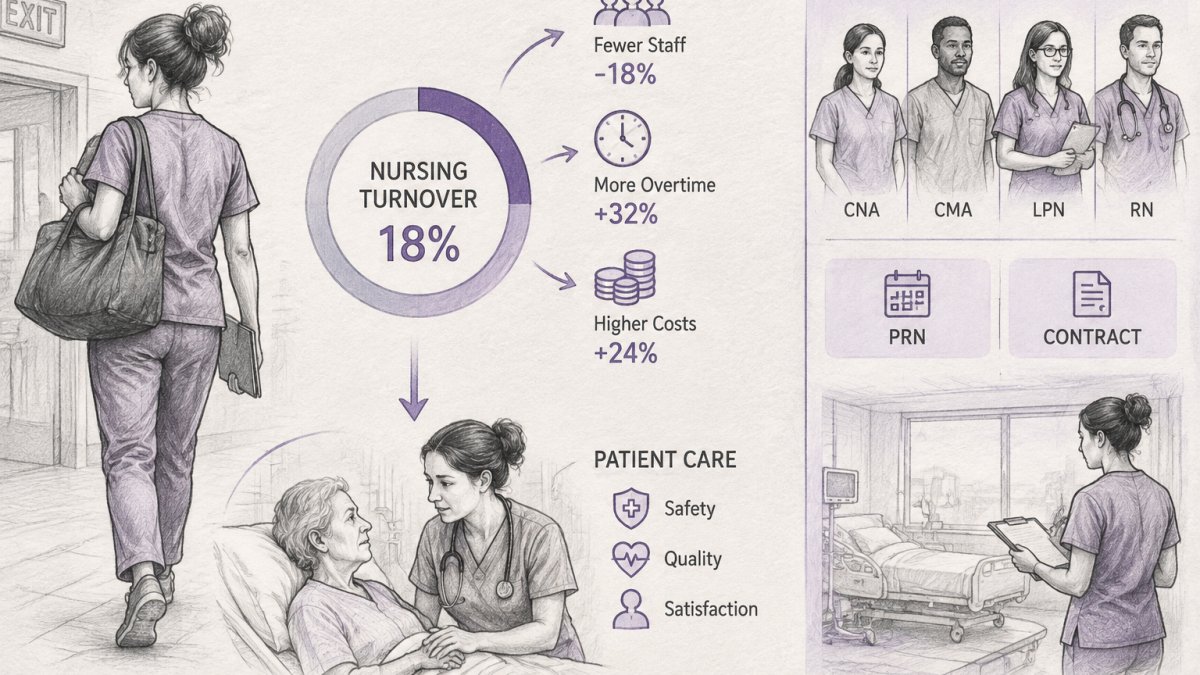
Nursing turnover hurts patient care because it breaks continuity and fills gaps with stretched ratios, rushed handoffs, and temporary staff learning a new building under pressure. Each of those conditions raises the chance of a preventable harm, from medication errors to falls.
- Chronic understaffing is the most common driver of nurses leaving their positions.
- Turnover harms patients through four channels: disrupted handoffs, reduced unit experience, novice-heavy mixes, and vacancy-driven workload spikes.
- Assisted living communities often run with the least staffing slack of any care setting.
- Retention strategy should match the setting, since harm lands differently in long-term care, rural hospitals, and emergency units.
- Track turnover rate, vacancy days, overtime hours per nurse, and safety events monthly to make impact measurable.
Table of Contents
- How Nursing Turnover Undermines Patient Safety
- Top Reasons for Nurse Turnover
- Nurse Turnover and Continuity of Care
- Nurse Retention and Patient Outcomes
- How Turnover Affects Different Care Settings
- Strategies to Reduce Nursing Turnover
- A Practical Framework for Measuring Turnover's Impact
- Building a Stable Nursing Team with Major Staffing
- Frequently Asked Questions
How Nursing Turnover Undermines Patient Safety
Nursing turnover is the rate at which nurses leave their positions and are replaced, and it directly weakens the safety net around every patient in a facility.
The core problem is not the vacancy itself. It is what fills the gap: stretched ratios, rushed handoffs, and temporary staff learning a new building under pressure.
Below, we walk through the specific mechanisms, the settings where the damage is worst, and a practical way to measure it.
Top Reasons for Nurse Turnover
Nurses rarely leave for one reason. They leave when several pressures stack up at once, and the exit usually follows a stretch of short staffing rather than a single bad day.
Workload and Staffing Levels
Chronic understaffing is the most common driver. When a unit runs short, the remaining nurses absorb extra patients, skip breaks, and stay late. That pattern repeats until the job stops feeling sustainable.
A common mistake is treating overtime as a fix. It patches the schedule and drains the people covering it.
Burnout and Emotional Exhaustion
Burnout is a state of physical and emotional depletion caused by prolonged workplace stress (the WHO).
Compassion fatigue follows close behind. Nurses who once found meaning in the work start going through the motions, and that shift is hard to reverse once it sets in.
U.S. Surgeon General's advisory on health worker burnout frames this as a system problem rather than a personal failing, which is the right lens for leaders.
Nurse Turnover and Continuity of Care
Continuity of care is the consistency of attention a patient receives across shifts, and nursing turnover breaks it. A resident who sees a new face every few days cannot build trust, and the staff cannot learn what "normal" looks like for that person. The mechanism matters more than the slogan: turnover does not harm patients in the abstract, it harms them through a small number of identifiable pathways that show up on the unit every shift.
The Four Mechanisms That Connect Turnover to Harm
Turnover can damage care through four overlapping channels. Naming them makes the problem measurable instead of vague.
- Disrupted handoffs. Every shift change is a transfer of responsibility. When the nurse giving report is unfamiliar with the patient, details get lost: a subtle change in appetite, a new confusion, a family concern raised the night before. Each unfamiliar handoff adds a small chance that a critical detail drops.
- Reduced unit experience. A unit's collective experience is a safety asset. Experienced nurses recognize early deterioration, know which physician wants a call at 2 a.m., and anticipate a fall before it happens. High turnover dilutes that shared knowledge faster than orientation can rebuild it.
- Novice-to-experienced mix. New graduates and nurses new to a facility are the most vulnerable during their first weeks. They are learning the building, the documentation system, and the unwritten norms at the same time. When a unit is mostly novices, there is no one left to catch what they miss.
- Vacancy-driven workload spikes. Open positions are not absorbed evenly. The remaining nurses absorb extra patients, skip breaks, and stay late, which raises fatigue and the error rate that follows it.
Handoffs and Team Communication
Handoff errors compound quietly. A missed note about a resident's fall risk does not announce itself until the fall happens.
Watch out: a handoff that feels smooth can still be incomplete. The nurse receiving report may not know what questions to ask if they have never cared for that patient before.
Orientation and Transition Risks for Novice Nurses
A structured plan shortens the vulnerable window. Our guide to fast onboarding for temporary nursing staff lays out a seven-step approach that gets new nurses safe and productive sooner. The key is to pair every new nurse with an experienced preceptor for a defined period and to check competency on the unit's highest-risk tasks first, not last.
Separating Association from Causation
It is worth being honest about the evidence. Research consistently finds an association between low nurse staffing and higher rates of adverse events, and between turnover and worse patient experience.
Nurse Retention and Patient Outcomes
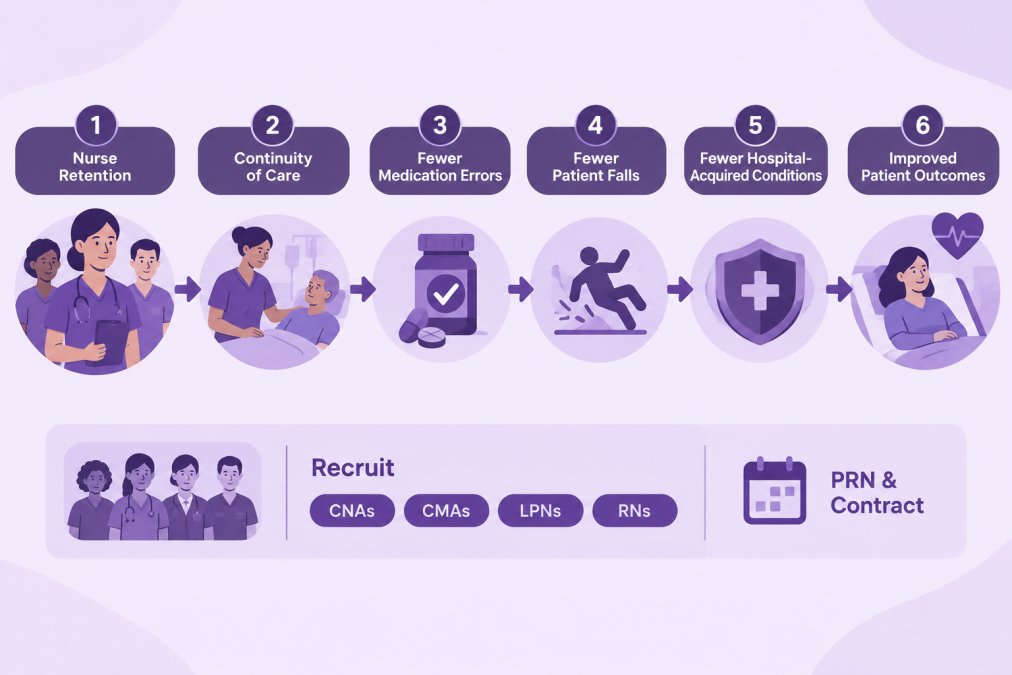
Strong nurse retention and patient outcomes move together. Units with stable teams report fewer errors, better communication, and more consistent care, because the people delivering it know the patients and each other.
Medication Errors and Treatment Delays
Medication errors rise when nurses are rushed, interrupted, or unfamiliar with a patient's regimen. Treatment delays follow the same pattern: a lab result sits unread, a pain complaint waits, a physician's question goes unasked.
These are not careless mistakes. They are predictable outcomes of too little time and too much ground to cover.
Patient Falls and Hospital-Acquired Conditions
Falls and hospital-acquired conditions cluster where supervision is thin. A resident who needs help to the bathroom will try alone if no one answers the call light quickly.
AHRQ guidance on preventing falls in hospitals ties fall risk directly to staffing and supervision levels, which is why retention is a safety issue and not just an HR metric.
How Turnover Affects Different Care Settings
The damage looks different depending on where care happens. A rural hospital with a thin roster feels a single resignation more sharply than a large system, and a small assisted living community may have no slack at all. Comparing settings side by side is where most general articles stop short, so it is worth walking through the differences.
Long-Term Care and Skilled Nursing
Long-term care and skilled nursing facilities carry high resident acuity with lean staffing, so continuity matters enormously. Residents live there, which means the staff are not just caregivers but the people who know a resident's routine, preferences, and baseline. Falls and missed toileting assistance are the most common harms when supervision thins.
Assisted Living
Assisted living communities often run with the least staffing slack of any setting. A single call-out can leave one aide covering an entire wing. Residents there are typically more independent than in skilled nursing, which means the risk shifts from clinical monitoring toward response time, medication reminders, and help with mobility.
Rural Hospitals
A rural hospital may have one nurse covering a unit that a larger facility would staff with three. There is no float pool to call and no nearby sister facility to borrow from. One resignation can change the unit's experience level overnight, and the remaining nurses carry both the workload and the loss of a colleague who knew the building.
Emergency and Acute Care
Emergency departments and acute care units see the fastest turnover-to-harm pathway because patient acuity is high and decisions are time-sensitive. A delayed lab result, a missed change in status, or a rushed triage handoff can matter within minutes rather than days. These settings also tend to have the most complex documentation and the steepest orientation curve, which lengthens the vulnerable window for every new hire.
Specialty Units
Specialty units, oncology, ICU, behavioral health, and others, concentrate expertise in a small number of nurses. When one leaves, the unit loses knowledge that is hard to replace because it took years to build. Cross-training helps, but a float nurse who is competent on a general floor is not automatically safe on a specialty unit without a defined orientation.
What the Comparison Means for Leaders
The practical takeaway is that retention strategy should match the setting. A long-term care facility gets the most return from protecting continuity and response time. A rural hospital gets the most return from cross-training and a reliable temporary staffing partner. An emergency department gets the most return from protecting the experienced-nurse mix on the hardest shifts.
Strategies to Reduce Nursing Turnover
Retention improves when leaders treat it as an operating priority rather than a recruitment problem. The facilities that hold their teams do a few things consistently well.
- Protect ratios on the hardest shifts instead of backfilling with overtime.
- Build real orientation time for every new hire, including temporary staff.
- Ask departing nurses why they left, and act on the pattern.
- Recognize good work specifically, not generically.
- Offer schedule flexibility where the unit can support it.
Our article on flexible nursing shift staffing solutions covers how scheduling design keeps nurses engaged. For the broader playbook, see strategies for managing nursing staff shortages.
| Problem | Practical Fix | Expected Impact |
|---|---|---|
| Chronic overtime | Protect ratios on hard shifts | Lower fatigue, fewer errors |
| Weak orientation | Structured first-week plan | Faster ramp, fewer handoff gaps |
| Unheard staff | Exit interviews with follow-up | Early warning on turnover |
| Rigid schedules | Flexible shift options | Better retention and morale |
A Practical Framework for Measuring Turnover's Impact
Measurement turns a vague concern into something a leadership team can act on. Start with four indicators and track them monthly.
- Turnover rate: separations divided by average headcount.
- Vacancy days: how long positions sit open.
- Overtime hours per nurse: a fatigue signal.
- Safety events: falls, medication errors, and hospital-acquired conditions.
Pair those with a simple pulse survey on workload and morale. When overtime climbs and safety events follow, the connection is visible in your own data, not just in studies.
Building a Stable Nursing Team with Major Staffing
A stable team is built shift by shift, and reliable coverage is where it starts. Major Staffing is a nurse-led agency.
We support last-minute shift coverage and long-term placements, with availability depending on current facility needs.
We also help facilities reduce the pressure that drives nurses out. Read our guidance on reducing nursing burnout in facilities and how better staffing improves patient outcomes to connect retention to the care your residents receive.
If you are a CNA, CMA, LPN, or RN looking for flexible work where your skills matter, or a facility that needs coverage you can count on, we would like to hear from you.
Frequently Asked Questions
How does nurse turnover affect patient care?
Nursing turnover disrupts care continuity, increases workload on remaining staff, and raises the risk of medication errors, patient falls, and treatment delays. When experienced nurses leave, facilities lose institutional knowledge and team communication suffers. Research consistently links higher turnover rates to worse patient safety outcomes and lower quality of care, especially in settings with already tight staffing levels.
What are the main causes of nurse turnover?
The top reasons for nurse turnover include heavy workloads and poor nurse-to-patient ratios, burnout and emotional exhaustion, lack of support from leadership, limited career growth, and scheduling inflexibility. Facilities that address these root causes through better staffing, recognition, and manageable workloads tend to retain experienced nurses longer and reduce recruitment costs.
How can facilities reduce nursing turnover?
Strategies to reduce nursing turnover include improving nurse-to-patient ratios, offering flexible scheduling, providing strong orientation for novice nurses, recognizing staff contributions, and fostering a supportive work environment. Partnering with a reliable staffing agency can also fill gaps during transitions, reducing overtime and burnout while maintaining consistent care coverage.
What is the connection between nurse retention and patient outcomes?
Nurse retention and patient outcomes are closely linked. Facilities with stable, experienced nursing teams report fewer adverse events, better care continuity, and higher patient satisfaction. Retaining nurses preserves team communication and handoff quality, which directly reduces medication errors and patient falls. Investing in retention strategies protects both patient safety and your facility's operational stability.
Turnover is not just a hiring headache; it is a patient safety issue that shows up in falls, errors, and families who lose confidence. Major Staffing can help you close the gaps with nurse-led staffing, last-minute shift coverage, and long-term placements built on dependable communication. Get started with Major Staffing and give your residents the continuity of care they deserve.