 How-to
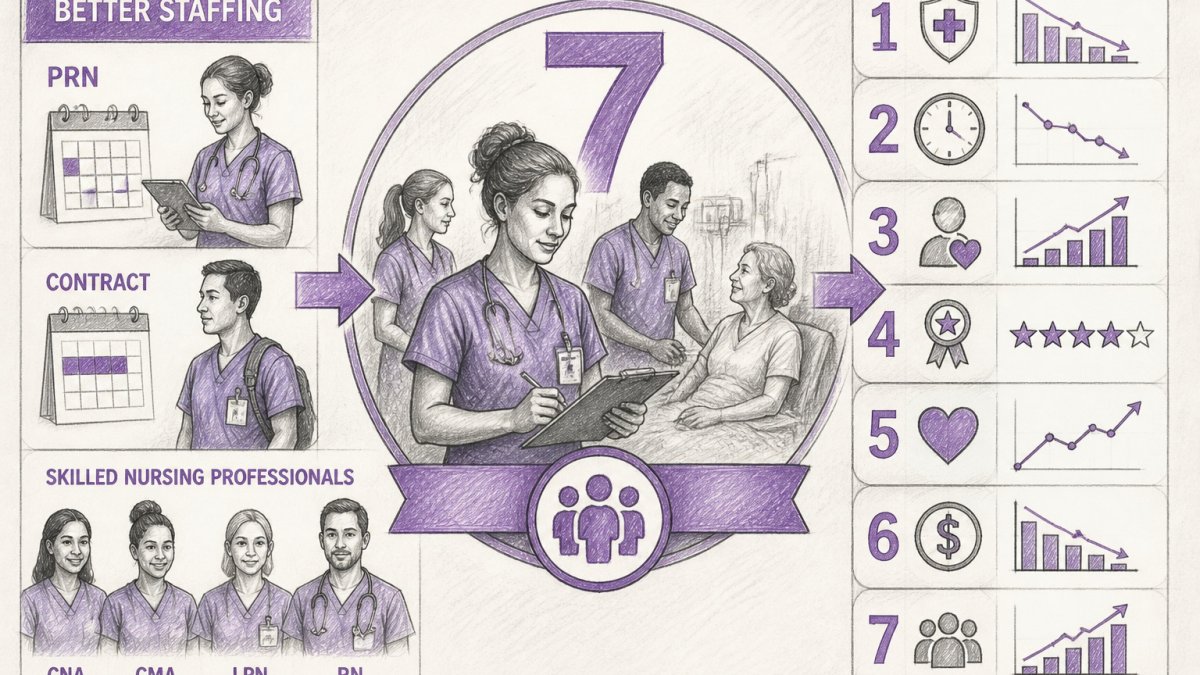
7 Ways Better Staffing Improves Patient Outcomes
Last Updated: November 1, 2026
Quick Summary
Better staffing improves patient outcomes by giving nurses the time to monitor residents closely, catch changes in condition early, and deliver medications and treatments on schedule. Facilities that track staffing alongside falls, medication errors, and complaints can see where changes help most.
- Thin coverage turns monitoring into spot checks, so early signs of decline get missed.
- Track two or three outcome measures before changing staffing so you can judge the result.
- Check worked hours against scheduled hours, since call-outs can leave a posted schedule looking full when it isn't.
- Match coverage to patient acuity at the start of each shift rather than only at admission.
- Understaffing shifts costs into overtime, turnover, and adverse events that are easy to miss.
Table of Contents
- Why Staffing Levels Shape Patient Outcomes
- Nurse Staffing Levels and Quality of Care: What the Link Looks Like on the Floor
- Matching Staff to Patient Acuity in Real Time
- A Step-by-Step Plan to Improve Staffing on Your Unit
- Building a Nurse Onboarding Checklist That Protects Safety
- Nurse Staffing Effectiveness Metrics to Track
- Staffing Costs, Workload and Sustainable Teams
- Bring Major Staffing Into Your Next Staffing Plan
- Frequently Asked Questions
Nurses who have worked a short-staffed shift know the difference staffing makes. When there are enough skilled hands on the floor, residents get timely care, medications go out on schedule, and changes in condition get noticed early.
Here is the core idea: better staffing improves patient outcomes. The rest of this article explains how, where the evidence is strongest, and what facility leaders can do about it.
Why Staffing Levels Shape Patient Outcomes
Staffing is not just a budget line. It shapes how much attention each patient gets, how quickly problems are caught, and how safe the care feels for the people receiving it. The research on this is not vague, it clusters around a recognizable set of outcomes that staffing levels reliably move.
The mechanism: time, attention, and continuity
When a nurse is responsible for too many patients, routine tasks get squeezed. Assessments get shorter. Follow-up calls get delayed. Small changes that could have been caught early can turn into bigger problems by the next shift. Three things break down first:
- Surveillance. Recognizing a change in condition depends on repeated, unhurried contact with the same patient. Thin coverage turns monitoring into spot checks.
- Timeliness. Medications, treatments, and repositioning are time-sensitive. When the queue is long, the schedule slips.
- Continuity. Stable teams carry context from shift to shift. Constant substitution means every handoff restarts the learning curve.
The outcomes most sensitive to staffing
Staffing-sensitive outcomes generally fall into a few families. Knowing them helps leaders pick measures that actually respond to staffing changes:
- Safety events: falls, medication errors, pressure injuries, and hospital-acquired infections.
- Clinical deterioration: failure to rescue, the missed or delayed recognition of a patient who is declining, and unplanned transfers to a higher level of care.
- Mortality and complications: the association between lower nursing hours per patient and higher rates of adverse events is one of the more consistent findings in health services research, though the size of the effect depends on setting and patient mix.
Setting matters: ICU versus non-ICU, and the long-term care floor
The strength of the staffing-outcome link varies by setting. Critical care units, where patients are unstable and interventions are frequent, tend to show the sharpest relationship between coverage and adverse events.
That distinction matters for planning. A unit that copies an ICU staffing model onto an assisted living floor will over-invest in the wrong measures and under-invest in the ones that actually predict harm there.
Headcount is not the whole story
A headcount number alone does not tell the full story. Skill mix, experience, and how well the team knows the residents all matter. A well-matched team of three can outperform a rushed team of four. Two units with identical ratios can produce very different outcomes depending on how many of those hours are delivered by nurses familiar with the unit and how many by staff rotating in cold.
What this means for your unit
The practical takeaway is not "hire more people." It is to match coverage to acuity, protect continuity where you can, and measure the outcomes that respond to staffing in your specific setting. The sections that follow turn that into a working plan.
Nurse Staffing Levels and Quality of Care: What the Link Looks Like on the Floor
The connection between nurse staffing levels and quality of care is one of the more consistent findings in health services research.
Keep in mind that a headcount number alone does not tell the full story.
Watch out: staffing numbers on paper can look fine while the actual shift is short because of call-outs. Check real coverage, not just the posted schedule.
Matching Staff to Patient Acuity in Real Time
Patient acuity changes throughout the day. A resident who is stable at breakfast may need closer monitoring after a fall or a medication change. Good staffing decisions account for this.
A practical approach:
- Review acuity at the start of each shift, not just at admission
- Flag residents who need more frequent checks
- Move float staff or adjust assignments when acuity spikes
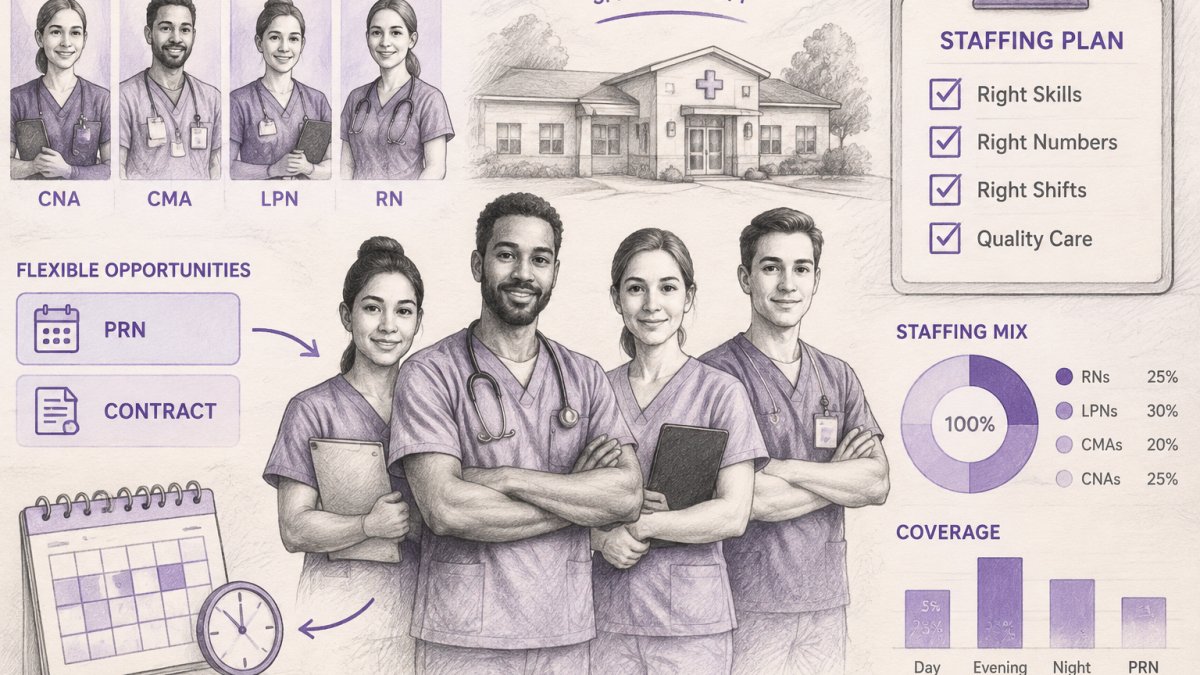
This is where flexible, experienced staff make a real difference. When a unit has access to nurses who can step in quickly, the team can respond to changing needs instead of falling behind.
A Step-by-Step Plan to Improve Staffing on Your Unit
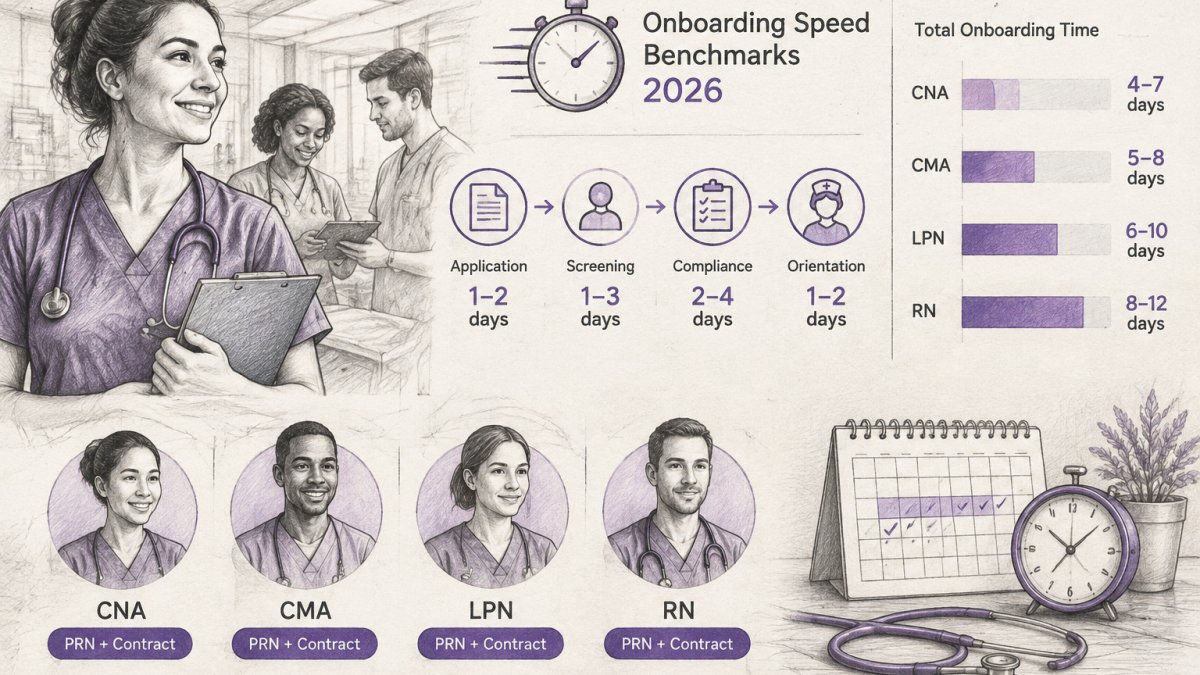
Improving staffing does not require a complete overhaul. Start small and build from there. Our fast onboarding plan for temporary nursing staff walks through how new relief nurses can be brought onto the unit quickly.
- Audit current coverage. Compare scheduled staff against actual worked hours for the last 90 days.
- Identify the gaps. Note which shifts, units, or days have the most call-outs or unfilled slots.
- Set a fill-rate target. Decide what percentage of shifts should be covered by planned staff.
- Build a backup pool. Line up relief nurses and CNAs for predictable gaps.
- Track outcomes. Watch falls, medication errors, and complaints alongside staffing changes.
- Review monthly. Adjust the plan based on what the numbers show.
Working through these steps in order keeps the effort focused and makes it easier to see what is actually helping.
Building a Nurse Onboarding Checklist That Protects Safety
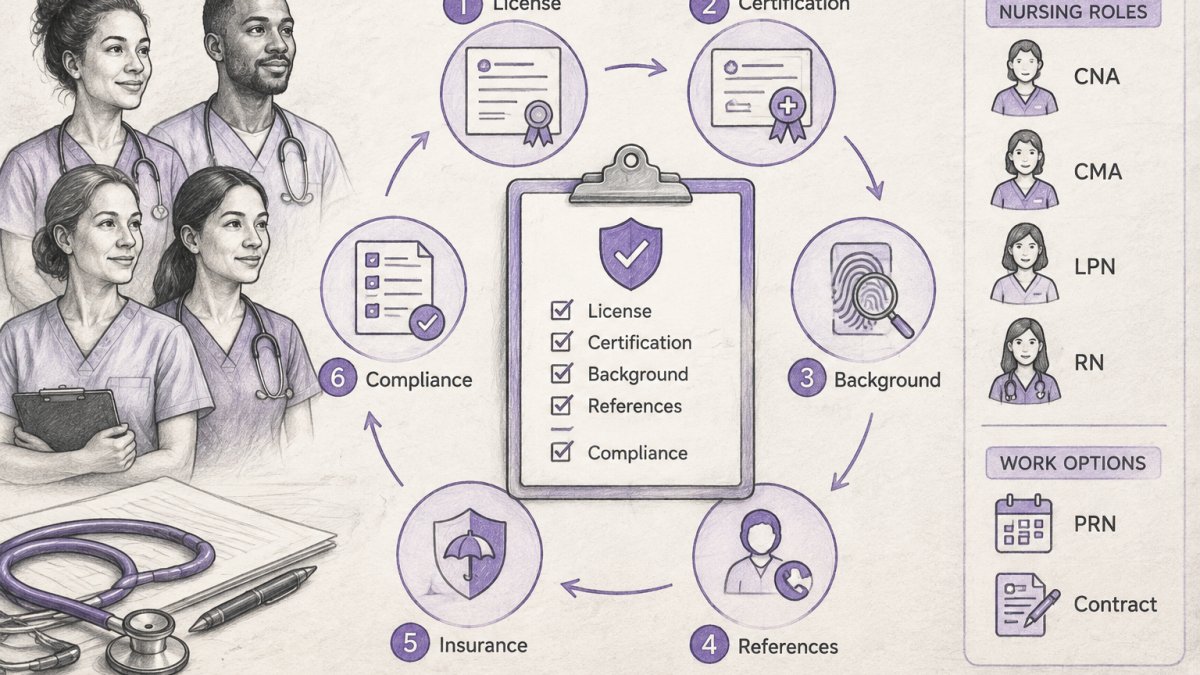
Temporary and new nurses need to get up to speed quickly, but speed should never come at the cost of safety. A short, consistent onboarding checklist helps.
Include these items on every checklist:
- Facility policies on medication administration and documentation
- Unit layout, emergency procedures, and equipment locations
- Resident care plans and any fall or infection precautions
A good onboarding process protects both the new nurse and the residents. It also reduces the chance that a relief nurse makes an avoidable mistake on an unfamiliar unit.
Nurse Staffing Effectiveness Metrics to Track
You cannot improve what you do not measure. Track a small set of metrics so you can tell whether staffing changes are working.
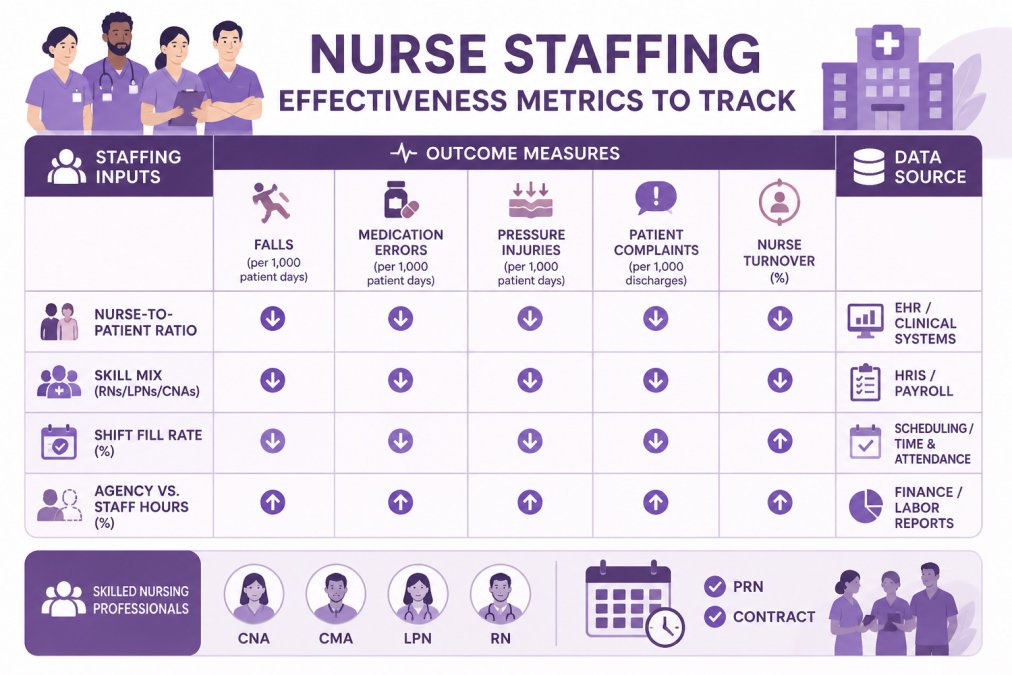
Useful metrics include:
- Nurse-to-patient ratio by shift
- Shift fill rate, including agency and float hours
- Falls, medication errors, and pressure injuries
Review these together, not in isolation. A rise in fill rate alongside fewer falls is a strong sign that staffing changes are helping.
Image: matrix of staffing inputs against outcome measures with data sources
Staffing Costs, Workload and Sustainable Teams
Staffing decisions always involve costs, but the trade-offs are more concrete than "short-term savings versus long-term problems." The useful question is not whether to spend on staffing, it is which spending reduces the costs that come from understaffing.
The costs that hide in a thin schedule
Understaffing does not eliminate cost. It moves it. A short shift tends to show up later as:
- Overtime and premium pay to cover the gap, often at a higher effective rate than planned coverage.
- Turnover. Heavy workloads and unpredictable schedules push experienced nurses out the door, and replacement carries recruitment, onboarding, and productivity costs.
- Adverse events. Falls, medication errors, and pressure injuries carry their own treatment and liability costs, and they are exactly the outcomes most sensitive to staffing.
A common pattern is that facilities compare the visible cost of planned staffing against the visible cost of a lean schedule and miss the second column entirely. The comparison only makes sense when both columns are on the page.
Workload, burnout, and why experienced staff leave
Sustainable teams depend on workload. When nurses have manageable assignments and predictable schedules, they stay longer and do better work. Our guide to reducing nurse burnout in facilities covers practical steps for easing workload pressure. The mechanism runs through a few levers leaders can actually pull:
- Assignment balance. Rotating difficult assignments fairly, rather than concentrating them on the same people, protects the staff most likely to leave.
- Schedule predictability. Nurses plan their lives around the schedule. Late, repeated changes erode trust faster than almost anything else.
- Recognition. Naming good work costs nothing and shows up in retention.
How to evaluate whether a staffing change pays off
This is where most staffing discussions stall, and where a simple framework helps. Before you change coverage, define a baseline and a follow-up window for a small set of measures:
- Labor measures: overtime hours, premium pay hours, and shift fill rate.
- Workforce measures: turnover rate, absenteeism, and vacancy duration.
- Outcome measures: falls, medication errors, pressure injuries, and patient or family complaints.
- Experience measures: patient satisfaction and staff-reported workload.
Track them together over a defined period, a quarter is a common starting point, and compare against the baseline. A rise in fill rate alongside fewer falls and lower overtime is a strong signal the change is working. A rise in fill rate with no movement in outcomes may mean the added hours went to the wrong shifts.
Budgeting the trade-off honestly
When you build the case for a staffing change, present it as a trade-off rather than a request. Show the current cost of overtime, turnover, and adverse events alongside the proposed cost of added coverage, and let the comparison make the argument.
Pricing depends on the facility's needs, dates, and the type of placement. Our overview of how nursing agencies price their services explains the common models facilities encounter. For current rates or a quote tailored to your unit, contact Major Staffing directly.
Bring Major Staffing Into Your Next Staffing Plan
Better staffing starts with the right people and a plan that holds up on a hard shift. Facilities ready to plan ahead can learn how to request long-term nursing placement services.
If your team is running thin or you want a more dependable way to cover gaps, reach out to Major Staffing to talk through your needs and current availability.
Frequently Asked Questions
How does nurse staffing affect patient outcomes?
Staffing affects outcomes mainly through workload. When nurses carry fewer patients, they have more time to assess, monitor and respond early, which is linked to fewer complications and better patient safety. Research on staffing-sensitive outcomes consistently points to nurse-to-patient ratios as a key factor, especially in surgical and intensive care settings. Adequate staffing also supports continuity, since familiar nurses notice small changes sooner. Facilities that track ratios alongside outcome data can see where workload is putting patients at risk and adjust before problems grow.
How can nurse managers balance staffing levels with patient acuity?
Start by classifying patients by acuity at each shift change, then compare the total care demand against the nurses available. Patients with higher care needs, such as those requiring frequent medication administration or close monitoring, should count for more than a simple head count suggests. Build a standard staffing grid for each unit, then flex it when acuity rises during the shift. Use float staff or flex shifts for those gaps, and document each adjustment so the pattern becomes visible in your planning.
How can effective onboarding help temporary nurses provide safe care?
Temporary nurses are often unfamiliar with a unit's policies, equipment and documentation systems. A structured onboarding checklist covering unit orientation, escalation paths, medication procedures and charting expectations shortens that learning curve. Pair the nurse with an experienced staff member for the first shift, and confirm competencies before assigning a full patient load. Clear onboarding reduces the errors that happen when a nurse is working out where things are, and it helps the nurse feel ready to ask questions.
What metrics can facilities use to evaluate staffing and patient outcomes?
Useful measures include nurse-to-patient ratios by shift, shift fill rates, the share of hours covered by agency staff, and staff turnover. Pair these with outcome indicators your facility already tracks, such as falls, medication errors, pressure injuries and patient complaints. Review the two sets together each month to look for patterns, such as falls rising on nights with high agency use. Consistent tracking, rather than one-time audits, shows whether staffing changes are actually helping patients.