 Ultimate guide
Strategies for Managing Nursing Staff Shortages?
Last Updated: October 30, 2026
Quick Summary
Managing nursing staff shortages starts with diagnosing where gaps actually occur, then building retention, scheduling, and communication practices that keep current staff on the floor. Facilities should forecast demand two weeks ahead, add acuity to shift assignments, and treat overtime as the last fill option.
- Map your hardest-to-fill shifts, units, or roles before choosing any strategy.
- Forecast census and acuity on a rolling two-week basis instead of using a static monthly template.
- Fill coverage gaps in order: voluntary swaps first, then per diem or PRN staff, then overtime.
- Give staff documented self-scheduling windows, a written swap process, and a fair holiday rotation.
- Track a short list of workforce KPIs against a recorded baseline and keep a written contingency protocol.
Table of Contents
- Why Nursing Staff Shortages Hit Some Facilities Harder Than Others
- Building Nurse Retention Strategies That Keep Staff on the Floor
- Preventing Nurse Burnout Before It Drives People Out
- Nursing Staff Scheduling Strategies That Balance Coverage and Rest
- Nurse Staffing Plan Examples by Care Setting
- Measuring Results and Planning for Sudden Shortages
- Where to Start Strengthening Your Nursing Workforce This Month
- Frequently Asked Questions
Nursing staff shortages do not hit every facility the same way. A long-term care home with a thin on-call list can go from fully covered to short three CNAs in a single weekend, while a rural hospital down the road keeps its floors steady. Strategies for managing nursing staff shortages work best when they start from an honest look at why your own facility is under pressure.
Why Nursing Staff Shortages Hit Some Facilities Harder Than Others
Shortages are rarely spread evenly. Facilities with high patient acuity, long shifts, limited local labor pools, or a history of heavy overtime tend to feel the strain first. Assisted living communities and long-term care homes often compete with hospitals and clinics for the same licensed nurses and aides, which means a small staffing gap can grow quickly when one or two people call out.
Before you adjust anything, map where your gaps actually occur: specific shifts, specific units, or specific roles. That diagnosis determines which strategies will help and which will waste time.
Building Nurse Retention Strategies That Keep Staff on the Floor
Recruitment fills vacancies, but retention prevents them from reopening. Nurse retention strategies usually succeed when they address the day-to-day realities staff face: predictable schedules, fair assignments, access to training, and a supervisor who backs them up. Facilities that treat retention as a standing agenda item, reviewed monthly alongside census and staffing levels, tend to see turnover respond sooner than facilities that only react when someone resigns.
Recognizing Early Signs of Turnover
Turnover rarely arrives without warning. Watch for rising call-outs, a growing pattern of voluntary overtime refusals, shorter tenure among newer hires, and shifts in how people talk about the unit in break rooms. These signals often appear weeks or months before a resignation letter. A brief, confidential check-in with staff who show these patterns can surface problems like an unfair assignment or a scheduling conflict that is still fixable.
Making Internal Communication Part of Retention
Staff who know what is happening stay longer than staff who hear about changes secondhand. Clear, consistent communication about census shifts, upcoming schedule changes, and open shifts builds trust. Short weekly huddles, a single shared schedule board, and a named point of contact for staffing questions do more than a long memo that nobody reads. See current best practices for staffing communication for keeping messages clear and consistent.
Preventing Nurse Burnout Before It Drives People Out
Burnout is one of the most common reasons experienced nurses leave bedside work, and it compounds shortages: each departure increases the load on everyone who remains. Prevention starts with workload design, not wellness slogans. Our step-by-step guide walks through practical changes you can make in your facility. Limiting consecutive long shifts, balancing high-acuity assignments across the team, and building in protected break time address the causes directly.
Nursing Staff Scheduling Strategies That Balance Coverage and Rest
Scheduling is where coverage and rest either align or collide. Most scheduling problems are not really scheduling problems, they are forecasting problems. If you build the schedule off last month's census instead of next month's expected census, you will be short on the days that matter and overstaffed on the days that do not.
Forecast Demand Before You Assign Shifts
Start with three inputs: expected census by day, expected acuity mix, and known absences (approved time off, planned procedures, predictable call-out patterns by day of week). A simple two-week rolling forecast beats a static monthly template because census variation in long-term care and assisted living clusters around admissions, discharges, and weekend coverage gaps.
A common pattern facilities use:
- Pull census and acuity data every Monday for the following two weeks.
- Flag days where forecast demand exceeds scheduled coverage by more than one role.
- Fill the gap first with voluntary shift swaps, then with per diem or PRN staff, and only then with overtime.
That order matters. Overtime is the most expensive and most burnout-inducing fill option, so it should be the last lever, not the default.
Build Acuity Into the Schedule, Not Just Headcount
Staffing by headcount alone misses the point. Two units with the same number of beds can need very different nurse time depending on patient acuity, fall risk, and care intensity.
Acuity-based scheduling does not require new software. A shared spreadsheet with a daily acuity column and a named charge nurse responsible for the rating is enough to start. The point is to make the mismatch visible before the shift, when you can still fix it.
Give Staff Real Control Over Their Schedules
Schedule control is one of the strongest retention levers available, and it costs nothing to implement. Practical mechanisms that work:
- Self-scheduling windows. Open a 24- to 48-hour window each cycle where staff pick shifts in seniority-rotating order, then the scheduler fills remaining gaps.
- Documented swap process. A written swap request form with a defined approval turnaround removes the ambiguity that makes staff stop asking.
- Fair weekend and holiday rotation. Track who worked which holiday the prior year and rotate explicitly. Resentment over holiday assignments is one of the most common and most preventable drivers of turnover.
Use Flexible Staffing Models for Predictable Peaks
Per diem and PRN staff can fill predictable peaks without forcing permanent overtime on your core team. The key word is predictable, PRN works best when you know the peak is coming (a scheduled admission surge, a seasonal census bump, a planned unit renovation) rather than as a same-day emergency fix. Learn how per diem agencies support facility staffing needs in five practical ways.
Nurse Staffing Plan Examples by Care Setting
No single model fits every facility. Hospitals often rely on a core team supplemented by per diem staff for surge days. Skilled nursing facilities frequently depend on consistent long-term assignments and a smaller pool of trusted float staff. Assisted living communities may need a blend of licensed nurses and certified aides with clear escalation paths.
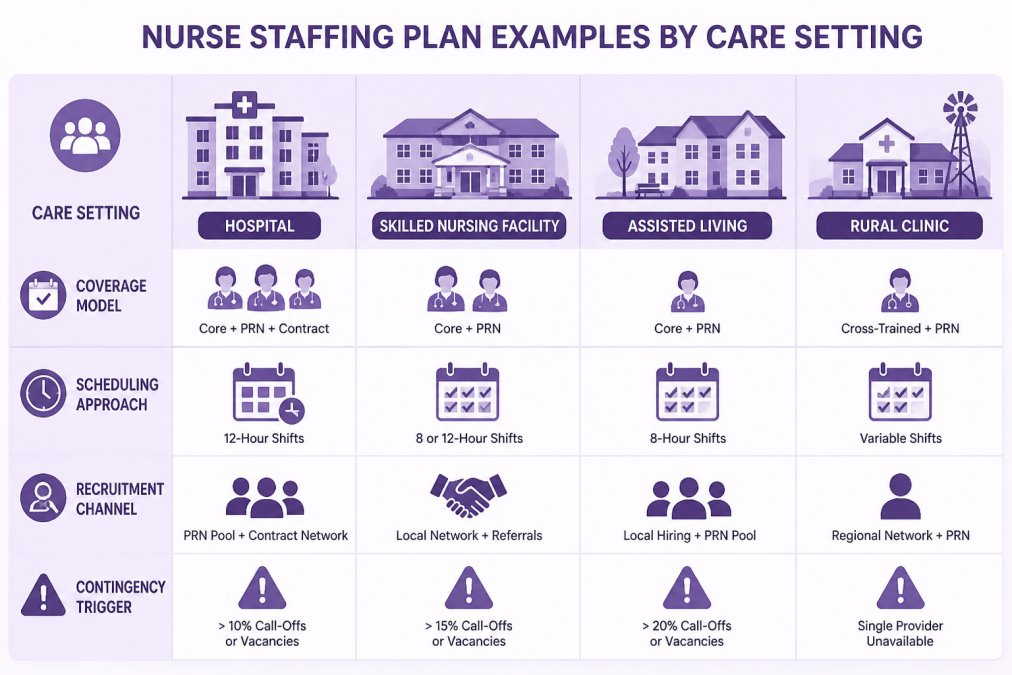
The matrix below compares how each setting typically structures coverage, scheduling, recruitment, and contingency planning.
| Care Setting | Coverage Model | Scheduling Approach | Recruitment Channel | Contingency Trigger |
|---|---|---|---|---|
| Hospital | Core staff plus per diem surge | Rotating shifts with float pool | Nursing school and agency partnerships | Census above planned threshold |
| Skilled nursing facility | Consistent long-term assignments | Fixed patterns with swap process | Referral programs and local recruiting | Two or more unplanned call-outs |
| Assisted living | Licensed nurse plus certified aides | Weekend and evening emphasis | Community networks and aide pipelines | Resident acuity change |
| Rural clinic | Cross-trained core team | Flexible contract coverage | Regional agencies and telehealth-supported roles | Single-provider absence |
Measuring Results and Planning for Sudden Shortages
Strategies only work if you can tell whether they are working. That requires two things most facilities skip: a small set of defined workforce measures reviewed on a fixed cadence, and a written contingency protocol that tells people what to do before a crisis starts.
Define a Short List of Workforce KPIs
Pick five to seven measures and define each one the same way every month so the trend is comparable. A workable starter set:
| KPI | How to Define It | What It Tells You |
|---|---|---|
| Vacancy rate | Open positions ÷ budgeted positions, by role | Whether recruitment is keeping pace |
| Time to fill | Days from posting to accepted offer, by role | Whether your hiring pipeline is too slow |
| First-90-day turnover | Separations within 90 days ÷ hires in the period | Whether onboarding and early scheduling are working |
| Overtime hours | Overtime hours ÷ total worked hours | Whether you are covering gaps with burnout risk |
| Agency and per diem hours | Agency or per diem hours ÷ total worked hours | How much of coverage depends on outside staff |
| Shift fill rate | Shifts filled ÷ shifts required | The most direct coverage measure |
| Absenteeism | Unplanned absence shifts ÷ scheduled shifts | An early signal of disengagement |
Review these monthly alongside census and acuity, and pair the numbers with a short note on staff feedback so you can see the human side of the trend. A KPI that moves without a story behind it is hard to act on.
Set Baselines and Targets Before You Change Anything
Record where each KPI stands today, that is your baseline. Then set a realistic target for 90 days out and a stretch target for 12 months. Without a baseline, you cannot tell whether a new scheduling process helped or whether the census simply changed. A common pattern is to pick two KPIs to move first (often shift fill rate and overtime hours) and leave the rest as watch measures until the first two stabilize.
Run a Phased Implementation Plan
Strategies fail when they are launched all at once with no owner. A phased plan with named owners and dates keeps the work moving:
- Days 1-30, Diagnose. Map the three hardest-to-fill shifts, record baselines for each KPI, and identify the top two causes of turnover from exit feedback. Owner: director of nursing or administrator.
- Days 31-60, Fix scheduling and communication. Launch self-scheduling, publish a documented swap process, and start a weekly staffing huddle. Owner: scheduler or staffing coordinator.
- Days 61-90, Add contingency and review. Write the contingency protocol below, pre-approve staffing sources, and review KPI movement against baseline. Owner: administrator with the leadership team.
Write a Contingency Protocol for Sudden Shortages
Sudden shortages will still happen, so keep a contingency plan on paper and rehearse it. A usable protocol answers four questions in advance:
- What triggers each step? Define thresholds, for example, two or more unplanned call-outs on the same shift, a census jump above the planned threshold, or a single-provider absence in a rural setting.
- Who decides? Name the person who can escalate and the backup, so the decision does not stall while people debate.
- What are the pre-approved sources? List the agency and per diem contacts, the cross-trained staff who can flex to another unit, and the on-call list, in the order they should be called.
- What is the patient-safety floor? Define the minimum staffing level below which the charge nurse escalates to the administrator, and document the escalation.
A written plan lets your team act in minutes rather than debating options during a crisis, and it protects both patients and staff when the unexpected happens.
Where to Start Strengthening Your Nursing Workforce This Month
Pick one or two actions you can complete within 30 days. A reasonable starting point is mapping your three hardest-to-fill shifts, setting up a weekly staffing huddle, and drafting a contingency list. Then review the results at the end of the month and adjust.
If you want to talk through options for your team, visit Major Staffing's website to learn about current opportunities and how to get started.
Frequently Asked Questions
What are the most effective strategies for managing nursing staff shortages?
The most effective approaches combine retention, scheduling and contingency planning rather than relying on emergency hiring alone. Facilities that track turnover and vacancy rates monthly can spot trouble early. Offering predictable schedules, clear communication from managers and development paths for early-career nurses helps keep current staff. Pairing those steps with a documented plan for short-notice coverage, including a vetted staffing partner, lets a facility keep shifts filled without overloading the team that remains on the floor.
How can healthcare facilities improve nurse retention?
Retention improves when nurses have a voice in their schedules, feel supported by their managers and see a path forward in their careers. Regular check-ins, fair assignment of shifts and visible recognition for good work all help. Mentorship for newer nurses reduces early departures. Facilities should also review the reasons nurses give when they leave and act on repeated themes, since exit feedback often points to fixable problems in workload, scheduling or communication.
How can managers reduce nurse burnout during staffing shortages?
During shortages, managers can protect staff by limiting consecutive shifts, rotating the hardest assignments and making sure breaks actually happen. Clear communication about what is changing and why reduces stress. Managers should watch for signs of exhaustion such as increased call-offs, irritability or errors, and respond with workload adjustments rather than simply asking for more effort. Short check-ins at the start of shifts help staff raise problems before they grow.
What role can flexible staffing play in managing nursing shortages?
Flexible staffing lets a facility match coverage to demand without leaving gaps during peak periods or unexpected call-offs. Per diem, PRN and contract nurses can fill specific shifts, which protects permanent staff from constant overtime. Facilities get the most value when they plan which shifts are likely to need extra help, such as weekends or holidays, and arrange coverage before the need becomes urgent.
How can nurse managers improve communication during staffing shortages?
Short, regular huddles give staff a chance to share concerns and hear what the plan is for the shift. Posting coverage updates in one consistent place reduces confusion. Managers should explain decisions about assignments in plain language and acknowledge when a change is hard on the team. Clear escalation paths, so staff know whom to contact when workload becomes unsafe, support both safety and trust.
What are practical ways to support nurses working short-staffed?
Practical support starts with realistic assignments that reflect acuity, not just headcount. Facilities can offer access to float or resource nurses, provide meals and breaks where possible, and make sure equipment and supplies are stocked. Recognizing extra effort and giving staff a say in how shortages are handled also helps. Nurses who feel the organization is working alongside them are more likely to stay through difficult stretches.
How does nurse staffing plan documentation help with shortages?
A written staffing plan sets out target coverage by unit and shift, the triggers that call for extra help, and who has authority to act. Having that plan on paper means decisions do not depend on one person's memory during a crisis. Reviewing the plan after each shortage period shows which triggers were too late or too early, so the next plan is more accurate.