 Ultimate guide
Best Practices for Nursing Agency Partnerships
Last Updated: November 4, 2026
Quick Summary
Effective nursing agency partnerships start with a written agreement that defines scope, credentialing, shift confirmation, named contacts, and review cadence. Build the relationship on a short recurring check-in, structured first-shift onboarding, and a shared scorecard tracking fill rate, retention, and unit feedback together.
- Replace vague contract language with mechanics: who does what, by when, and through which channel.
- Name one point of contact on each side, not a department, and define a two-step escalation path.
- Onboard temporary nurses before the first shift with badge access, unit expectations, and a named preceptor.
- Review a six-to-eight metric scorecard monthly and attach one or two commitments to every red metric.
- Share anticipated vacancies and seasonal patterns so the agency can plan rather than react.
Table of Contents
- Why Nursing Agency Partnerships Fail Without a Shared Foundation
- What to Look for in a Nurse Staffing Agency Partnership Agreement
- Nursing Agency Communication Best Practices for Busy Facilities
- The Nurse Staffing Agency Onboarding Checklist Every Facility Needs
- Facility Staffing Agency Performance Metrics That Actually Matter
- Building Workforce Resilience Through Long-Term Collaboration
- Choosing the Right Nursing Agency Partner for Your Facility
- Frequently Asked Questions
Why Nursing Agency Partnerships Fail Without a Shared Foundation
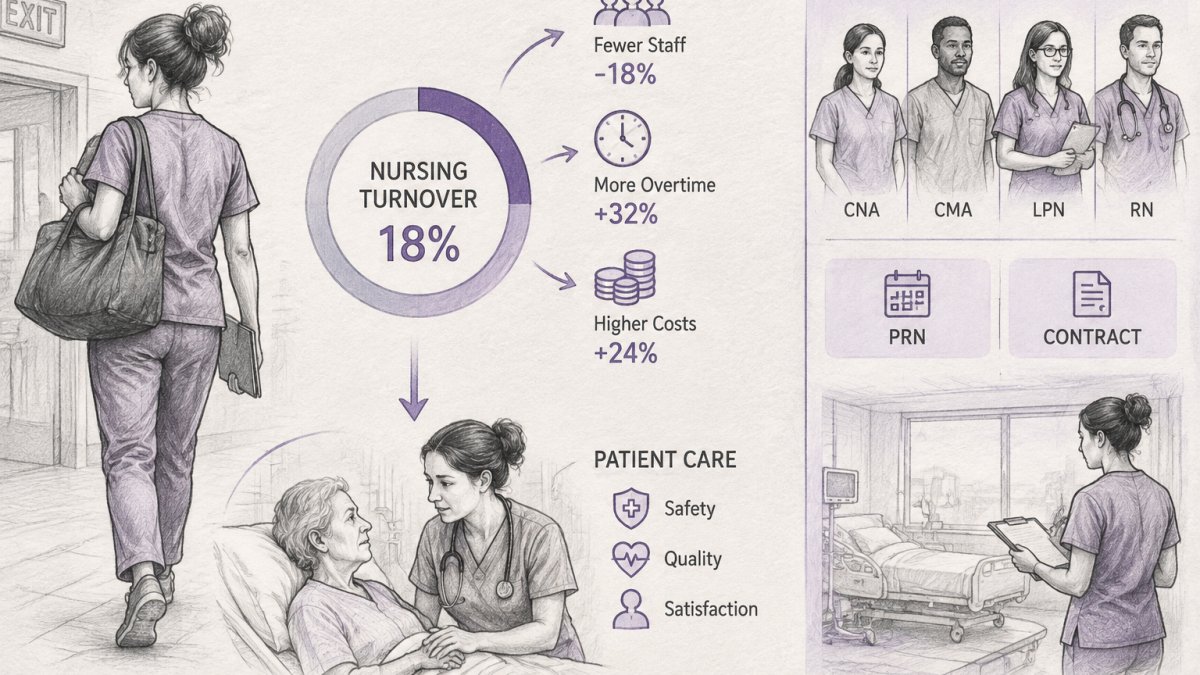
Most nursing agency partnerships don't collapse over a bad shift. They collapse because nobody defined the relationship upfront.
At Major Staffing, we start from partnership over placement. We're nurse-led, so the people coordinating your coverage understand what an understaffed unit feels like at shift change.
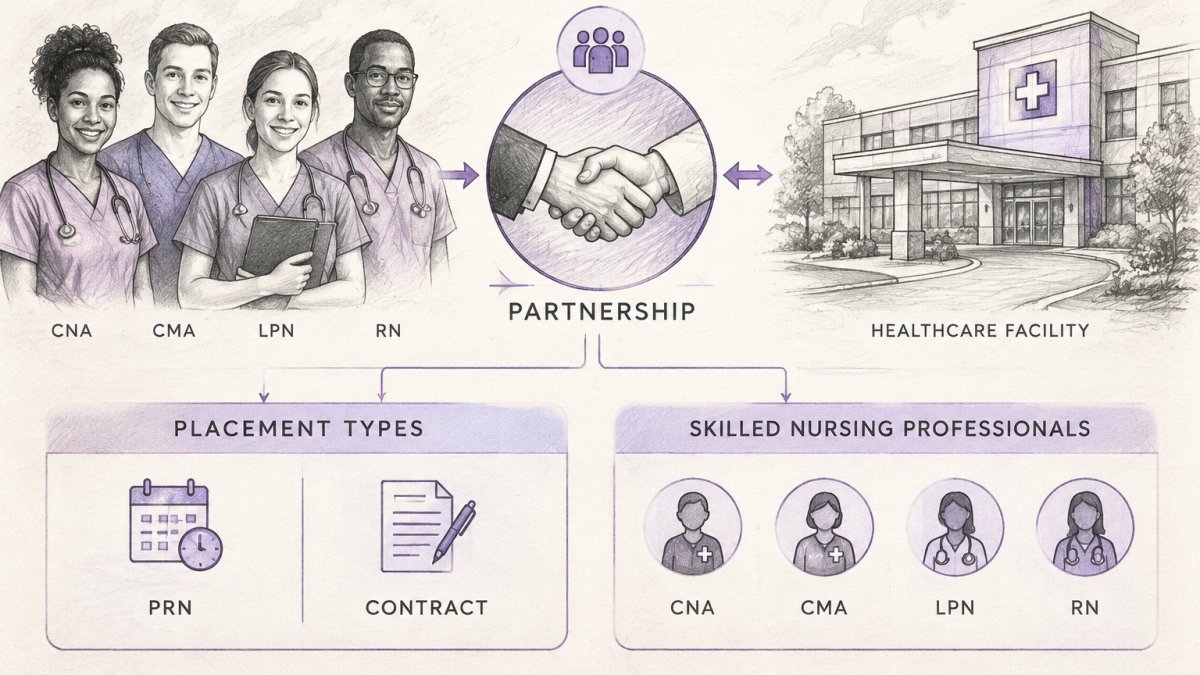
The distinction matters. A vendor delivers a service on request. A partner works to understand your staffing patterns and unit culture.
The Cost of Treating an Agency Like a Vendor
When a facility treats its staffing provider as a vendor, three things tend to happen.
First, communication narrows to order-and-confirm, nobody shares census trends or upcoming vacancies, so the agency always reacts rather than plans. Second, onboarding resets with every new face. Third, there's no shared language for quality, so problems surface as complaints instead of corrections.
A common mistake is measuring the relationship only by whether the shift got covered. Coverage is the floor, not the ceiling.
What to Look for in a Nurse Staffing Agency Partnership Agreement
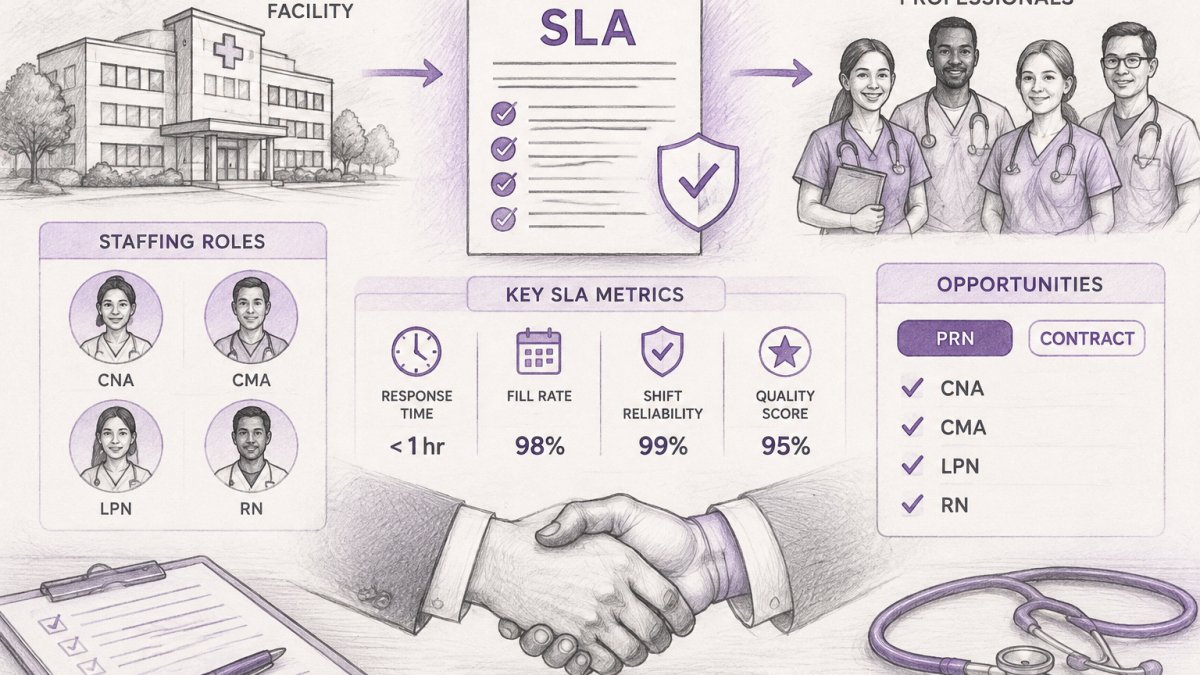
A strong nurse staffing agency partnership agreement does three jobs: it defines who is responsible for what, it sets clear expectations for credentialing and shift confirmation, and it gives both sides a way to resolve problems without escalating into a contract dispute. If your agreement doesn't do all three, it's incomplete.
Most agreements fail not because a clause is missing but because it's vague. "Reasonable notice" sounds fine until a 6 AM gap hits and both sides read the same sentence differently. Replace adjectives with mechanics: who does what, by when, through which channel, and what happens if it doesn't.
Before signing, walk through these elements:
- Scope of service. Which roles are covered (CNA, CMA, LPN, RN), which settings, and whether the arrangement includes PRN coverage, contract placements, or both.
- Credentialing and licensure verification. Who confirms active licensure, and how often it's re-checked.
- Shift confirmation and cancellation expectations. What notice each side commits to, and what happens when a shift changes.
Contract Terms That Protect Both Sides
The terms that protect facilities usually protect agencies too. Clear cancellation expectations, for example, keep a facility from being surprised by a no-show and keep an agency from absorbing last-minute losses it can't plan around.
A few terms deserve a closer read before you sign:
- Cancellation terms. Specify notice windows on both sides and what happens inside the window. Symmetry matters.
- Credentialing responsibilities. Decide who tracks background checks, licensure verification, and required training, and how often those refresh.
- Service-level expectations. Put fill rate, time to fill, and response time targets in the agreement itself. If it isn't in the contract, it isn't a commitment.
Watch out: signing an agreement that never names a specific contact or escalation path. When a 6 AM gap hits, an unnamed contact becomes a voicemail box while the shift goes uncovered.
Governance Mechanics: Decision Rights and Escalation
Contracts set the rules; governance keeps them working. Two mechanics are worth building into the relationship from day one.
Decision rights. Decide who can approve a shift request, who can authorize overtime, and who can change the scope of service.
Escalation paths. Define a two-step path: a named day-to-day contact for routine issues and a named backup for after-hours or unresolved problems.
A short review cadence ties it together.
If you're reviewing pricing structures and how they're typically built, our guide to nursing agency pricing models for facilities walks through the options before you commit to terms.
Before signing, walk through these elements of the agreement.
| Element | What it should cover |
|---|---|
| Scope of service | Roles covered (CNA, CMA, LPN, RN) and settings |
| Credentialing and licensure verification | Who confirms active licensure and how often |
| Shift confirmation and cancellation | Notice each side commits to when shifts change |
| Communication contacts | Named people on both sides with after-hours escalation path |
| Performance review cadence | How often fill rate, retention, and quality are reviewed |
| Termination and transition terms | Notice periods and handling of existing assignments |
Nursing Agency Communication Best Practices for Busy Facilities
The most effective communication habit in nursing agency partnerships is a short, recurring check-in rather than a stream of urgent messages.
Practical habits that hold up on a busy unit:
- Name one point of contact on each side. Not a department, a person.
- Share needs early when you can. A heads-up about a known vacancy beats an emergency call.
- Close the loop after every shift. A two-line note about how it went is worth more than a monthly report.
- Keep a single channel for shift changes. Mixed texts, calls, and emails create gaps.
- Escalate by exception. Routine updates shouldn't require a meeting.
Two-way communication is the part facilities skip. If your agency never hears feedback, they can't adjust who they send or how they prepare them. For a deeper walkthrough of keeping those lines clear, see our guide to nursing agency communication best practices.
The Nurse Staffing Agency Onboarding Checklist Every Facility Needs
Fast, consistent onboarding is where nurse staffing agency partnerships earn or lose trust. A temporary nurse who spends the first hour hunting for a badge reader isn't delivering care, and the unit absorbs that cost.
Use this checklist before the first shift:
- Facility orientation packet sent to the agency in advance
- Unit-specific expectations documented: charting system, shift report format, break coverage
- Badge, parking, and building access arranged before arrival
The facilities that onboard well treat the first shift as an investment, not an interruption. If you want a structured sequence to work from, our fast onboarding plan for temporary nursing staff lays out the steps in order.
Facility Staffing Agency Performance Metrics That Actually Matter
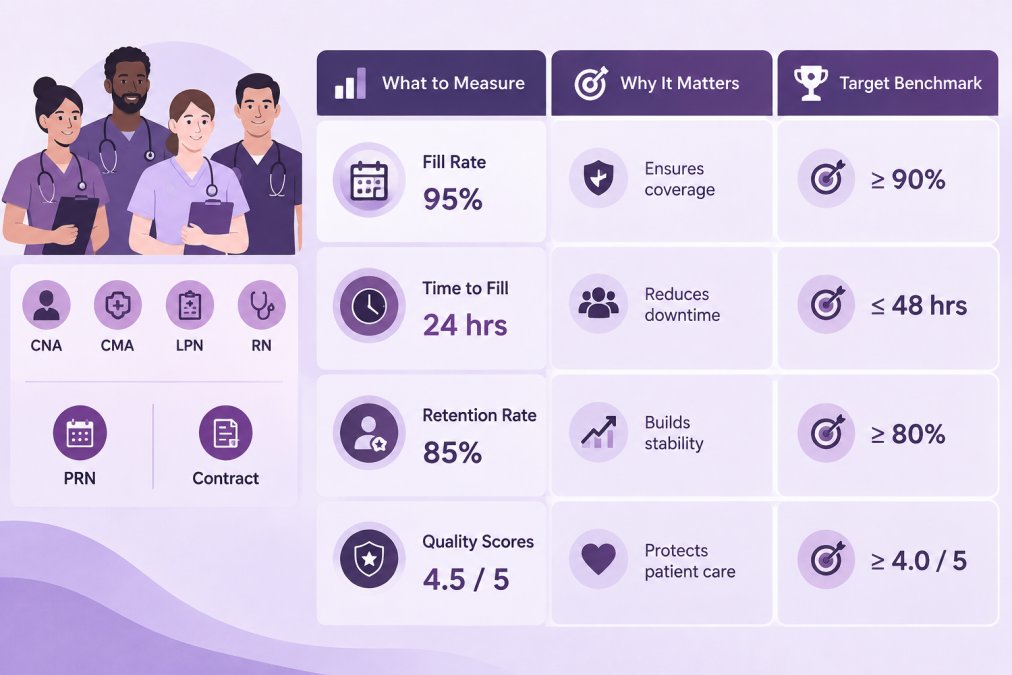
Fill rate alone tells you whether a shift got covered, not whether the right person showed up, stayed the whole shift, and was welcome back.
The practical move is a shared scorecard, one document both sides review on the same cadence, with the same numbers.
Beyond Fill Rate: Measuring Quality and Retention
Fill rate answers a scheduling question. Retention answers a relationship question, and it's the better predictor of what next month looks like.
Track these alongside coverage:
- Time to fill. How quickly a confirmed need becomes a confirmed shift.
- Shift completion. How often a scheduled nurse finishes the shift as booked.
- Retention across assignments. Whether the same nurses return to your facility.
We'd argue retention is a metric worth watching closely. A nurse who knows your building, your charting, and your residents brings continuity that a stranger on a first shift does not. That's a partnership outcome, not a placement outcome.
Building a Shared Scorecard Both Sides Own
A scorecard only changes behavior when it has an owner, a cadence, and a consequence. Set it up like this:
- Agree on a short list. Six to eight metrics is enough: coverage (fill rate, time to fill, shift completion), quality (retention, unit feedback, credential accuracy), and safety signals (incident reports, orientation completion).
- Define each metric the same way on both sides. Decide whether fill rate counts shifts confirmed or worked, and whether time to fill starts at the request or the confirmed need. Ambiguous definitions are the most common reason scorecards stall.
- Name an owner for each metric. The facility owns unit feedback and orientation completion; the agency owns time to fill and credential accuracy. Shared metrics like retention get a joint owner.
- Set a review cadence. A monthly scorecard review with a quarterly deeper look is common. Keep the monthly meeting short and focused on exceptions.
- Attach an action to every red metric. A number without a next step is just a complaint with a chart. End each review with one or two specific commitments and a date to check them.
Watch out: letting the scorecard become a scoreboard. If the monthly review turns into the facility grading the agency, the agency stops volunteering bad news. The point is a shared view of the same problem, not a verdict.
Turning Metrics Into Corrections, Not Complaints
Metrics earn their keep when they shorten the distance between a problem and a fix. A drop in shift completion should trigger a specific question, callouts, late arrivals, or mid-shift departures?, and a specific response, such as adjusting notice expectations or reviewing which units are hardest to staff.
A few patterns worth watching for:
- High fill rate with low retention. Coverage is being bought with unfamiliar faces. The fix is usually a consistent nurse pool and better first-shift onboarding, not more recruiting.
- Strong retention with slow time to fill. The relationship is healthy but the pipeline is thin. That's a forecasting conversation, not a performance problem.
- Good unit feedback with weak credential accuracy. Nurses are well liked but documentation is lagging. Tighten the pre-shift checklist before it becomes a compliance issue.
Reviewing these together, on a set cadence, is what separates a partnership from a vendor arrangement. The numbers are the same ones any agency can produce; the difference is whether both sides sit down with them and leave with a plan.
Building Workforce Resilience Through Long-Term Collaboration
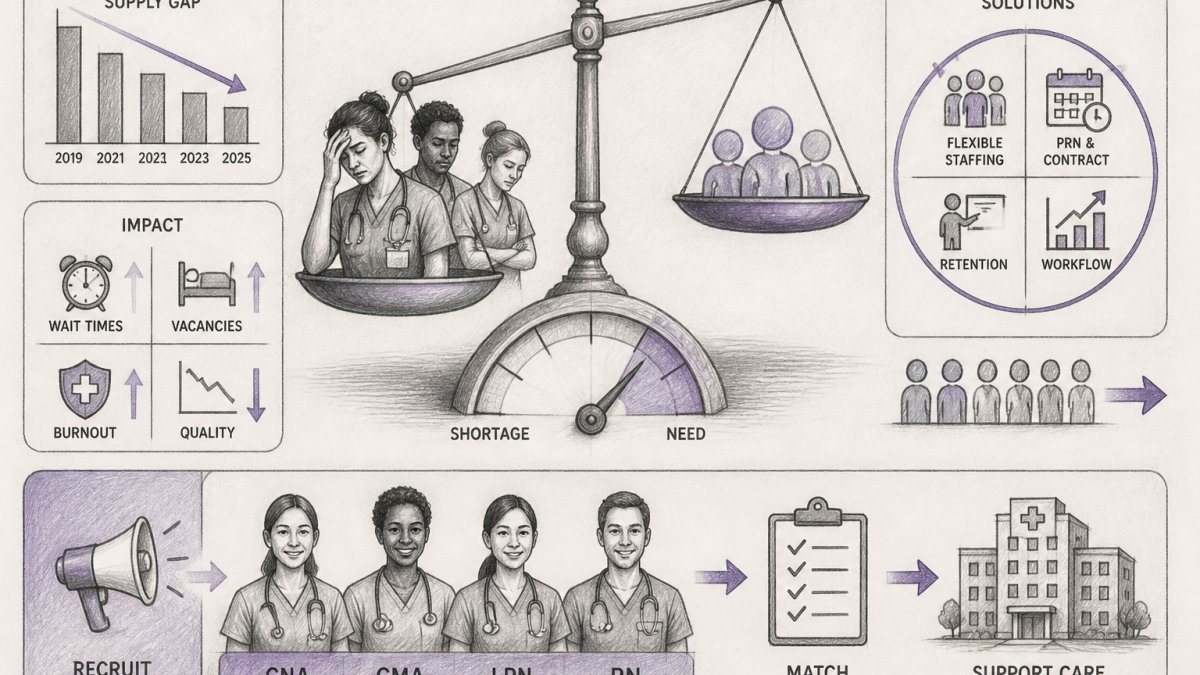
Workforce resilience comes from relationships that survive a bad week. Facilities that plan coverage with their agency rather than around it absorb callouts, census swings, and seasonal pressure without the scramble of a purely reactive arrangement.
What long-term collaboration looks like in practice:
- Forecasting conversations. Sharing anticipated vacancies and seasonal patterns so the agency can prepare.
- Consistent nurse pools. Familiar faces who already know the unit.
- Joint problem-solving. Reviewing a rough stretch together instead of assigning blame.
A nurse-led agency model supports this because the coordination is done by people who understand clinical workflow, not just scheduling software. Our article on the benefits of nurse-led staffing agencies explains why that difference shows up on the floor.
Choosing the Right Nursing Agency Partner for Your Facility
The right nursing agency partner answers honestly when you ask what it can and cannot cover.
Ask direct questions before you commit:
- Who is our point of contact, and how do we reach them after hours?
- How do you verify licensure and credentials, and how often?
- What happens when a nurse cancels, and what notice do we get?
If you're already working with a provider and considering a change, our guide to switching nursing staffing agencies without losing shifts covers how to protect coverage during the transition.
At Major Staffing, we're nurse-led, and we aim to be honest about what we can realistically staff.
Finding reliable coverage shouldn't feel like a gamble every time the phone rings at 6 AM.
Frequently Asked Questions
How should a healthcare facility choose a nursing staffing agency?
Start by defining your facility's specific needs: shift volume, specialty requirements, and long-term staffing goals. Then evaluate agencies on their recruitment and screening process, communication style, and local presence. Ask for references from similar-sized facilities and review their performance metrics for fill rate and retention. Prioritize partners who ask about your culture and resident dignity, not just your open shifts.
What should a facility include in a nursing agency partnership agreement?
A strong nurse staffing agency partnership agreement should define roles, expectations, and communication protocols. Include clear terms for shift request and cancellation, credentialing and licensure verification, and onboarding requirements. Specify how performance will be measured, such as fill rate and time to fill. Address financial transparency, including billing cycles and any fees, without stating specific prices. Outline a process for resolving issues and reviewing the partnership regularly. This contract protects both the facility and the agency, setting a foundation for mutual trust.
How can facilities improve communication with nursing staffing agencies?
Adopt nursing agency communication best practices by establishing a single point of contact on both sides and agreeing on response times for shift requests. Use a shared digital platform for posting needs and confirming placements to reduce back-and-forth. Schedule brief weekly check-ins to discuss upcoming staffing gaps and recent shift feedback. Provide clear, written instructions for each assignment, including unit protocols and reporting expectations. Encourage agency nurses to share concerns directly. This two-way communication builds trust and helps prevent last-minute surprises.
How do healthcare facilities evaluate the quality of agency nurses?
Evaluate agency nurses through a combination of direct observation, resident feedback, and performance data. Track metrics like incident reports, patient satisfaction scores, and retention rates for agency staff. Conduct post-shift debriefs with charge nurses to identify strengths and areas for improvement. Use a nurse staffing agency onboarding checklist to ensure each nurse receives proper orientation to your facility's policies and culture. Regularly review these findings with your agency partner to address issues and recognize excellent care.
What information should a facility provide before an agency nurse’s first shift?
Before an agency nurse's first shift, provide a comprehensive onboarding packet that includes facility maps, unit-specific protocols, medication administration procedures, emergency codes, and documentation systems. Share your culture and resident dignity guidelines. Use a nurse staffing agency onboarding checklist to confirm all items are covered. Assign a point person for questions during the shift. Clear expectations upfront reduce errors and help the nurse integrate smoothly with your team.
How often should a facility review its staffing agency partnership?
Review your staffing agency partnership quarterly to assess performance against agreed metrics like fill rate, time to fill, and retention. Use these reviews to discuss upcoming staffing needs, workforce forecasting, and any process improvements. An annual comprehensive review can evaluate long-term fit and strategic alignment. Regular check-ins build mutual trust and allow both parties to adjust to changing facility needs. This continuous improvement cycle strengthens workforce resilience.