 Ultimate guide
The Facility Leader's Guide to Nursing Staffing Agency SLAs
Last Updated: November 10, 2026
Quick Summary
Staffing agency SLAs are the written section of a staffing contract that defines measurable commitments between the agency and your facility, including fill rates, response times, credentialing standards, and remedies when performance falls short. They sit inside or alongside the master staffing services agreement, which sets the legal relationship while the SLA sets the operational promises.
- Define confirmed shift precisely, because a shift pending at 6 AM is not coverage.
- Track six metrics: fill rate, time to fill, response time, agency cancellations, attendance reliability, and replacement speed.
- Set targets as a floor and a stretch number, such as a 90% fill-rate floor with a 95% goal.
- Name contacts at two levels and hold a monthly review with the report in hand.
- A remedy clause saying the parties will discuss is not a remedy; name the trigger, response, and deadline.
Table of Contents
- Why Nursing Staffing Agency Service Level Agreements Decide Whether Shifts Get Filled
- Staffing Services Agreement vs. Service Level Agreement: What Each One Covers
- What to Put in a Healthcare Staffing Agency Contract Template
- Nurse Staffing Agency Performance Metrics That Actually Predict Coverage
- Nursing Shift Coverage Expectations: Cancellations, Replacements, and Response Time
- A Nursing Staffing Agency Service Level Agreements Template You Can Adapt
- How Care Setting Changes the Terms: Hospitals, Skilled Nursing, and Assisted Living
- Reviewing Your Staffing Agreement Before You Sign With Major Staffing
- Frequently Asked Questions
Why Nursing Staffing Agency Service Level Agreements Decide Whether Shifts Get Filled
A staffing agreement that never names a fill-time target is not a contract, it is a hope.
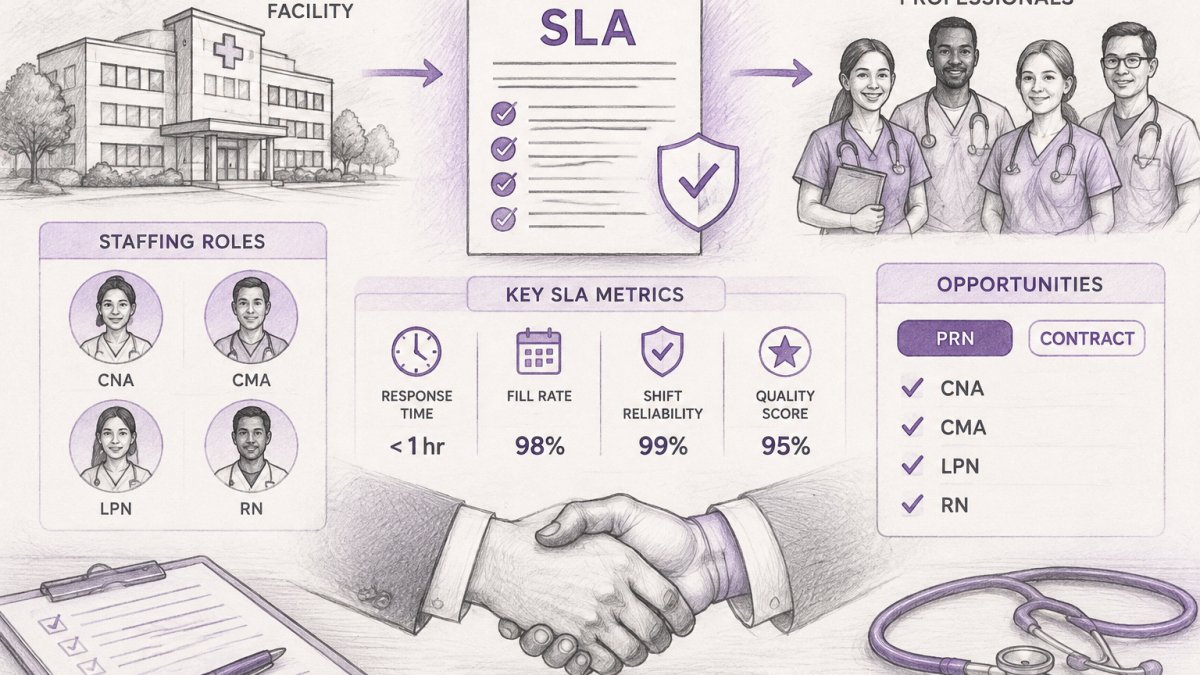
A service level agreement is a written section of a staffing contract that defines measurable commitments between the agency and the facility, including fill rates, response times, credentialing standards, and remedies when performance falls short.
Below, we walk through what belongs in that document, how it differs from the master agreement, and a template you can adapt. But first, the part most guides skip: the terms that sound protective in a sales call and turn out to be unenforceable in a contract.
Staffing Services Agreement vs. Service Level Agreement: What Each One Covers
The staffing services agreement is the master contract. It sets the legal relationship: term length, liability and insurance requirements, invoicing terms, termination clauses, and confidentiality.
Think of it this way. The master agreement answers "are we doing business together, and under what rules?" The SLA answers "what does a good week actually look like?"
Most disputes we see trace back to a facility that negotiated hard on the master agreement and skimmed the SLA.
If you are comparing how pricing structures fit into each document before you sign, our guide to nursing agency pricing models for facilities breaks down the options.
What to Put in a Healthcare Staffing Agency Contract Template
A healthcare staffing agency contract template should cover eight areas at minimum. Miss any one of them and you leave a gap that surfaces at the worst possible moment.
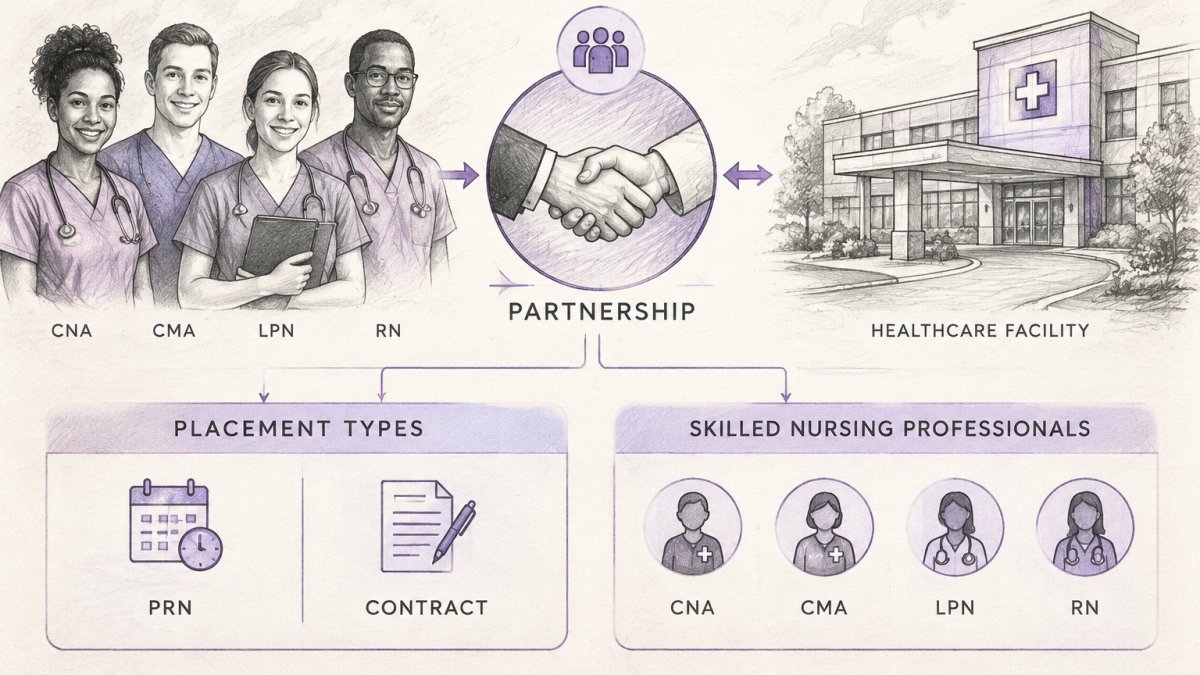
- Scope and roles: which positions the agency supplies (CNA, CMA, LPN, RN), and in which care settings
- Credentialing and screening: licensure verification, background checks, competency validation, and who owns each step
- Shift request process: how orders are placed, confirmed, and modified
- Coverage commitments: fill rate, time to fill, and response time targets
- Cancellation and replacement: notice windows and replacement obligations
- Billing and invoicing: bill rate structure, overtime handling, invoice cycle, and dispute process
- Performance reporting: what the agency reports, how often, and in what format
- Termination and transition: notice periods and obligations during wind-down
Two clauses deserve extra attention. First, define "confirmed shift" precisely, because a shift that is "pending" at 6 AM is not coverage. Second, state who bears the cost when a facility cancels inside the notice window. Ambiguity here is where relationships sour.
Nurse Staffing Agency Performance Metrics That Actually Predict Coverage
Fill rate alone tells you what already happened.
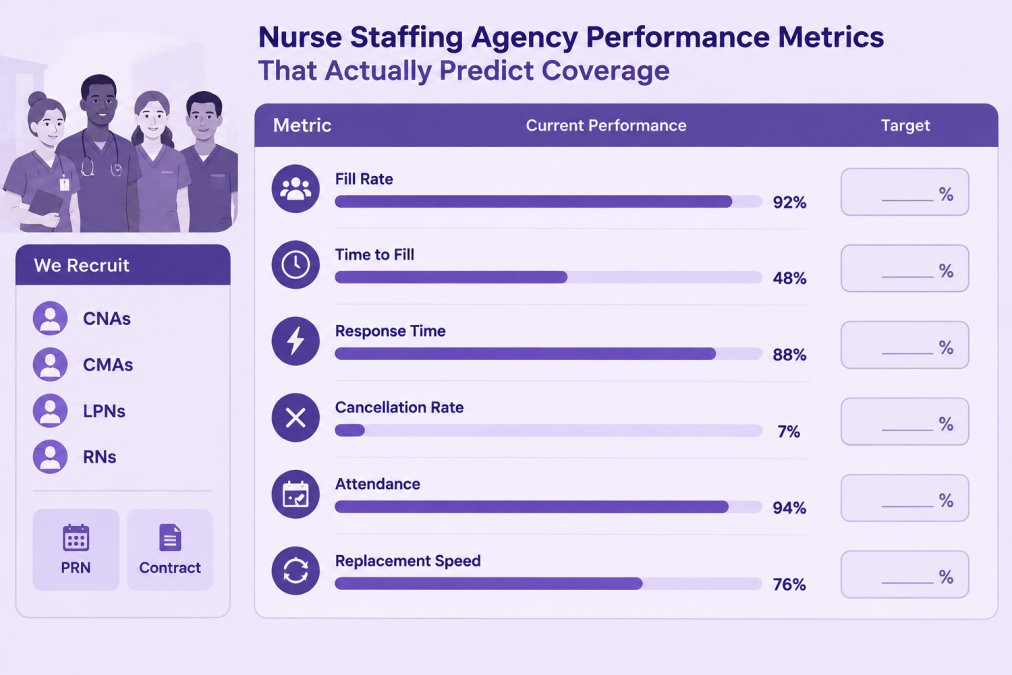
Track these six, and define each one in the agreement so both sides count the same way:
- Fill rate: percentage of requested shifts filled, measured per pay period. Count a shift as filled only when a named, credentialed clinician is confirmed, not when the order is acknowledged.
- Time to fill: hours from request received to confirmed clinician, reported as a median and a 90th-percentile figure so one hard-to-fill night shift does not hide a pattern.
- Response time: minutes to acknowledge a request during business hours and after hours, tracked separately because after-hours behavior is where most agreements quietly fail.
- Agency-side cancellation rate: agency cancellations as a share of confirmed shifts, with the reason code attached (clinician callout, credential lapse, facility cancellation misclassified).
- Attendance reliability: show rate against confirmed shifts, plus late arrivals beyond a defined grace window.
- Replacement speed: hours to substitute after a confirmed clinician calls out, measured from the callout to the replacement's confirmation.
A common pattern is to set targets as a floor and a stretch number rather than a single figure.
Watch out: a fill rate that counts "pending" or "offered" shifts as filled will look excellent on a dashboard and leave your unit short at 7 AM. Define "confirmed" in writing before you agree to any target.
Metrics should also connect to care quality, not just coverage.
Facilities that treat metrics as a partnership tool rather than a scorecard tend to get better results. Our article on best practices for nursing agency partnerships goes deeper on that dynamic.
Nursing Shift Coverage Expectations: Cancellations, Replacements, and Response Time
Nursing shift coverage expectations should be written as specific commitments, not intentions. "We try to respond quickly" is not a term. "We acknowledge requests within 30 minutes and confirm or decline within two hours" is.
Cover these three scenarios in writing:
- Planned leave and vacancies: how far ahead orders are placed and confirmed
- Unexpected callouts: the response window and who is responsible for escalation
- Seasonal census fluctuation: how volume changes are communicated and absorbed
Then define cancellation rules on both sides. A facility that cancels inside the notice window and an agency that pulls a confirmed clinician are different failures, and the agreement should treat them differently.
Clear communication standards prevent most of these problems before they start. Our guide to nursing agency communication best practices covers the protocols worth writing into the agreement.
A Nursing Staffing Agency Service Level Agreements Template You Can Adapt
Use this checklist as the working draft for your next negotiation. Fill in the target column with your facility's actual requirements, then attach the sample clause language below so the numbers have teeth.
| SLA Element | What to Specify | Your Target |
|---|---|---|
| Response time | Minutes to acknowledge a request, business hours and after hours | ___ |
| Time to fill | Median and ceiling hours from request to confirmation | ___ |
| Fill rate | Percentage of shifts filled per pay period, with "confirmed" defined | ___ |
| Cancellation notice | Hours of notice before a shift, by both parties | ___ |
| Replacement window | Hours to substitute after a callout | ___ |
| Credential verification | Who verifies, against what source, and before first shift | ___ |
| Reporting cadence | Frequency, format, and metrics included | ___ |
| Review meeting | How often both parties review results | ___ |
| Escalation path | Named contacts and response windows at each tier | ___ |
| Remedy | What happens after repeated misses | ___ |
Sample clause language you can adapt:
- Confirmation: "A shift is confirmed only when the agency provides the name and credential status of a specific clinician and the facility acknowledges the assignment in writing."
- Response: "The agency will acknowledge shift requests within 30 minutes during business hours and within 60 minutes after hours, and will confirm or decline within the time-to-fill ceiling stated in Schedule A."
- Replacement: "If a confirmed clinician cancels, the agency will notify the facility within one hour of receiving the cancellation and will use reasonable efforts to provide a qualified replacement within the replacement window."
- Credentialing: "The agency will verify licensure and required certifications against the issuing source before the clinician's first shift and will notify the facility within one business day if a credential lapses."
- Reporting: "The agency will provide a monthly performance report covering fill rate, time to fill, response time, cancellations, attendance, and replacement speed, in a format the facility can review at the monthly meeting."
Three governance habits make the template stick. Name a contact on each side at two levels, an operational contact for daily requests and an escalation contact for unresolved problems. Set a monthly review with the report in hand before the meeting, not after. And agree in advance what happens when a target is missed twice in a row, whether that is a written corrective plan with a deadline, a service credit defined in the contract, or a termination right.
Watch out: a remedy clause that says "the parties will discuss" is not a remedy. Name the trigger, the response, and the deadline, or the clause will not survive the first disagreement.
For facilities in skilled nursing, selection criteria differ from hospital settings. Our guide to the best nurse staffing agency for skilled nursing facilities explains why.
How Care Setting Changes the Terms: Hospitals, Skilled Nursing, and Assisted Living
The same SLA language produces different results across care settings, because the underlying demand looks different.
Hospitals typically need fast response for acute callouts and tighter competency documentation for specialty units.
Rural facilities face a distinct constraint: a thinner local clinician pool means fill-time targets must be realistic, and the agreement should address how hard-to-fill shifts are escalated rather than simply marked unfilled.
Ask your agency how they adjust terms by setting. An agency that offers one template for every facility is telling you something about how they operate.
Reviewing Your Staffing Agreement Before You Sign With Major Staffing
Read the SLA as if you are the one on the floor at 6 AM. Does it tell you who to call, how fast they answer, and what happens if no one does?
Major Staffing is a nurse-led agency. We provide staffing solutions ranging from last-minute shift coverage to long-term placements.
If you are weighing a change, our guide to switching nursing staffing agencies without losing shifts walks through the transition.
The test of any staffing agreement is simple: when a shift is on the line, does the document tell both sides exactly what happens next? If it does not, it is worth rewriting before you sign.
Frequently Asked Questions
What is a service level agreement for a nursing staffing agency?
A service level agreement is the section of your staffing contract that defines what the agency commits to deliver and how that commitment is measured. It covers response time to a staffing request, fill rate, time to fill, cancellation and replacement rules, credentialing turnaround, and reporting cadence. The agreement also names what happens when a target is missed. The staffing services agreement sets the legal framework; the SLA sets the operating expectations inside it.
What should a nurse staffing agency service level agreement include?
At minimum, include the roles and specialties covered, credentialing and screening requirements, shift request and confirmation process, fill rate and time-to-fill targets, cancellation and replacement terms, attendance expectations, invoicing and bill rate mechanics, reporting frequency, and a review schedule. Add care-setting specifics such as competency requirements for specialty units. Write each item as something you can count, because a target nobody can measure is not a service level.
How do you measure a nursing staffing agency's performance?
Track fill rate, time to fill, response time to requests, cancellation rate, attendance, and replacement speed. Pair those with quality signals: credential compliance, onboarding completion, and incident or complaint trends tied to agency staff. Review the numbers monthly against the targets in your agreement and keep the reports in one place so trends are visible. Facilities that review metrics on a schedule catch coverage problems before they turn into empty shifts.
What is the difference between a staffing services agreement and an SLA?
The staffing services agreement is the contract: parties, term, rates, liability, insurance, compliance obligations, and termination. The service level agreement is the performance layer attached to it, defining measurable expectations like fill rate and response time plus remedies when targets are missed. You can sign a solid contract with a weak SLA and still get poor coverage. Read them together, because the contract should reference the SLA targets and remedies.
How should a facility handle unfilled or canceled nursing shifts?
Set the process in writing before it happens. Define how quickly the agency must notify you of a cancellation, how long it has to offer a replacement, and what happens if no replacement is found. Ask for a documented reason for each cancellation and review patterns monthly. Build a backup plan for hard-to-fill shifts, such as a prioritized request list or a secondary agency relationship, so one cancellation does not leave a unit short.
How often should a nursing staffing SLA be reviewed?
Review performance monthly and revisit the agreement terms at least annually, or sooner if your census or acuity has shifted. A quarterly sit-down works well for most facilities: walk through the metrics, confirm targets still match your needs, and adjust. Bring your own data to the review so the conversation is about shared numbers, not impressions. If a target is consistently missed or consistently easy to hit, the target needs to change.