 how-to
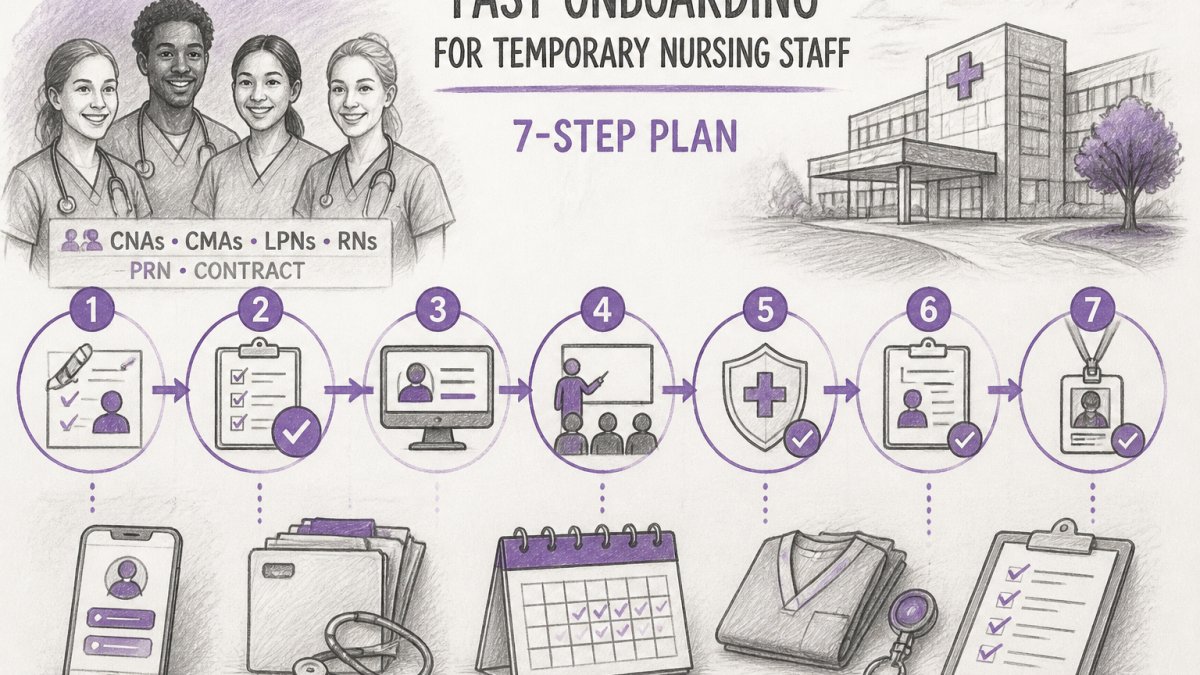
Fast Onboarding for Temporary Nursing Staff: 7-Step Plan
Table of Contents
- Why Fast Onboarding for Temporary Nursing Staff Stalls (and What It Costs)
- The Temporary Nurse Onboarding Checklist: Booking Through First Shift
- Nurse Credentialing and Compliance Checklist: Clear Before the Floor
- The Per Diem Nurse Onboarding Process: Focused Orientation That Fits the Shift
- First Shift Checklist for Agency Nurses: What Readiness Looks Like on the Floor
- Who Owns What: Splitting Onboarding Duties Between Agency and Facility
- Contingency Planning: When Credentials, Access, or the Schedule Fall Through
- Measuring Onboarding Speed Without Cutting Safety Corners
- Frequently Asked Questions
Last Updated: October 18, 2026
Why Fast Onboarding for Temporary Nursing Staff Stalls (and What It Costs)
Fast onboarding for temporary nursing staff is the process of getting an agency nurse credentialed, oriented, and productive on a facility floor without cutting safety corners.
Here's the hard truth: most onboarding stalls are self-inflicted. A missing document, an unreturned email, a login that was never created. None of it is clinical.
The cost shows up in real ways:
- Empty shifts that stay open and burn out your core team
- Nurses who take one assignment and never come back
- Managers spending their mornings on paperwork instead of patients
The fix is a plan with owners, deadlines, and a checklist everyone can see.
The Temporary Nurse Onboarding Checklist: Booking Through First Shift
The temporary nurse onboarding checklist below runs from the moment a shift is booked to the moment the nurse clocks in. Each phase has a clear owner and a clear finish line.
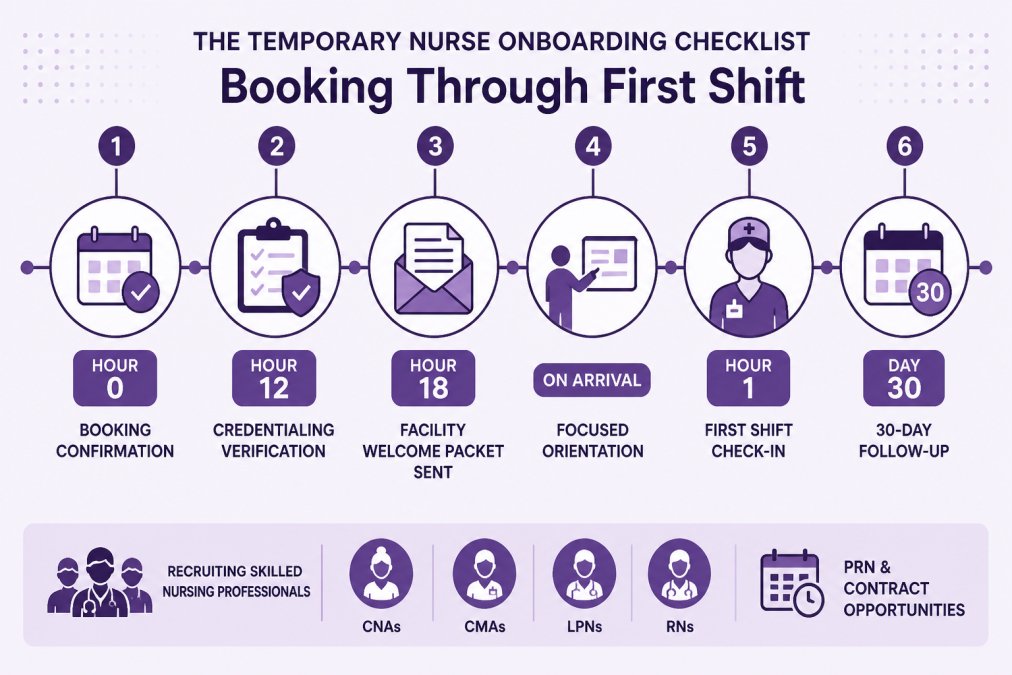
Phase 1: Booking and Pre-Arrival (0-24 Hours)
This phase decides whether the shift happens at all. Move fast and confirm everything in writing.
- Confirm the booking in writing. Send shift date, unit, start time, and who to report to.
- Verify the credential file. Check license status, required documents, and compliance documentation before the nurse is offered.
- Send the welcome packet. Include a facility map, parking notes, dress code, and a short welcome video if you have one.
- Assign a point of contact. One name and one number, not a general line.
A common mistake is treating the welcome packet as optional. It isn't. A nurse who knows where to park and who to ask for walks in calmer.
Phase 2: Day-of-Shift Readiness (24 Hours to First Clock-In)
Readiness is a checklist, not a feeling. Run it the evening before.
- Badge or access request submitted
- EHR login created or confirmed
- Unit assignment and preceptor named
- Shift confirmed with the nurse by text or call
- Facility contact briefed on the arrival time
Nurse Credentialing and Compliance Checklist: Clear Before the Floor
The nurse credentialing and compliance checklist is the gate every agency nurse passes through before touching a patient. Clear it early, because it is the slowest part of onboarding.
What belongs in the file:
- Active license verification
- Required certifications for the unit
- Compliance documentation and signed acknowledgments
- Clinical clearance from the agency
- Facility-specific paperwork
The Joint Commission standards on credentialing and privileging outline why verification must happen before care begins. Speed means doing this in parallel, not skipping it.
The Per Diem Nurse Onboarding Process: Focused Orientation That Fits the Shift
The per diem nurse onboarding process should fit inside the shift, not spill past it. Per diem staff need the essentials, not a full employee orientation. But "essentials" means different things for a CNA on a long-term care hall, an LPN running a medication pass, and an RN taking a charge assignment in a rural hospital.
Focused orientation covers four things, in this order:
- Where things are on the unit
- How to use the EHR and equipment
- Who to ask when something is unclear
- What the facility's policies and procedures require in practice
That's the frame. The content inside it should shift by role and setting.
Role-Specific Orientation Pathways
A practical pattern is to keep the same four-part frame but change the depth and the emphasis. Most practitioners find this cuts first-shift questions without adding orientation time.
CNA and CMA pathways (long-term care and assisted living)
- Walk the assigned hall first, not the whole building. Name the residents on the assignment and point out mobility, fall-risk, and dignity-of-care considerations.
- Show the supply closet, linen, and lift equipment locations before the first call light.
- Review the facility's approach to resident rights, reporting changes in condition, and documentation expectations.
- Confirm who the CNA reports to on the shift and how to escalate a concern.
LPN pathways
- Prioritize the medication room, MAR access, and the facility's medication pass workflow.
- Review treatment cart location, wound care supplies, and the process for ordering or restocking.
- Confirm the escalation path for a change in condition and who signs off on orders.
- Walk the hall with the nurse who will be on the same shift, not just a daytime educator.
RN pathways (including rural hospital assignments)
- Confirm charge or team assignment, patient assignment ratios, and who covers during breaks.
- Review EHR order entry, code and rapid response procedures, and where emergency equipment lives.
- Identify the provider contact and the process for reaching them after hours.
- Walk the unit's high-acuity rooms and confirm equipment checks.
Unit Orientation in 30 Minutes or Less
A 30-minute unit orientation is realistic if you follow a set route and skip anything the nurse can learn during the shift. Walk the floor in this order:
- Nurses' station and charge nurse
- Supply and medication rooms
- Patient rooms and call system
- Break room and restrooms
- EHR login and charting demo
Name a preceptor for the shift. Preceptor support is the difference between a nurse who asks good questions and one who guesses. For contract staff who stay longer, add the deeper training modules after the first shift, not before it.
First Shift Checklist for Agency Nurses: What Readiness Looks Like on the Floor
The first shift checklist for agency nurses answers one question: can this nurse work safely right now? Readiness looks like a nurse who knows the unit layout, has working equipment access, and understands role expectations.
Run this at the start of the shift:
- Badge works and access is granted
- EHR login confirmed
- Unit layout and equipment located
- Scope of practice and assignment reviewed
- Charge nurse and preceptor introduced
- Communication channel set for questions
Who Owns What: Splitting Onboarding Duties Between Agency and Facility
Clear ownership prevents the "I thought you handled it" problem. Split duties in writing before the first shift.
| Onboarding Task | Agency Owns | Facility Owns |
|---|---|---|
| License and credential check | Yes | No |
| Compliance documentation | Yes | Reviews |
| Badge and access setup | Requests | Grants |
| EHR login | No | Yes |
| Unit orientation | Supports | Leads |
| Shift confirmation | Yes | Confirms |
The agency handles clinical clearance and paperwork. The facility handles access, systems, and unit-specific training. When both sides know their lane, staffing agency coordination stops being a bottleneck.
Contingency Planning: When Credentials, Access, or the Schedule Fall Through
Things break. A credential lapses, a badge doesn't print, a shift gets cancelled. Have a plan ready.
- Incomplete credentials: Flag the gap the moment it appears and name the fix and deadline.
- Missing access: Have a backup contact who can grant temporary access on arrival.
- Last-minute changes: Keep a short list of nurses cleared for the same unit.
Measuring Onboarding Speed Without Cutting Safety Corners
Track speed and safety together, or speed will quietly win. The trick is to define each metric the same way every time, assign an owner, and set a safety guardrail that pauses the process when something looks off. Most practitioners find that a short, consistent scorecard beats a long dashboard nobody reads.
Define the Metrics Before You Measure Them
- Time to clear: hours from booking confirmation to credential approval. Owner: agency credentialing lead. Start the clock at the written booking, not the verbal request.
- Time to first shift: hours from booking to the nurse clocking in. Owner: agency coordinator with facility confirmation.
- First-shift completion: share of nurses who finish the shift they accepted. Owner: facility charge nurse reports, agency tracks.
- Second-assignment rate: share of nurses who accept another shift within a set window. Owner: agency.
- Orientation completion: share of first shifts where the four-part orientation was actually delivered. Owner: facility preceptor.
Pick a review cadence, weekly for high-volume units, monthly otherwise, and keep the definitions fixed so month-over-month numbers mean something.
Safety Guardrails That Override Speed
Speed only counts when these stay green:
- No credential shortcuts. If a required document is missing, the nurse does not go to the floor, no matter how tight the shift. A single missing item can pull a nurse off the unit mid-shift and leave it short again.
- No access workarounds. A nurse without working EHR access is not ready, even if the badge prints.
- No skipped orientation. If the four-part orientation did not happen, log it as a miss and fix it on the next shift.
- Stop rule. If first-shift completion or second-assignment rate drops while time to clear improves, pause the speed push and audit the process before scaling it.
A Simple Weekly Review
Once a week, look at the five metrics side by side. If time to clear is falling but first-shift completion is flat or rising, the process is working. The HRSA guidance on nursing workforce and patient safety makes the link between staffing and safety clear.
Major Staffing is nurse-led, so we build every onboarding plan around what actually happens on the floor. Reliable care starts with a nurse who was set up to succeed.
Frequently Asked Questions
How can healthcare facilities speed up onboarding for temporary nursing staff?
Start credentialing before the first shift is booked by keeping a current compliance file on hand. Send a short welcome packet with unit layout, policies, and parking details the same day you confirm the booking. On arrival, run a focused orientation that covers only what the nurse needs for that assignment, then pair them with a preceptor for the first few hours. Clear communication between the facility and the staffing agency about role expectations and shift readiness keeps the process moving without skipping safety checks.
What should be included in a temporary nurse onboarding checklist?
A solid temporary nurse onboarding checklist covers license and certification verification, compliance documentation, facility-specific policies, unit layout and equipment access, electronic health records login, emergency procedures, and a named contact for questions. Include a first shift checklist for agency nurses with clock-in instructions, badge pickup, and preceptor assignment. Keep the list short enough to finish before the shift starts, and review it with the nurse by phone or email so nothing gets missed.
How can facilities verify a temporary nurse's credentials before a shift?
Ask the staffing agency for a credentialing summary that confirms active license, certifications, and completed compliance documentation before the nurse arrives. Verify the license through the state board's public lookup, and confirm that required training records are current. A nurse credentialing and compliance checklist shared between the agency and facility prevents last-minute surprises. If something is missing, document it and set a clear deadline rather than letting the nurse start without it.
How can facilities balance fast onboarding with patient safety?
Speed comes from preparation, not shortcuts. Pre-verify credentials, send facility-specific information ahead of time, and use a focused orientation that covers safety-critical items first: emergency codes, medication processes, and who to call for help. Pair the temporary nurse with a preceptor during the first shift and check in at the halfway point. Track time to clearance and first-shift incidents together so you can see whether faster onboarding is holding up on the floor.