 How-to
6 Steps to Verify Nursing Agency Credentials
Last Updated: November 17, 2026
Quick Summary
To verify nursing agency credentials, confirm the agency's business registration and liability insurance, then run state board license lookups and primary source checks on every clinician it places. Record each check with its source and date, and recheck credentials at every renewal, not just at onboarding.
- Verify the agency's legal entity name, business registration, and professional liability insurance before signing any contract.
- Run a free state board of nursing lookup on every clinician for every placement, not once at onboarding.
- Confirm certification numbers directly with the issuing organization, since certifications expire on a different clock than licenses.
- Log what you checked, where, the date, and who performed it for every line on your credentialing checklist.
- Hold the shift if a license shows inactive, lapsed, or restricted until the record checks out.
Table of Contents
- Why Nursing Agency Credentials Need Checking Before You Sign
- Step 1: Confirm the Agency Is a Registered Business
- Step 2: Run State Board License Verification on Every Clinician
- Step 3: Apply Primary Source Verification Nursing Standards
- Step 4: Verify Nursing Certification and Specialty Credentials
- Step 5: Use a Nursing Agency Credentialing Checklist for Every File
- Step 6: Read the Red Flags and Resolve Mismatches
- Request Credential Documentation From Major Staffing
- Frequently Asked Questions
Why Nursing Agency Credentials Need Checking Before You Sign
Before you sign with any staffing agency, you need to know how to verify nursing agency credentials. That means checking the business itself and every clinician it sends you. A friendly recruiter and a slick website prove nothing about the license standing behind the badge.
A license lapses, a certification expires, and the facility carries the risk. The patient carries it too.
The fix is a repeatable process. Below, we walk through six steps you can run on any agency, including ours. Each step takes minutes once you know where to look.
Step 1: Confirm the Agency Is a Registered Business
Start with the entity, not the nurses. A license lookup tells you about one clinician. It tells you nothing about whether the company sending that clinician is authorized to operate, insured, or even real. Verify the business first, then the people.
Ask the agency for four documents in writing:
- Its exact legal business name, plus any trade names or DBAs it operates under
- Its business registration or formation records from the state where it is organized
- A certificate of professional liability insurance showing current coverage and the named insured
- The name and direct contact of the person who owns credential questions
Then confirm each one against an independent source rather than the agency's own paperwork.
Business registration. Most states run a free business entity search through the secretary of state's office or an equivalent business registry. Search the legal name and confirm the entity is active, not dissolved or administratively revoked. Match the name on the registration to the name on the contract and the name on the insurance certificate.
Insurance. Read the certificate of professional liability insurance, not just the presence of one. Confirm the named insured matches the legal entity, the policy is currently in force, and the coverage type is professional liability rather than general business liability alone. Ask for the certificate to be sent directly from the insurance broker if you have any doubt about a forwarded copy.
State staffing-agency requirements. This is where facilities get surprised. Some states require healthcare staffing agencies to register, license, or meet specific operating standards before placing clinicians; others regulate the facility's use of agency staff instead. Confirm what your state requires of the agency itself, and ask the agency to identify the specific rule or registration it operates under. A confident agency can name it.
Complaint and enforcement history. Check whether your state's attorney general, department of labor, or health facility regulator publishes enforcement actions or complaints tied to the business name. This step is quick and rarely done, which is exactly why it is worth doing.
Watch out: an agency that will not provide its legal entity name, insurance certificate, or state authorization in writing before a contract is signed is asking you to carry risk you cannot see.
If you are weighing whether to sign at all, our guide on Best Practices for Nursing Agency Partnerships covers how to build a sound partnership before you commit. Facility leaders who want to know what service standards to expect can read The Facility Leader's Guide to Nursing Staffing Agency SLAs.
Step 2: Run State Board License Verification on Every Clinician
Every clinician needs a check, every time. Not once at onboarding. Every placement.
State board license verification is free and public in most states. You look up the nurse by name or license number and read the official record.
Here is what to pull for each person:
- Full name as it appears on the license
- License number and license type
- License status: active, inactive, or lapsed
- Expiration date
- Any public disciplinary history or restrictions
Match the name on the license to the name on the assignment paperwork. A middle initial mismatch is worth a phone call.
Most state boards of nursing publish an online lookup tool through their official site. Use the board's own tool rather than a third-party aggregator, which can lag behind the official record.
Step 3: Apply Primary Source Verification Nursing Standards
Primary source verification nursing means confirming credentials directly with the body that issued them. Not a copy of a certificate. Not a screenshot. The issuing source.
A photocopied license proves someone had a printer. A primary source check proves the license is real and current.
For licenses, the primary source is the state board of nursing. For certifications, it is the certifying organization. For identity, it is a government-issued document.
Ask the agency how it documents primary source checks. A solid answer names the source, the date of the check, and who performed it. A weak answer is "we verify everything."
For national checks, some agencies use a national license verification service. That helps with multistate and compact licenses, where a nurse may hold privileges in several states. Confirm the compact status on the board's own record anyway.
Step 4: Verify Nursing Certification and Specialty Credentials
Verify nursing certification separately from the license. A license says someone may practice. A certification says they met a specialty standard.
Common checks include:
- Certification number and issuing body
- Certification status and expiration date
- Specialty match to the assignment
- Education credentials where the role requires them
- Background screening completion date
Ask for the certification number, then confirm it with the certifying organization.
The thing nobody tells you about certification checks is that they expire on a different clock than licenses. A nurse can hold a perfectly active license and a lapsed specialty certification at the same time. If the assignment needs that specialty, the gap matters.
Step 5: Use a Nursing Agency Credentialing Checklist for Every File
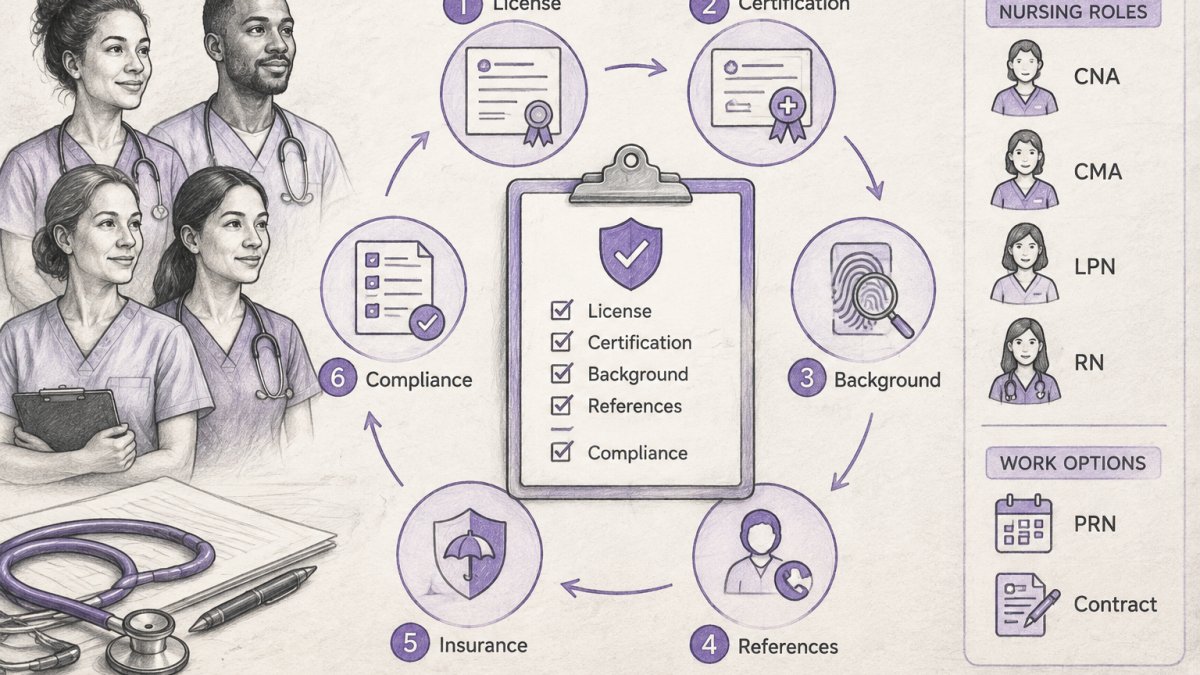
Build one checklist and use it for every file, every time. A nursing agency credentialing checklist turns a scattered process into a repeatable one, and it gives you something to show a surveyor or an auditor later.
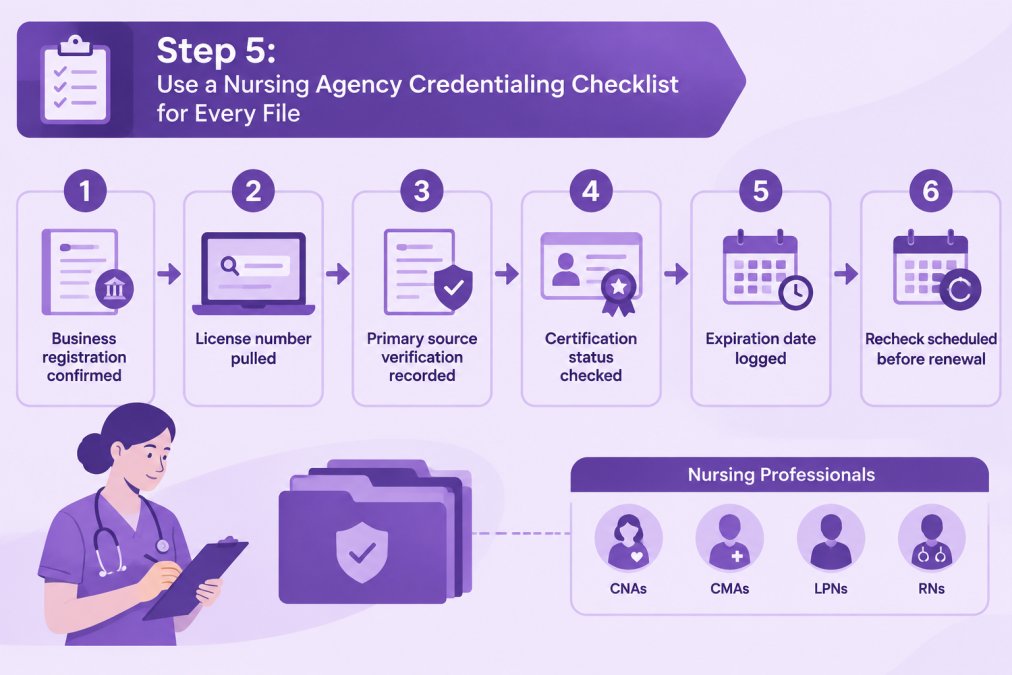
A complete file goes beyond the license. Run each clinician through these checks:
- Agency business registration and insurance confirmed (Step 1)
- Identity confirmed against a government-issued photo ID, with name matched to the license
- License number pulled from the state board lookup, with status and expiration recorded
- Primary source verification recorded with source name, date, and the person who checked
- Education or training records confirmed where the role requires them
- Specialty certification number confirmed with the issuing body, with status and expiration
- Work history reviewed for gaps or mismatches against the assignment
- Background screening and required health screenings completed, with dates on file
- Compact or multistate privilege confirmed on the board's own record where applicable
- Recheck scheduled before each renewal date
Record the evidence, not just the result. For every line, log what you checked, where you checked it, the date, and who performed the check. A credential file without dates is a story, not a record. Store the confirmation page or report alongside the entry so a later reviewer can retrace the step.
Set renewal reminders before you need them. Licenses and certifications renew on different clocks, and a nurse can hold an active license with a lapsed specialty certification. Calendar each expiration date and set the reminder far enough ahead that the agency has time to produce an updated record before the next shift. Recheck at each renewal, not only at onboarding.
Recheck on a schedule, not just at onboarding. A common pattern is to recheck credentials at every renewal and whenever a clinician returns after a long gap. Ongoing monitoring is the step most facilities skip, and it is the one that catches the lapse before it reaches a resident.
If you are a smaller facility without a credentialing team, How to Evaluate Agency Support for Small Clinics gives you a framework for judging how much support an agency actually provides.
Step 6: Read the Red Flags and Resolve Mismatches
Some signals should stop a placement cold. Watch for these:
- A license that shows inactive, lapsed, or restricted
- A name that does not match across documents
- An agency that will not share license numbers
- Certification claims with no number to check
- Expiration dates that pass with no update from the agency
Watch out: an agency that sends a clinician before you have confirmed the license puts your facility and your patients on the line. Hold the shift until the record checks out.
Mismatches happen, and most are clerical. A married name, a transposed digit, a renewal in progress. The test is how the agency responds. A quick, documented correction is fine. Silence is not.
If problems keep repeating, you may need to change agencies. How to Switch Nursing Staffing Agencies Without Losing Shifts walks through how to do that without dropping coverage.
Request Credential Documentation From Major Staffing
Ask any agency for its credential documentation before you sign. We expect the question, and we will answer it.
Major Staffing is a nurse-led agency. Our team works with long-term care, assisted living, and rural hospitals, and we match clinicians to current facility needs, with availability depending on those needs.
To see what a nurse-led agency offers facilities, read Benefits of Nurse Led Staffing Agencies for Facilities. Then ask us for the documentation you need.
Credential checks take time your team may not have. Major Staffing handles license verification, certification tracking, and expiration monitoring as part of our nurse-led placement process, with flexible coverage for last-minute shifts and long-term placements. Get started with Major Staffing and build a credential file you can trust.
Frequently Asked Questions
How can a facility verify a nursing agency's credentials?
Start with the business side: confirm the agency is registered as a business in its state and carries professional liability and workers' compensation insurance. Then ask for its credentialing process in writing and spot-check individual clinicians through the state board of nursing public lookup. A legitimate agency will hand over license numbers and documentation without hesitation. If a provider stalls or sends only a summary sheet instead of source records, treat that as a reason to keep looking.
What is primary-source verification for nursing credentials?
Primary source verification nursing means confirming a license or certification directly with the body that issued it, not with the clinician or a third-party summary. In practice, that means the state board of nursing's own lookup tool for a license, and the certifying organization's registry for credentials like BLS or specialty certifications. A photocopied card or a screenshot is secondary evidence. Ask the agency how it documents each primary source check and how often it repeats them.
How often should a facility recheck nursing credentials?
Recheck before every assignment start and again whenever a license or certification nears its expiration date. Licenses can lapse, be restricted, or carry disciplinary action between renewals, and a file that was clean six months ago may not be clean now. Build a simple tracking column for expiration dates and set a reminder 30 to 60 days out. For long-term placements, a quarterly spot check of the state board record keeps the file current without much staff time.
What should a nursing agency credentialing checklist include?
At minimum: the agency's business registration and insurance coverage, each clinician's license number and license type, current license status from the state board, certification status and expiration dates, identity matching against a government-issued ID, background screening results, and a record of when each item was verified and by whom. Add a column for disciplinary history and one for recheck dates. The checklist should be auditable, meaning a surveyor or HR reviewer can follow each line back to its source.