 How-to
How to Evaluate Agency Support for Small Clinics
Last Updated: November 8, 2026
Quick Summary
Evaluating agency support for small clinics starts with a written staffing needs assessment covering which roles you are short, when gaps hit hardest, and what patient care requires. Score every provider against a clinic-specific checklist weighted toward fill reliability, communication, and cost transparency.
- Write down which roles, shifts, and care tasks leave your clinic short before contacting any provider.
- Ask for documented verification workflows and recent fill examples rather than policy statements and averages.
- Weight shift fill reliability at 25% and communication responsiveness at 20% on your scorecard.
- Run a 20-minute monthly review call with your named agency contact and track five consistent measures.
- Agree in writing on a named contact, backup, response window, and cancellation reporting before the first shift.
Table of Contents
- Start With a Clinic Staffing Needs Assessment
- Why Agency Support Matters for Small Clinics
- Build a Healthcare Staffing Agency Evaluation Checklist
- Questions to Ask a Nursing Staffing Agency Before You Sign
- Set Staffing Agency Communication Expectations Up Front
- Score and Compare Agencies With a Weighted Scorecard
- Monitor Agency Performance After the Contract Starts
- Request a Coverage Plan From Major Staffing
- Frequently Asked Questions
Start With a Clinic Staffing Needs Assessment
Evaluating agency support for small clinics starts with a clear staffing needs assessment: a written picture of which roles you are short, when coverage gaps hit hardest, and what patient care requires. Major Staffing is a nurse-led healthcare staffing agency focused on helping facilities fill shifts reliably.
Before you talk to any provider, answer three questions:
- Which roles leave you short most often, CNAs, CMAs, LPNs, or RNs?
- Which shifts or seasons cause the worst gaps?
- What care tasks can wait, and what cannot?
Write the answers down. A needs assessment turns a vague feeling of "we're always short" into something you can measure against.
Why Agency Support Matters for Small Clinics
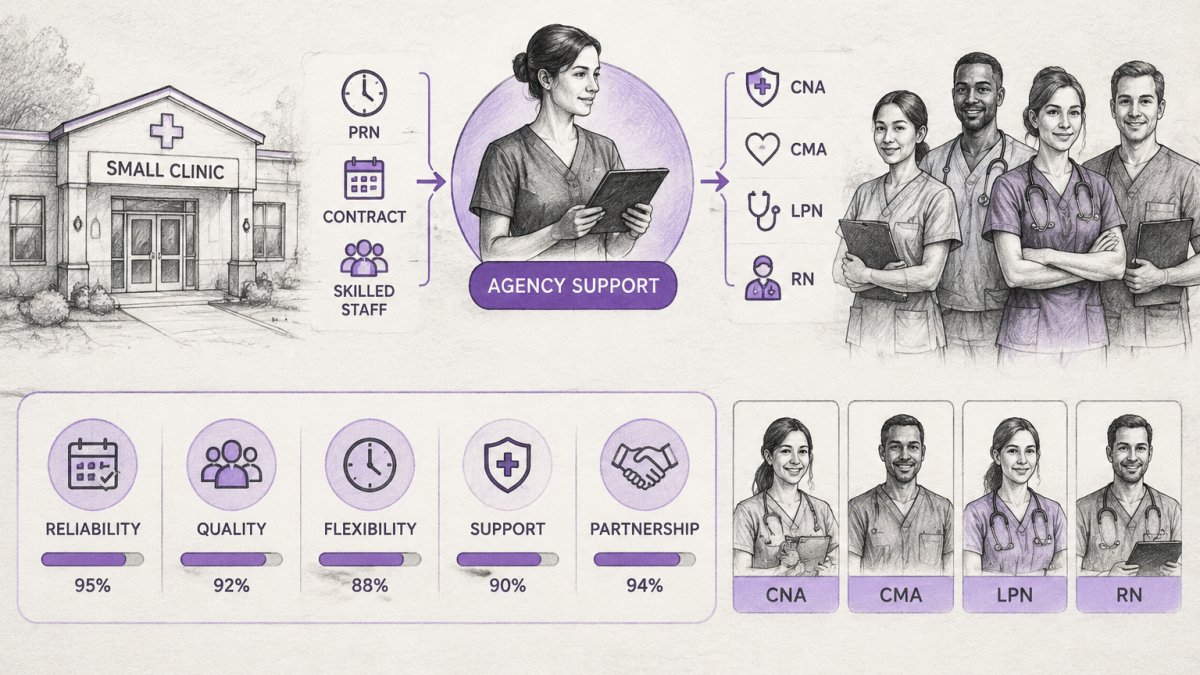
Small clinics carry big staffing risk. One call-out can stretch a whole team thin, and there is rarely a deep bench to absorb it.
Agency support fills that gap without adding permanent overhead. The National Association of Community Health Centers notes that community health centers serve millions of patients with limited resources, which makes flexible staffing a practical necessity rather than a luxury. Per diem and contract nurses can cover a leave, a surge, or a hard-to-fill night shift.
The right partner also protects quality. Reliable, skilled staff keep care consistent, and that matters for patient trust.
Build a Healthcare Staffing Agency Evaluation Checklist
A healthcare staffing agency evaluation checklist is a written set of criteria you score every candidate against, so the decision rests on evidence instead of a sales pitch. Build it once, then reuse it every time you review providers. The version below is written for a small clinic, which means it weights the things a thin administrative team actually feels: fill reliability, a single accountable contact, and paperwork that does not land on your desk.
Most generic checklists stop at "do they verify licenses." A clinic-specific checklist goes further and separates what an agency promises from what it can document. For each criterion, ask for the artifact, not the assurance.
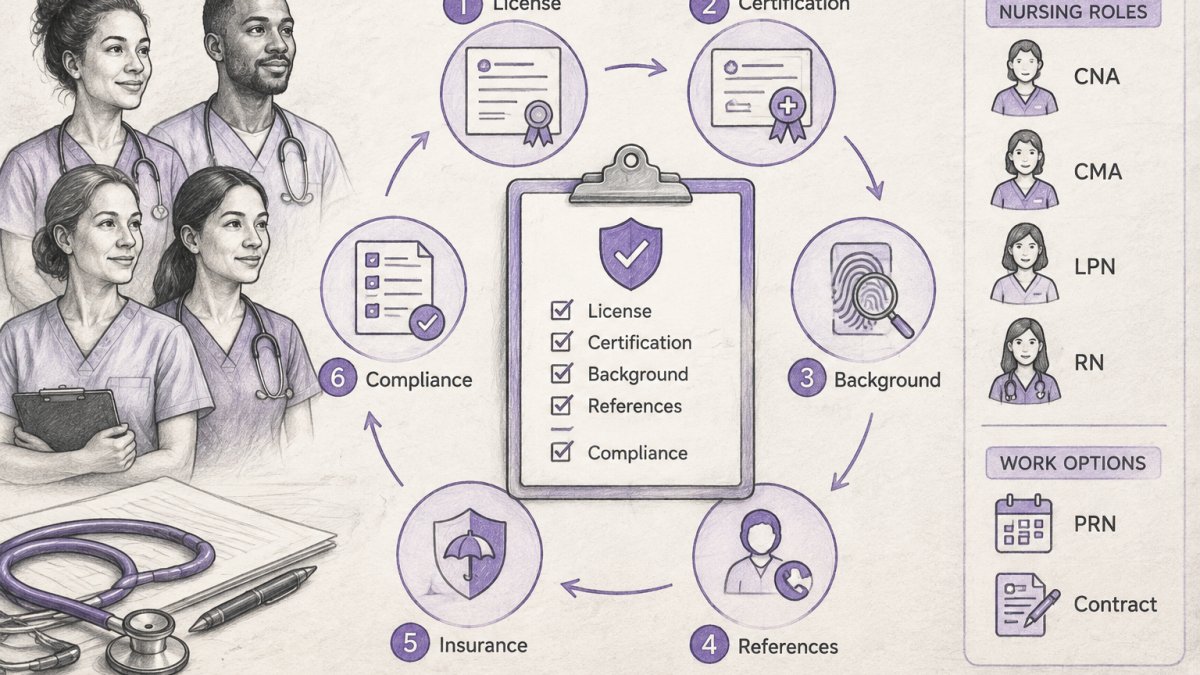
- Licensure and credential verification: Ask to see the verification workflow, not just a policy statement. Who runs the primary-source check, how often are expirables re-verified, and what happens when a license lapses mid-assignment?
- Coverage range and fill speed: Which of your roles, CNA, CMA, LPN, RN, can the agency actually fill, and what is its typical time from request to confirmed shift? Ask for a recent example, not an average.
- Communication and escalation: Who is your named contact, who is the backup, and who answers after hours? A clinic with one office manager cannot absorb a voicemail loop.
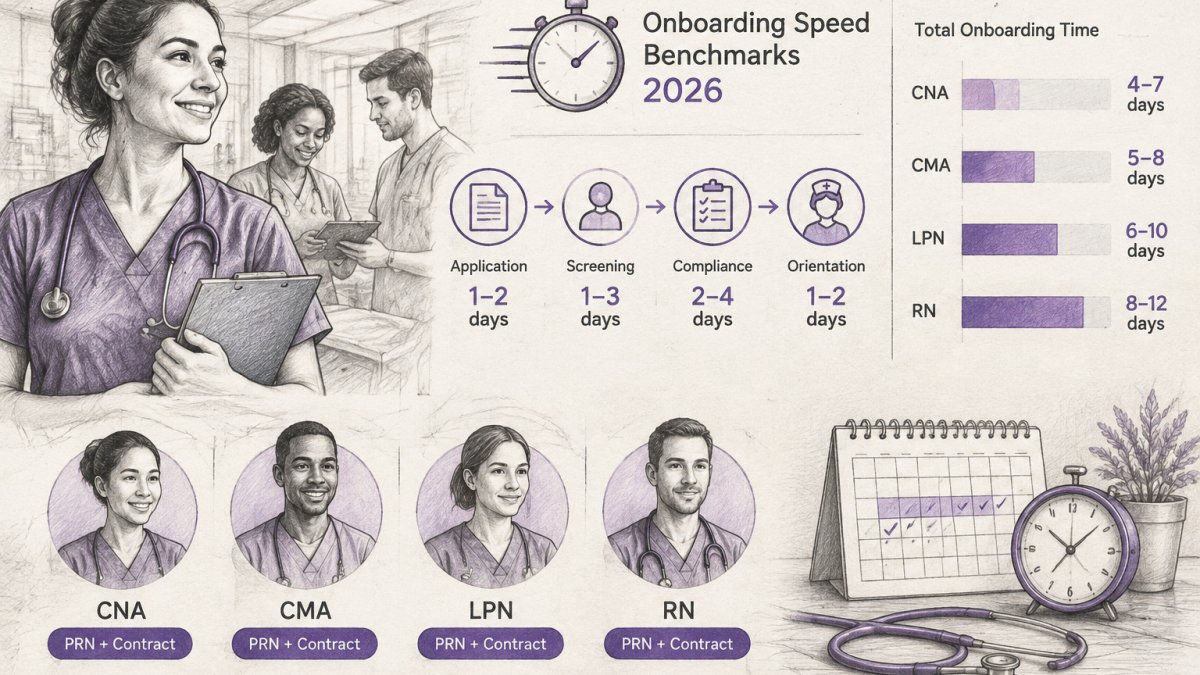
- Onboarding fit: How does the agency orient staff to your policies, documentation system, and resident-care expectations before the first shift? Orientation time is a real cost to a small team.
- Compliance and risk: How are background checks, required training, immunization records, and incident reporting handled, and who owns each step?
- Cost clarity: How are rates, fees, and any pass-through charges explained up front, and what triggers a rate change mid-assignment?
- Contract and scope terms: What is the cancellation notice on both sides, what are the service-level expectations, who owns the scheduling data, and how are disputes escalated?
- Retention and continuity: Do the same nurses come back to your facility, or is every shift a new face? Continuity matters more in long-term care and assisted living, where residents notice who is in the room.
Two criteria deserve extra weight for a small clinic. First, administrative load: every hour your staff spends chasing credentials or correcting timesheets is an hour off the floor. Second, flexibility: a clinic with seasonal surges and a shallow bench needs an agency that can scale requests up and down without renegotiating the relationship each time.
Watch out: a checklist that scores only price will push you toward the cheapest provider and then cost you more in rework, orientation time, and turnover, score cost transparency and fill reliability alongside it.
If cost is part of your comparison, our guide on how to estimate what a nurse staffing agency costs walks through what to ask before you commit.
Questions to Ask a Nursing Staffing Agency Before You Sign
The best questions to ask a nursing staffing agency before you sign are the ones that reveal how it behaves when something goes wrong. Anyone can promise coverage. You want proof of follow-through.
Ask directly:
- How do you verify licenses and credentials?
- What happens when a confirmed nurse cancels?
- Who is our point of contact after hours?
- How quickly can you place someone for an urgent gap?
- Can you share how you handle complaints?
Listen for specific answers, not slogans. A provider that cannot describe its own process in plain terms likely does not have one.
Set Staffing Agency Communication Expectations Up Front
Put staffing agency communication expectations in writing before the first shift. This one step prevents most of the friction that sours agency relationships.
Agree on the basics:
- A named contact and a backup
- How shift requests are submitted
- A response window for urgent needs
- How cancellations and changes get reported
Clear rules cut the back-and-forth that drains a stretched HR team. For a deeper look at what works, see our guidance on nursing agency communication best practices.
Score and Compare Agencies With a Weighted Scorecard
A weighted scorecard turns a messy comparison into a number you can defend. Give each criterion a weight based on what matters most to your clinic, then score every agency from 1 to 5.
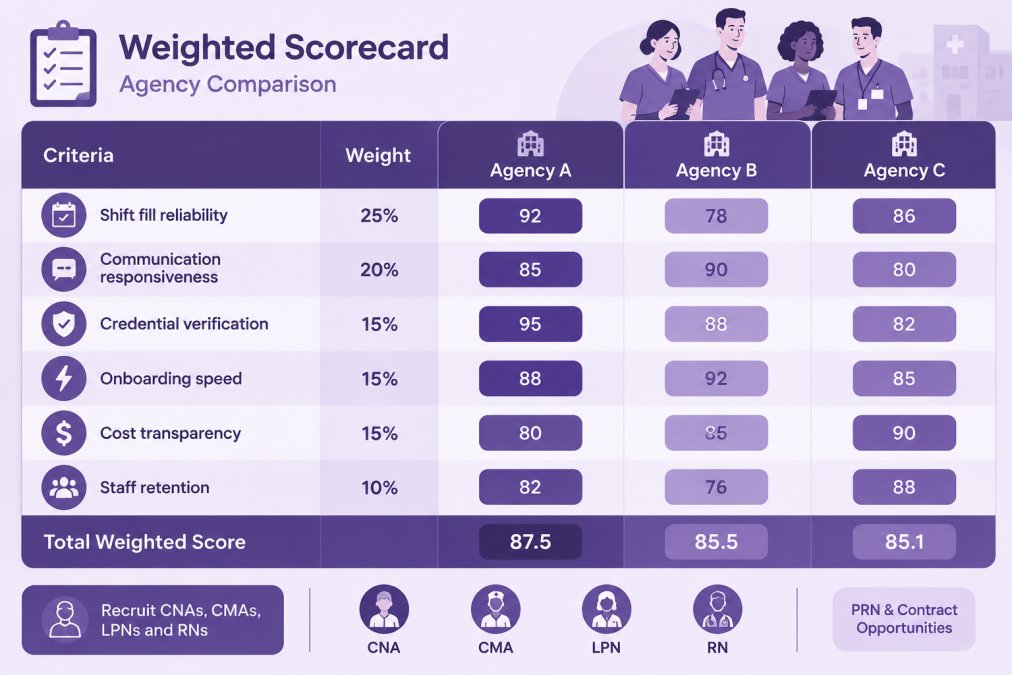
| Criterion | Weight | What a 5 Looks Like |
|---|---|---|
| Shift fill reliability | 25% | Fills nearly every request |
| Communication responsiveness | 20% | Answers within the agreed window |
| Credential verification | 15% | Documented, repeatable process |
| Onboarding speed | 15% | Staff ready without delay |
| Cost transparency | 15% | Clear rates, no surprises |
| Staff retention | 10% | Nurses return to your shifts |
Weight
Multiply each score by its weight, then add the totals. The highest number wins, and you can show your leadership exactly why. If the review points to a change, our article on how to switch nursing staffing agencies without losing shifts covers how to move without a coverage gap.
Monitor Agency Performance After the Contract Starts
Signing the contract is the starting line, not the finish. What happens after onboarding matters: a small clinic benefits from a short, repeatable review loop so small problems get fixed before they become coverage failures. Build that loop once and run it on a fixed cadence.
Pick a small set of measures. You do not need a dashboard. Five measures, tracked the same way every month, will tell you more than a dozen inconsistent ones:
- Fill rate: confirmed shifts divided by requested shifts, tracked separately for each role and for urgent versus planned requests.
- Time to confirm: how long from request to a confirmed name, with urgent requests reported separately.
- Cancellations and no-shows: count them and note who initiated, the agency, the worker, or your clinic.
- Credential issues caught at onboarding: each one is a near-miss worth reviewing.
- Charge-nurse feedback: a two-question check after each shift, was the worker prepared, and would you request them again?
Set a review cadence. A 20-minute monthly call with your named agency contact is enough for most small clinics, with a longer quarterly review to look at trends. Bring the numbers, not impressions. A pattern of late confirmations in one role is a staffing-planning signal; a cluster of cancellations from one worker is a fit signal.
Close the loop with a corrective-action step. When a measure slips, agree in writing on what changes, who owns it, and when you will check again. A named owner and a review date tend to resolve issues more effectively than a general request to "do better." If the same issue recurs across two review cycles, escalate to the agency's leadership and document it, that record is what makes a renewal decision defensible.
Keep the feedback two-way. Tell the agency what is working, not only what is not. Charge nurses who flag a strong worker help the agency place that person with you again, which improves continuity in long-term care and assisted living settings where residents recognize familiar faces.
Watch out: reviewing performance only when something goes wrong turns the relationship adversarial, a standing monthly review keeps the conversation routine and the data honest.
Our guide to best practices for nursing agency partnerships explains how to keep that partnership strong over time.
Request a Coverage Plan From Major Staffing
A coverage plan is a written outline of how a staffing agency will meet your clinic's needs, and it is the clearest test of whether a provider listened. At Major Staffing, we build one around your actual gaps, not a generic package.
As a nurse-led agency, we focus on dependable care, resident dignity, and clear communication. Our team supports last-minute shift coverage and long-term placements. Availability depends on current facility needs.
Bring your needs assessment and checklist to the conversation. Ask us the hard questions. A good partner will answer them.
Staffing gaps will not wait for a perfect plan. If your clinic needs dependable coverage and a team that answers the phone, Major Staffing can help. Our nurse-led approach pairs flexible per diem and contract placements with straightforward communication, and we build every coverage plan around your real needs. Get started with Major Staffing and put a reliable staffing partner behind your care team.
Frequently Asked Questions
What should a small clinic look for in a staffing agency?
Look for verified credentials, a clear fill-rate track record, and responsive communication. Ask how the agency handles last-minute call-offs and whether it provides a named contact. Confirm it serves facilities your size. A strong agency support partner will also explain its onboarding timeline and provide references from similar clinics. Use a healthcare staffing agency evaluation checklist so every candidate is judged on the same criteria.
How can a clinic evaluate the quality of agency support?
Track a few concrete measures: how often shifts are filled, how quickly the agency responds to requests, and how many placements complete their assignment. Review credential files for completeness. Survey your charge nurses quarterly about the clinical performance of agency staff. Compare results against the staffing agency communication expectations you set at contract signing. A simple scorecard with weighted criteria keeps the review objective.
What questions should a clinic ask a staffing agency before partnering?
Ask how the agency verifies licenses and certifications, what its average response time is, and how it handles no-shows. Request references from small clinics or rural facilities. Ask who your day-to-day contact will be and how after-hours requests are handled. Clarify contract terms, cancellation policies, and how performance is reported. These questions to ask a nursing staffing agency reveal whether the partnership will actually reduce your administrative load.
How can a small clinic assess whether an agency is reliable?
Start with a trial period of several shifts and measure fill rate, punctuality, and credential completeness. Ask for references and call them. Check that the agency confirms shifts in writing and has a backup plan for call-offs. Reliable agency support shows up in the data: consistent fills, complete files, and clear communication. Review results at 30 and 90 days before committing to a longer contract.