 How-to
How Do You Build a Nurse Staffing Plan for Small Facilities?
Last Updated: November 15, 2026
Quick Summary
Build a nurse staffing plan for small facilities by starting with three numbers: resident census, acuity, and required care hours. Then map each shift's required staff mix against scheduled names, and fill the remaining gaps with a written call-out ladder and PRN or agency coverage.
- Small facilities plan shift by shift because they have no float pool, in-house scheduler, or cushion for call-outs.
- Hours per resident day equals total direct care hours divided by total resident days.
- Build your coverage plan around five columns: shift, required mix, scheduled staff, gap, and coverage source.
- Protect the RN role first, since an uncovered RN is a compliance problem, not just a scheduling inconvenience.
- Set a census trigger number where you add a shift, and approve it automatically when census crosses it.
Table of Contents
- Why Nurse Staffing for Small Facilities Is a Different Job
- How to Assess Your Staffing Needs Before You Build Anything
- What Nursing Home Staffing Requirements Actually Demand of You
- Building Your Nurse Staffing Plan Template
- When to Use Last-Minute Nurse Shift Coverage (and When Not To)
- Choosing a Nurse Staffing Agency for Small Facilities
- Contingency Planning for Call-Outs and Census Swings
- What to Bring to Your First Conversation With Major Staffing
- Frequently Asked Questions
Why Nurse Staffing for Small Facilities Is a Different Job
Nurse staffing for small facilities means covering every shift in a building with no float pool, no in-house scheduler, and no cushion when someone calls out. A 40-bed nursing home and a 400-bed hospital follow the same rules but not the same reality.
Small facilities plan staffing shift by shift, and that is the work we are built around.
The Constraints That Shape Every Small-Facility Plan
Small buildings run on thin margins. One call-out can pull a nurse aide off the floor and into a role they were not hired for.
The constraints are always the same:
- A small staff roster, so one absence is a real gap
- Limited budget control, with little room for overtime
- A fixed bed count that cannot flex to absorb a bad night
Your plan has to work with the people you have, not the people a spreadsheet wishes you had.
How to Assess Your Staffing Needs Before You Build Anything
Start with three numbers: resident census, acuity, and required care hours. Every staffing decision flows from those three.
Census tells you how many people need care tonight. Acuity tells you how much care each one needs. Required care hours tell you the floor you cannot drop below.
Start With Census, Acuity, and Required Care Hours
Write down your current census. Then sort residents into rough groups: low, medium, and high need.
A resident who needs help with mobility and meals is not the same workload as one who needs close monitoring.
Next, list the direct care hours each shift needs. Compare that to the hours you actually schedule.
A common mistake is planning around last month's census.
What Nursing Home Staffing Requirements Actually Demand of You
Federal rules set a baseline, and state rules can add to it. The requirements cover the staffing mix, the care hours, and the documentation that proves you met them.
For nursing homes that take Medicare and Medicaid, the federal nursing home requirements from the Centers for Medicare & Medicaid Services set the framework facilities are surveyed against.
The Three Numbers Surveyors Actually Look At
Most nursing-home staffing standards come down to three measurements. Learn them, because they drive your schedule and your survey record.
- Hours per resident day (HPRD). Total direct care hours divided by total resident days. A 40-bed building with 30 residents and 90 direct care hours in a day is running 3.0 HPRD. The same 90 hours across 40 residents is 2.25 HPRD. Census moves the number, which is why a plan built around last month's census can fail a survey this month.
- Staffing mix. The rule usually specifies which roles must be present and when, for example, an RN on duty for a defined portion of the day, licensed nursing coverage around the clock, and nurse aides providing the bulk of direct care. A schedule that hits the total hours but misses the required role still fails.
- Facility-wide and shift-specific minimums. Some standards apply across the whole day; others apply per shift. A building can look compliant on a daily average and still be short on the night shift.
A common pattern in small facilities is to track total hours and stop there. That is the gap surveyors find first.
How to Verify What Applies to Your Building
Do not assume the federal rule is the whole rule. Work through this in order:
- Confirm which federal requirements apply based on your participation in Medicare and Medicaid.
- Pull your state health department's current licensing and staffing regulations for your facility type. Nursing homes, assisted living, and rural hospitals are governed differently, and assisted living in particular varies widely by state.
- Check whether your state publishes a required HPRD, a required staff mix, or both, and whether either changes by shift or by day of week.
- Write down the specific citation for each requirement you must meet, and keep that list with your staffing plan.
- Re-check the list at least annually and whenever your state updates its rules.
The Documentation That Survives a Survey
Compliance is not just a number on a form.
Keep these records current and easy to produce:
- Daily census and resident acuity notes
- Actual hours worked by role, by shift
- The schedule as posted, plus every change made after posting
Watch out: building a schedule that only looks right on the day of inspection. Staffing data is reviewed over time, and gaps show up in the record.
The Medicare.gov Care Compare tool lets you see how staffing data is reported and compared. It is worth checking how your building looks before a surveyor does.
Where Small Facilities Get Caught
The most common failures are not dramatic. They are small and repeatable:
- Meeting total hours but missing the required RN coverage on a shift
- Scheduling to the minimum with no buffer, so one call-out drops the building below the line
- Letting the posted schedule and the actual hours worked drift apart
Your staffing plan has to do two things at once: meet the required staffing levels on paper, and match the care hours to what residents actually need. When those two line up, the survey record takes care of itself.
Building Your Nurse Staffing Plan Template
A good nurse staffing plan template is one page you can read at 6 a.m. If it takes more than a minute to understand, it will not get used.
The Five Columns Every Coverage Plan Needs
Build your plan around five columns. One row per shift.
| Column | What It Holds | Example |
|---|---|---|
| Shift | Day, evening, or night | Night, 11p-7a |
| Required mix | Roles and count needed | 1 RN, 1 LPN, 2 CNAs |
| Scheduled staff | Names assigned | J. Ruiz, T. Cole, M. Vance |
| Gap | Uncovered roles | 1 CNA open |
| Coverage source | How the gap gets filled | PRN call, agency, shift swap |
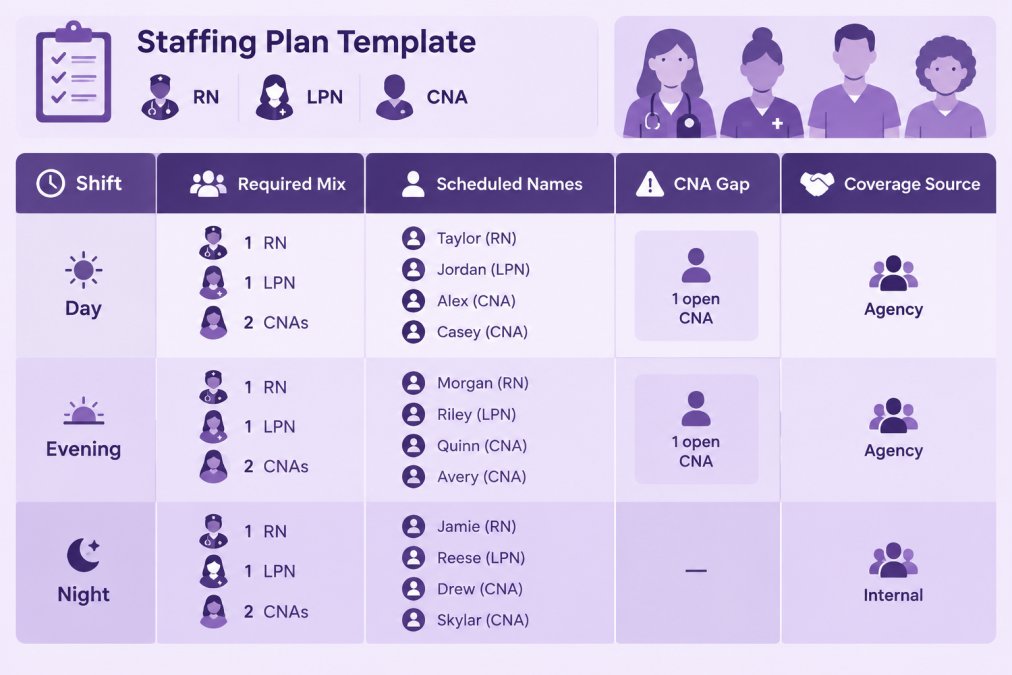
Fill in the required mix first. Then add names. Whatever is left is your gap, and the gap is what you solve.
Keep the template in the same place every week. A plan that lives in three different files is a plan nobody trusts.
When to Use Last-Minute Nurse Shift Coverage (and When Not To)
Last-minute nurse shift coverage is the right call when a real gap appears and no internal option exists.
Use it when:
- A call-out lands with no time to find a swap
- Census jumps and the care hours no longer match
- A required role, such as the RN, is uncovered
Do not use it to paper over a schedule that is short every single week. That is not a coverage problem.
A guide to per diem nursing and how agencies fill urgent gaps explains the model well: per diem staff fill specific shifts, not permanent roles.
Choosing a Nurse Staffing Agency for Small Facilities
The right nurse staffing agency for small facilities answers the phone at 6 a.m. and knows your building by name. That is the test.
Ask three questions before you sign anything:
- Do you work with buildings our size?
- How fast can you fill a shift, and who do we call?
- What happens when a nurse cancels on you?
If the answers are vague, keep looking. You can read more on how to evaluate agency support for small clinics before you start those calls.
Cost matters too, and it is fair to ask how it works. Our guide on how to estimate what a nurse staffing agency costs walks through what drives the number, so you can compare fairly.
At Major Staffing, we are nurse-led. We understand why one open CNA shift matters more than it looks on paper.
Contingency Planning for Call-Outs and Census Swings
Every small facility needs a written answer to one question: what do we do when someone calls out at 5 a.m.? The buildings that handle call-outs well planned for them on a quiet Tuesday.
Build the plan before you need it. It should name the order of calls, the person who makes them, and the point where you bring in outside coverage.
The Call-Out Ladder, With Triggers
A simple ladder works, but only if each step has a trigger and an owner.
- Voluntary swap on the unit. Trigger: any call-out received with more than a few hours' notice. Owner: charge nurse.
- On-call list, in order. Trigger: no swap within the first hour. Owner: charge nurse or designated scheduler.
- Assignment adjustment to protect the highest-need residents. Trigger: gap still open two hours before shift start. Owner: charge nurse, with DON notified.
- Agency contact. Trigger: gap open at the two-hour mark, or any uncovered RN role. Owner: DON or administrator.
Two rules make the ladder work. First, protect the RN role before anything else, an uncovered RN is not a scheduling inconvenience, it is a compliance problem. Second, name the person who makes the calls in advance, so nobody stands in the hallway at 5 a.m. deciding who to phone.
Watch out: a ladder that only exists in one person's head. If the charge nurse is the one who called out, the plan has to work without them.
Protecting Care When You Are Short
When the gap cannot be filled, the shift still has to run. Decide in advance how you will adjust:
- Group residents by need and assign the most experienced aide to the highest-acuity group
- Defer non-urgent tasks, routine documentation, supply restocking, non-clinical rounds, to the next shift
- Move a licensed nurse to direct care only if it does not leave a required role uncovered
Documenting the adjustment matters. A surveyor who sees a short shift with a written plan and a documented rationale reads it differently than one who sees an unexplained gap.
Census Swings Need a Trigger Number Too
Census swings are the quieter version of the same problem. Know your trigger point, the census number where you add a shift, and who approves it.
Set the trigger by working backward from your required HPRD.
The same logic works in reverse. When census drops, decide in advance which shift gets reduced first and which roles are never cut.
Seasonal and Predictable Demand
Some swings are not surprises. Flu season, holiday admissions, and summer discharge patterns repeat every year. Pull your census and call-out data from the same month last year and look for the pattern.
For a wider set of tactics, see strategies for managing nursing staff shortages. The point is not to predict every absence. It is to make sure the first hour of a short shift is spent on care, not on deciding what to do.
What to Bring to Your First Conversation With Major Staffing
Come with your census, your current schedule, and your open shifts.
Bring these:
- Current census and acuity mix
- Your shift schedule for the next two weeks
- The roles you struggle to cover most
We will ask about your building, your residents, and how you like to communicate.
Good partnerships are built on clear expectations. These best practices for nursing agency partnerships are a useful read before we talk.
We will give you a straight answer about what we can cover and when.
Your building does not need a bigger roster. It needs a plan that holds when one person calls out.
Frequently Asked Questions
What is the minimum requirement for RN staffing in nursing facilities?
Federal rules require a licensed nurse on duty at all times and an RN on duty at least eight consecutive hours a day, seven days a week in Medicare- and Medicaid-certified nursing homes. Beyond that floor, the right level depends on your resident census, acuity, and what your state adds on top. Small facilities should document how they set daily staffing and keep that reasoning on file, because surveyors ask for it during inspections.
How can a small facility create a safe nurse staffing plan?
Start with census and acuity, convert them into required care hours per role, then map those hours against the shifts you actually cover. Build in a buffer for call-outs and admissions, and name a backup source for each shift before you need it. Review the plan monthly against actual hours worked. A written nurse staffing plan template keeps the numbers visible so gaps show up before they become a 6 AM scramble.
What should a small facility look for in a nurse staffing agency?
Look for a partner that confirms shift commitments, communicates in writing, and knows your building before the first shift. Ask how they verify licenses, how quickly they can respond to a last-minute request, and who your single point of contact is. A nurse staffing agency for small facilities should also be comfortable with your size, since a 40-bed building has different coverage math than a hospital system.
What information should a facility provide when requesting nurse coverage?
Give the agency the shift date and hours, the role and license needed, the unit or hall assignment, any behavioral or clinical considerations, and who will orient the arriving nurse. Confirm the point of contact for the shift and the check-in process. Complete details up front cut the back-and-forth and get a qualified nurse on the floor faster, especially for last-minute nurse shift coverage.