 How-to
Nursing Recruitment Tips for Assisted Living: What Works
Last Updated: November 14, 2026
Quick Summary
Effective nursing recruitment for assisted living starts with a specific job description, sourcing by license type, and fast, clear hiring decisions. Facilities also need to track their funnel and benchmark total pay, since hospitals compete for the same licensed nurses.
- Write job postings that describe the actual daily shift, the license required, and the resident population served.
- Split sourcing by role: nursing schools and referrals suit RNs and LPNs, while community channels often fill CNA roles faster.
- Track time-to-fill, cost-per-hire, offer acceptance and 90-day retention to find where the funnel breaks down.
- Compare total compensation, including differentials, benefits and paid time off, not just the hourly wage.
- Respond to every candidate inquiry within one business day, because slow replies lose nurses to faster employers.
Table of Contents
- Why Nursing Recruitment Is Hard in Assisted Living
- Writing an Assisted Living Nurse Job Description That Attracts Qualified Candidates
- Sourcing Nurses: Schools, Referrals, Job Boards and Social Media
- Interview Questions That Reveal Clinical Judgment and Fit
- Nurse Onboarding Checklist for the First 90 Days
- Measuring Your Recruitment Funnel and Compensation Position
- Scheduling, Workload and Support as Retention Tools
- Start Filling Your Next Assisted Living Nursing Shift With Major Staffing
- Frequently Asked Questions
Why Nursing Recruitment Is Hard in Assisted Living
Recruiting nurses for assisted living is harder than it looks. Facilities compete with hospitals, home health agencies and other care settings for the same licensed professionals. Shifts can be unpredictable, and residents need steady, familiar faces.
Most facilities feel the pressure most during call-outs and weekend gaps. When a shift goes unfilled, staff end up working extra hours, and that wears people down fast.
Knowing where the friction comes from is the first step. Common problems include:
- Job postings that sound generic and attract few qualified applicants
- Slow hiring decisions that lose good candidates to other employers
- Unclear schedules that make nurses hesitant to commit
- High workloads that push experienced nurses to leave
Writing an Assisted Living Nurse Job Description That Attracts Qualified Candidates
A strong nurse job description tells candidates exactly what the work looks like day to day. Start with the license required, whether that is an RN or LPN, and state any experience you need.
Next, describe the resident population and the care setting. Nurses want to know if they will handle medication passes, wound checks or family communication.
Include the details that matter most to nurses:
- Shift lengths and scheduling options
- Supervision structure and who they report to
- Training and orientation support
- Pay information you can verify and share
Avoid vague phrases like "fast-paced environment." Instead, describe what a typical shift involves. Specific language helps the right nurses self-select.
Sourcing Nurses: Schools, Referrals, Job Boards and Social Media
No single channel fills every assisted living opening, and the mix that works for an RN charge nurse is not the mix that works for a PRN CNA. Learn how per diem agencies can fill gaps quickly when recruiting alone falls short. Build a source plan for nursing recruitment by role, then measure which channel actually produces hires who stay past 90 days.
Split your sourcing by license type. RN and LPN openings usually reward targeted outreach: local nursing school career services, professional nursing associations, and referrals from your current licensed staff. CNA and CMA openings tend to fill faster through community channels, walk-in interest, and job boards with strong mobile apply flows. Treating all four roles as one pipeline is the most common reason assisted living postings sit open.
Nursing schools and clinical partnerships. Reach career services offices at community colleges and practical nursing programs before graduation season, not after. Ask about clinical placement rotations at your facility, which give students a low-risk look at assisted living and give you a warm pool of candidates who already know the building. Keep a simple contact list of program coordinators and follow up each term.
Employee referrals with a clear process. Current CNAs and nurses know who is reliable and who communicates well. Make referring easy: a short form, a named contact, and a thank-you that follows your facility's policy. Track referral hires separately so you can see whether they outperform other sources on retention.
Job boards and social media. Post with a specific title (for example, "LPN, Assisted Living, Evening Shift"), the license required, and the setting. On social channels, share short updates about the team and the resident community rather than generic hiring graphics. Respond to every inquiry within one business day; slow replies lose candidates to hospitals that move faster.
Build a small candidate pool before you need it. Keep a list of past applicants, former staff in good standing, and PRN nurses who have worked your building. When a call-out hits, a warm list beats a fresh posting.
Watch out: sourcing through a single job board and stopping there leaves you competing on price alone, which assisted living rarely wins against hospitals.
Interview Questions That Reveal Clinical Judgment and Fit
Interviews should test how a nurse thinks, not just what they have memorized. Ask scenario-based questions that reflect real situations on the floor.
Useful questions include:
- "A resident's blood pressure drops during your shift. What do you do first?"
- "Tell me about a time you disagreed with a coworker about resident care."
- "How do you prioritize tasks when two residents need help at once?"
- "What does good communication with families look like to you?"
Listen for clear reasoning, patient-centered answers and a willingness to ask for help. These traits matter more than polished responses.
Nurse Onboarding Checklist for the First 90 Days
A structured onboarding plan helps new nurses feel confident quickly. Use this checklist to guide the first three months:
- Complete facility orientation and safety training in week one
- Review resident care plans and documentation systems
- Shadow an experienced nurse for at least three shifts
- Schedule a check-in at day 30 to discuss questions and concerns
- Review performance goals and feedback at day 60
- Hold a 90-day review to confirm fit and next steps
Assign one consistent point of contact for questions. New nurses who know who to ask stay longer and perform better.
Measuring Your Recruitment Funnel and Compensation Position
Most assisted living operators track applications and stop there. A working recruitment dashboard follows each candidate from first touch to the 90-day mark, and pairs those numbers with a realistic read on total compensation. That combination is what lets you fix the right problem instead of guessing.
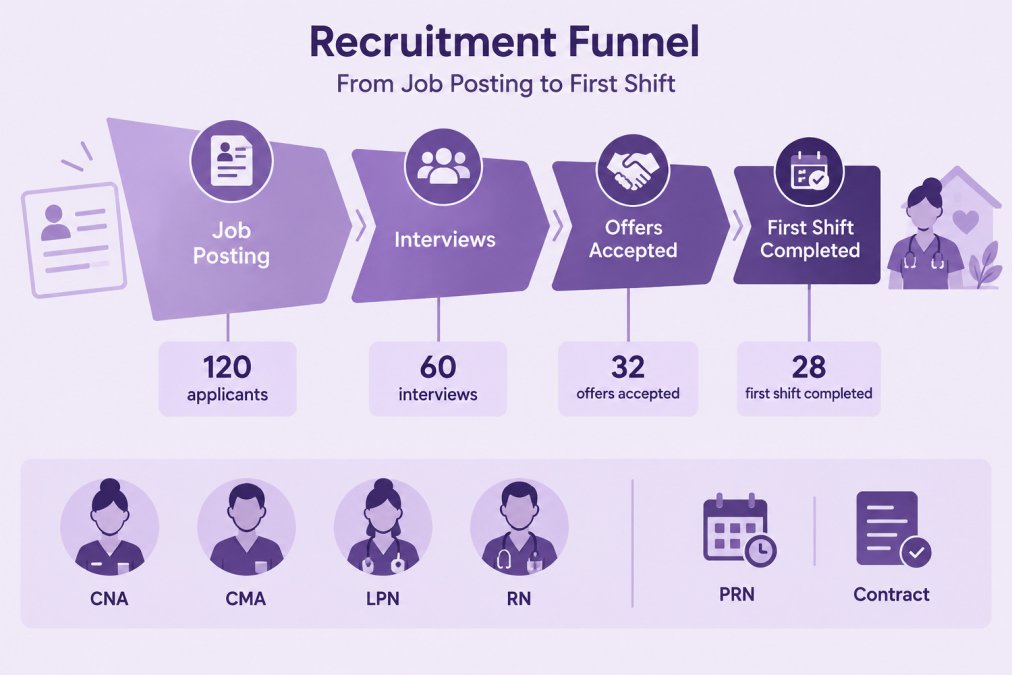
The five numbers to track. Keep a simple spreadsheet or your applicant tracking system set up to report:
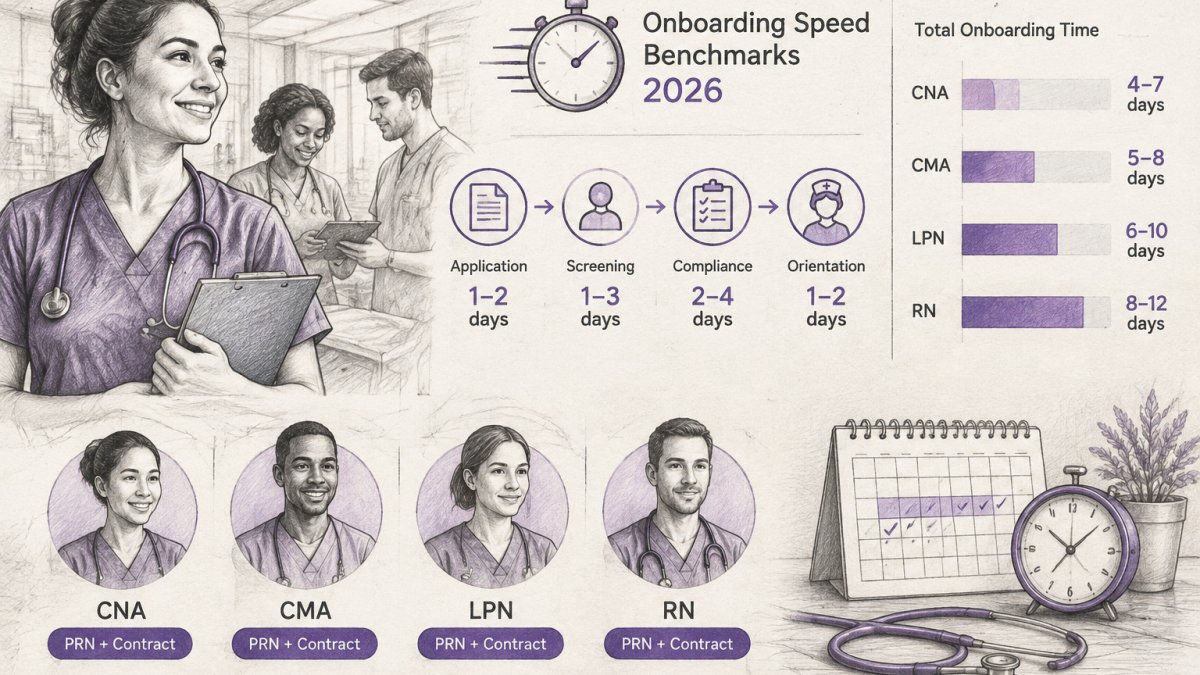
- Time-to-fill: days from posting to accepted offer, by role. RN and LPN openings usually take longer than CNA roles; track them separately.
- Cost-per-hire: total recruiting spend divided by hires in the period. Include job board fees, referral thank-yous per your policy, and staff time where you can estimate it.
- Application completion rate: started applications divided by submitted ones. A low rate often means a long or mobile-unfriendly form.
- Offer acceptance rate: offers accepted divided by offers made. A falling rate points to pay, schedule, or slow decisions.
- 90-day retention: new hires still on the schedule at 90 days divided by hires. This is the number that tells you whether sourcing and onboarding actually worked.
Read the drop-off, not just the totals. A large gap between interview and offer usually means slow decisions or uncompetitive pay. A large gap between offer and start date often means the candidate took a faster or clearer offer elsewhere. A large gap at 90 days points back to onboarding, workload, or scheduling.
Benchmark total compensation, not just hourly wage. Hospitals and other senior-care employers compete for the same nurses, so compare the whole package: base rate by shift, shift and weekend differentials, overtime rules, paid time off, health coverage, retirement match, and any continuing education support. Pull local wage data from public sources, and compare against nearby hospitals, home health agencies, and other assisted living communities. For a closer look at the numbers, read how nurse staffing agency costs are estimated. Where you cannot match base pay, be honest about what you do offer, predictable scheduling, a consistent assignment, or clinical support, and make sure the job posting says so.
Review the dashboard monthly. Look for one metric to improve each month rather than trying to fix everything at once. Small, steady gains in offer acceptance and 90-day retention compound faster than a single hiring push.
Watch out: comparing only hourly rates against a hospital down the road can make your offer look worse than it is, or better than it is, once differentials and benefits are counted.
Scheduling, Workload and Support as Retention Tools
Nurses who feel overworked leave, even when they like their residents. Our guide on reducing nurse burnout in facilities offers practical steps for workload and scheduling. Schedule shifts with reasonable patient loads and predictable patterns. Where possible, let staff request time off and swap shifts through a clear process.
Support matters too. Make sure nurses have access to supervisors, supplies and the clinical help they need during busy shifts. Regular recognition and fair feedback show that the facility values their work.
Start Filling Your Next Assisted Living Nursing Shift With Major Staffing
Finding dependable nurses takes time, and gaps can't always wait. See how long-term nursing placement services keep ongoing coverage steady. Major Staffing is a nurse-led agency that helps facilities fill last-minute shifts and longer-term placements with skilled nursing professionals. We focus on partnership and clear communication.
Reach out to Major Staffing to talk through your current needs and learn about current opportunities at https://majorstaffingsolutions.com/. You can also hire skilled nursing professionals for shifts directly through our team. For current pricing, contact Major Staffing for a quote.
Frequently Asked Questions
What should an assisted living nurse job description include?
A useful assisted living nurse job description states the license required (RN or LPN), the specific resident population and care setting, the core duties such as medication administration, assessments and care plan updates, and the shift options available. It should also name the supervisor, the required certifications, and the physical demands of the role. Be specific about what the facility offers and avoid vague phrases like fast-paced environment. Candidates who see clear expectations are more likely to apply and stay after they start.
What are some effective strategies for recruiting nurses for assisted living?
Combine several channels rather than relying on one job board. Ask current nurses for referrals, build relationships with local nursing programs for clinical placements and new graduate outreach, and post on both general and healthcare-specific boards. Keep your application short, respond to applicants within a day, and make the interview process quick. Many candidates accept the first offer they receive, so speed matters as much as reach.
What are some common interview questions for assisted living nursing positions?
Ask scenario-based questions such as how a nurse would handle a resident who declines medication, or how they would document a change in condition for a resident with dementia. Also ask how they prioritize tasks during a short-staffed shift and how they communicate with aides and families. Behavioral questions about past teamwork and conflict resolution reveal fit. Score answers against a consistent rubric so decisions are based on the same criteria for every candidate.
How can assisted living facilities improve nurse retention?
Retention usually depends on predictable schedules, reasonable workloads, and access to clinical support when a nurse has questions. Give new nurses a named preceptor for their first weeks, hold brief regular check-ins, and ask for feedback on scheduling and staffing levels. Nurses who feel supported and see their concerns acted on are more likely to stay past their first year.