 How-to
How to Switch Nursing Staffing Agencies Without Losing Shifts
Last Updated: October 28, 2026
Quick Summary
To switch nursing staffing agencies without losing shifts, read your contract for notice periods, exclusivity, and buyout clauses, then line up onboarding with the new agency before you resign. Give written notice, finish your scheduled shifts, and transfer your credentials without a gap.
- Never resign before confirming your new agency can actually onboard you.
- Ask your new recruiter in writing how they handle facility submission conflicts.
- Follow the exit order: confirm end date, onboard, give notice, finish shifts.
- Request agency-held records in writing and follow up after one week.
- Give notice in writing, keep a copy, and never resign verbally only.
Table of Contents
- Why Nurses Switch Staffing Agencies (and When It's Worth It)
- Review Your Nursing Agency Contract Terms Before You Move
- How to Handle Switching Nursing Agencies Mid Contract
- Write a Nursing Agency Resignation Letter That Protects You
- Questions to Ask a Nursing Staffing Agency Before You Sign
- Transfer Your Credentials and Onboarding Without a Gap
- Apply to Major Staffing and Pick Up Your First Shift
- Frequently Asked Questions
Why Nurses Switch Staffing Agencies (and When It's Worth It)
Most nurses don't leave a staffing agency because of one bad shift. They leave because the communication dried up, the recruiter stopped calling back, or the schedule stopped matching what was promised. If that sounds familiar, you already know the feeling of waiting on a text that never comes while a facility down the road is short-staffed.
Making the switch nursing staffing agencies mid contract is a real decision, not a dramatic one. At Major Staffing, we're a nurse-led agency. The nurses who move well are the ones who plan the exit before they announce it.
Here's the honest truth: a switch is worth it when your current agency can't give you steady shift pickup, clear answers, or a recruiter who treats you like a person. It's not worth it if you're chasing a rumor about better pay you haven't confirmed.
Below, we'll walk through the contract terms to check, the letter to write, the questions to ask, and how to move your credentials.
When a switch makes sense:
- Your recruiter stops responding to calls or texts
- Shift availability no longer fits your calendar
- You want more say in work location or facility type
- Onboarding and credential support feel disorganized
- You're ready for PRN flexibility instead of a fixed rotation
Watch out: never resign before you've read your current agreement and confirmed your new agency can actually onboard you. A gap in credentials means a gap in shifts.
Review Your Nursing Agency Contract Terms Before You Move
The first step in any plan to switch nursing staffing is reading the agreement you already signed. Most nurses skim it during onboarding and never open it again. That document decides how clean your exit will be, and in most cases, the agency is not going to remind you what it says.
Pull out your contract and look for four things: notice periods, exclusivity language, buyout clauses, and the section on assignment cancellation. If you can't find your copy, ask your recruiter for it in writing. If they stall, that itself tells you something about how the exit will go.
Notice Periods, Exclusivity Clauses, and Buyout Language
A notice period is the amount of time you agree to give before ending the relationship. It might be stated in shifts, days, or weeks. Follow it exactly, even if you're frustrated.
An exclusivity clause may limit you from working through another agency while you're active with the first one. Read the wording closely. Some agreements only restrict you during an active assignment, not forever. Others are broader and can create a real problem if you pick up a PRN shift through a second agency while still on the first agency's roster. If the clause is ambiguous, ask your recruiter to clarify in writing before you accept anything from a new agency.
Buyout language sometimes appears when a facility wants to hire you directly. It's about the facility paying the agency, not about you writing a check. Know which clause applies to your situation before you assume the worst, and before you tell a facility you're interested in a direct hire.
Cancellation terms are the one nurses forget. If you cancel a confirmed shift inside the agency's window, some agreements allow a penalty or a strike on your record. Read that section before you give notice, because your last few weeks are exactly when a schedule conflict is most likely.
What to Ask About Facility Submission Conflicts
Here's a scenario that trips up plenty of nurses. You apply to a facility through a new agency, and the facility says you're already in their system through the old one. That's a submission conflict, and it can quietly kill a start date.
Ask your new recruiter one direct question: "If this facility already has me on file, how do you handle it?" Get the answer in writing. Ask what happens if there's overlap. The rules vary by facility, so ask the recruiter who is submitting you.
That single question saves weeks of confusion.
What to Do If the Agency Won't Send Your Contract or Release You
If your recruiter won't send a copy of your agreement, send the request by email so there's a dated record, and copy a second contact at the agency if you have one. If you're on an active assignment and want to leave early, ask the recruiter whether the facility will release you.
If you're being told you can't leave at all, read the contract again. Read the contract carefully and distinguish between a clause that creates a penalty and a clause that limits your ability to resign.
How to Handle Switching Nursing Agencies Mid Contract
Switching while you're on an active assignment is doable, but timing matters more than speed. The goal is to finish what you committed to, then move.
Start by checking when your current assignment ends. If it wraps in two weeks, wait. If it runs another three months and you're miserable, ask your recruiter whether the assignment can be shortened.
Then line up your next step before you resign. Confirm the new agency can onboard you, verify the facility types you want are available, and get your start window in writing. Availability depends on current facility needs, so treat any start date as a target, not a guarantee.
Timing Your Exit Around an Active Assignment
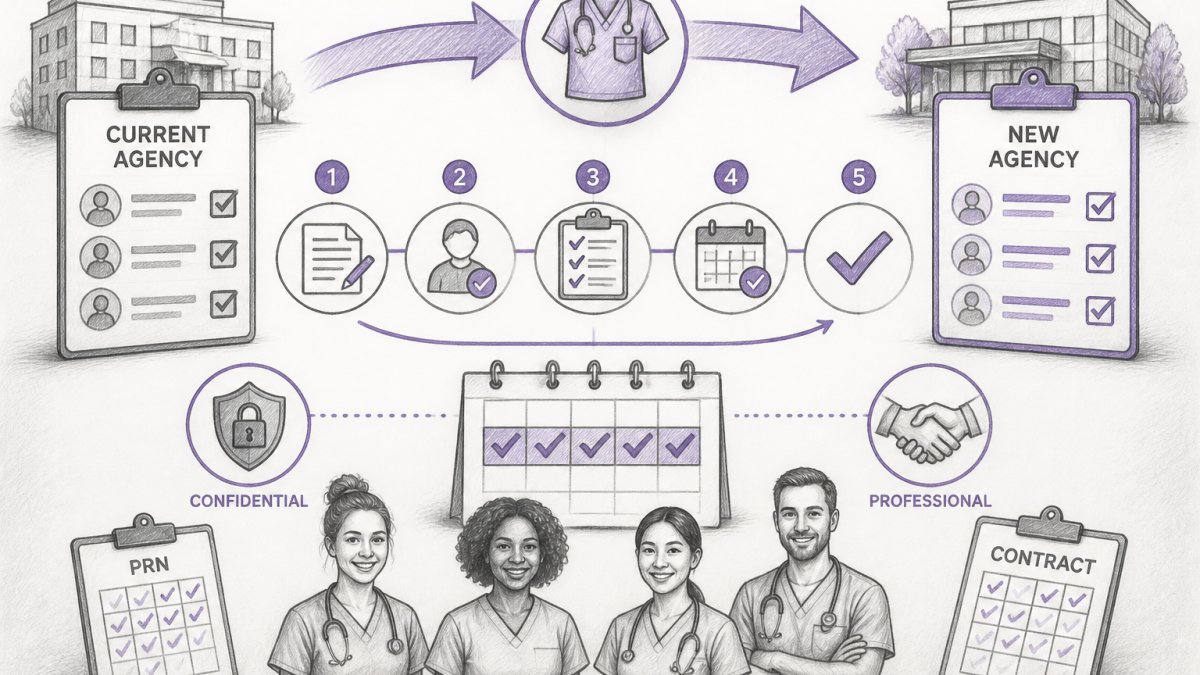
The cleanest exit follows this order:
- Confirm your assignment end date
- Apply to the new agency and start onboarding
- Give notice per your contract
- Finish your current shifts as scheduled
- Complete the new agency's background check and orientation
- Pick your first shift
Don't quit mid-shift or no-show to speed things up. Reliability matters.
The cleanest exit follows a set order, so line up each step before you resign.
| Step | What to do |
|---|---|
| 1 | Confirm your assignment end date |
| 2 | Apply to the new agency and start onboarding |
| 3 | Give notice per your contract |
| 4 | Finish your current shifts as scheduled |
| 5 | Complete the new agency's background check and orientation |
| 6 | Pick your first shift |
Write a Nursing Agency Resignation Letter That Protects You
A nursing agency resignation letter doesn't need to be long. It needs to be clear, dated, and polite. Send it the way your contract requires.
Here's a template you can adapt:
Dear [Recruiter Name],
I'm writing to formally give notice of my resignation from [Agency Name], effective [Date], in line with the notice period in my agreement.
Thank you for the opportunities you've provided. I'll complete my scheduled shifts through [Last Shift Date] and help with any handoff needed.
Please confirm receipt of this notice and let me know if you need anything else from me.
Sincerely, [Your Name], [License Type], [License Number]
Keep a copy.
A few rules: don't air grievances in the letter, don't promise shifts you can't work, and don't resign verbally only. Give notice in writing.
Questions to Ask a Nursing Staffing Agency Before You Sign
Before you commit to a new agency, interview them the way they interview you. Ask questions about what matters to you.
Ask about communication first. How fast do they respond to a text? Who is your point of contact when your recruiter is out? What's the process for shift pickup and cancellations? If the answers are vague, that's your answer.
Then cover the practical side:
- Which facility types do you staff: skilled nursing, assisted living, hospitals?
- How do you handle credential tracking and renewals?
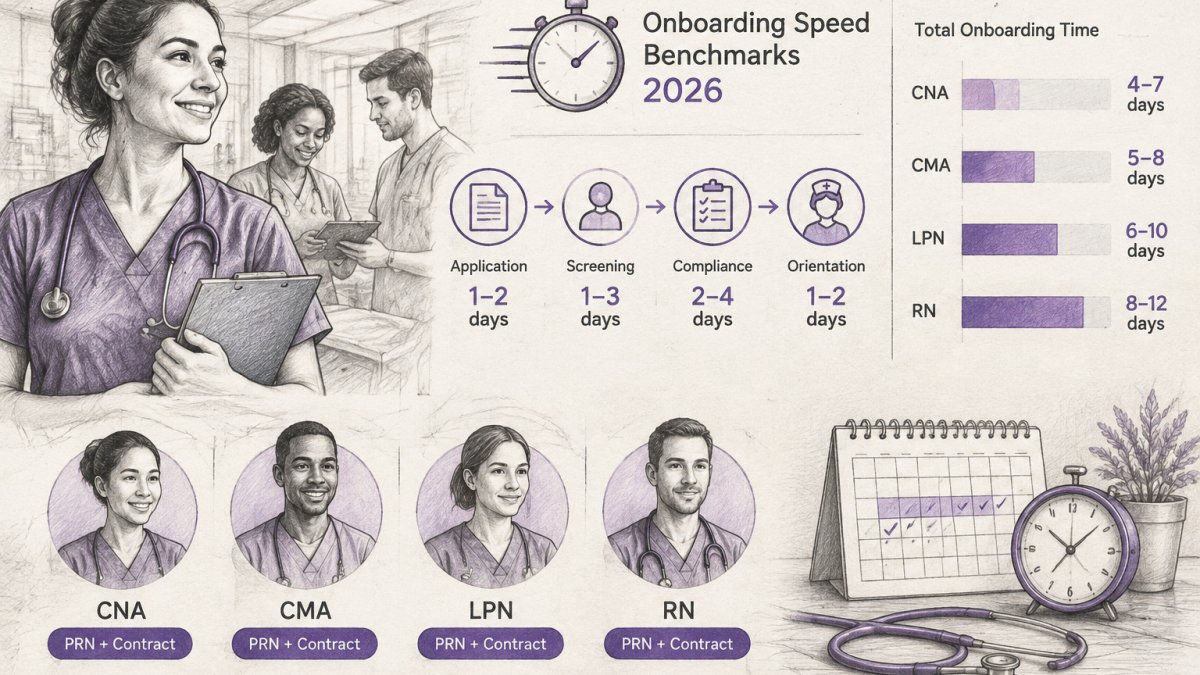
- What does onboarding look like, and how long does it take?
- How do you confirm shift details before I accept?
- What happens if a facility cancels my shift?
For a deeper look at what healthy communication should look like, read our guide to nursing agency communication best practices. It walks through response times, check-ins, and what to expect from a recruiter who actually picks up the phone.
Transfer Your Credentials and Onboarding Without a Gap
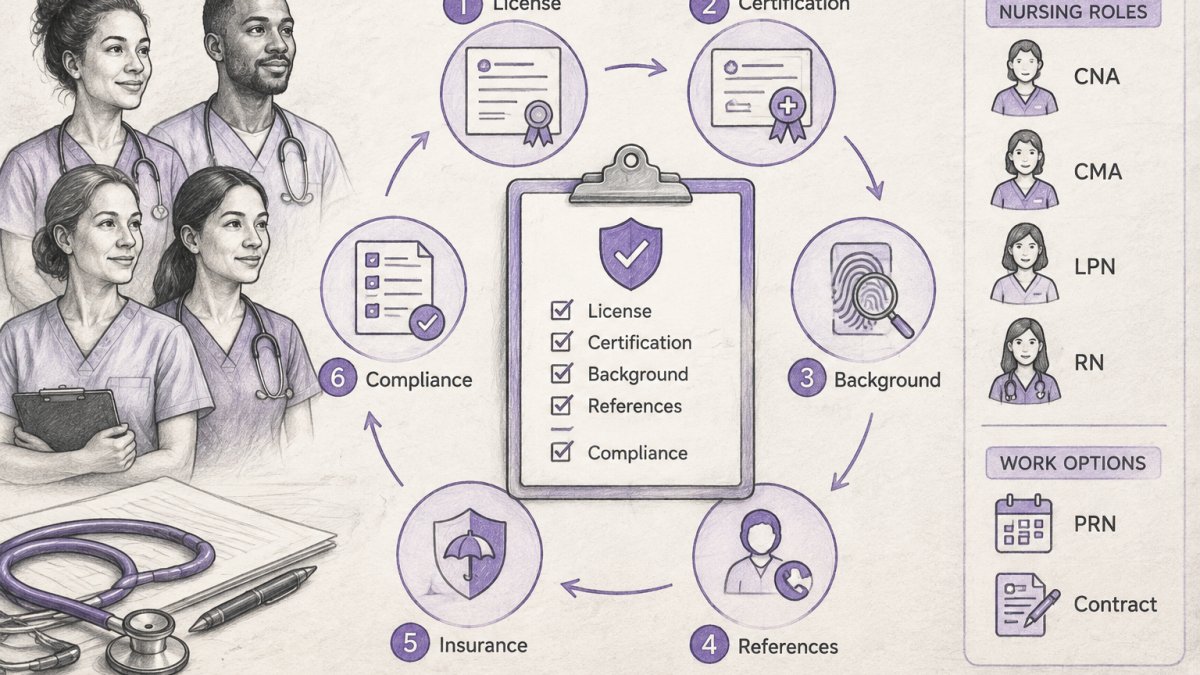
Gather your documents before you resign, not after. Know which items you own and which ones the agency controls.
What You Own vs. What the Agency Holds
Some credentials may be available to you directly:
- Copy of your active license (CNA, CMA, LPN, or RN)
- Current certifications, including BLS if you hold one
- Immunization and health records you've kept on file
- Two or three professional references
You may need to request other items from your current agency:
- Onboarding file and credential packet
- Background check results on file
- Facility-specific orientation records
- Any completed competency or skills checklists
Request any needed items in writing before your last day.
The Order That Prevents a Gap
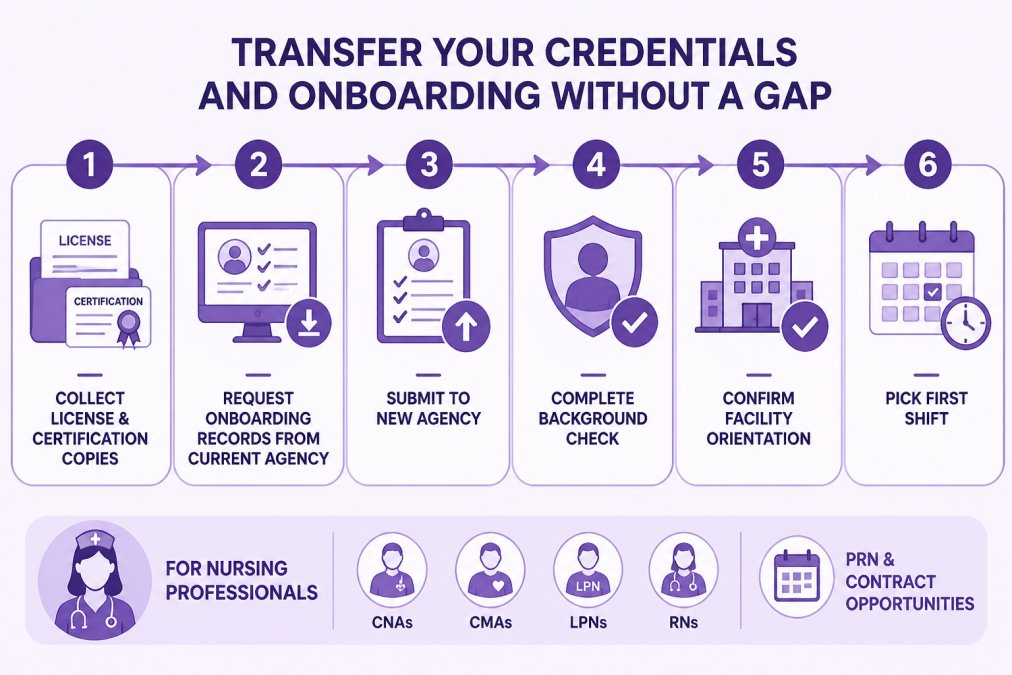
Consider organizing the steps in this order:
- Collect everything you own and save it in one folder.
- Request agency-held records in writing and set a follow-up reminder for one week.
- Apply to the new agency and start the application while records are in transit.
- Authorize the background check as soon as the new agency is ready to run it.
- Submit agency-held records as they arrive, not in one batch at the end.
- Confirm each item is received, not just sent.
- Schedule orientation and confirm the facility before you pick a first shift.
Availability depends on current facility needs, so treat any start date as a target, not a guarantee.
When Onboarding Stalls
If onboarding stalls, ask what information or documents are still needed.
For a step-by-step walkthrough of the full process, see our fast onboarding plan for temporary nursing staff.
Apply to Major Staffing and Pick Up Your First Shift
You've read the contract, timed the exit, written the letter, and moved your credentials.
Major Staffing is a nurse-led agency. We provide staffing solutions for last-minute shift coverage and long-term placements, with availability depending on current facility needs.
If you want to see how flexible shift staffing works and how to get started, read our guide to flexible nursing shift staffing solutions.
Frequently Asked Questions
Can I switch nursing staffing agencies while I'm working a contract?
Read your contract first. Look for notice requirements, assignment completion clauses, and any exclusivity language that limits where you can work. Finish the assignment if you can, give written notice, and keep a copy of everything. If a buyout or penalty clause applies, get the exact terms in writing before you accept a new offer.
How do I avoid being submitted to the same facility by two agencies?
Tell your new recruiter which facilities you've already worked at or been submitted to, and when. Ask them to confirm in writing before submitting you anywhere. Keep a simple log of facility names, dates, and the agency that submitted you.
What documents should I have ready when joining a new nursing agency?
Gather your active license, certifications, health records, immunization records, photo ID, and any facility-specific orientation certificates. Ask your current agency for copies of your onboarding file before you leave. Keep the documents together in one folder.
How much notice should I give my current staffing agency?
Check your contract for the required notice period, then give at least that much in writing. If you're mid-assignment, ask whether finishing the current rotation is expected. Keep the conversation professional.
Ready to work where your skills matter, with a team that treats you like a colleague instead of an account number? Apply through majorstaffingsolutions.com or message the Major Staffing page to ask about current opportunities. Tell us your license type, your availability, and the facility settings you prefer. We'll take it from there.