 How-to
Nursing Agency Onboarding Speed Benchmarks: 2026
Quick Summary
Onboarding speed benchmarks measure the time from a nurse accepting an offer or confirming interest in a placement to that nurse clocking in for the first shift. Agencies should report the median days for this span and track the 90th percentile separately to see slow files. Stage targets should come from the agency's own measured history.
- Start the clock at offer acceptance or confirmed interest in a specific placement.
- Stop the clock at first shift clock-in, not at credential clearance.
- Report median days and the 90th percentile rather than a single average.
- Segment benchmarks by role (CNA, CMA, LPN, RN) and by placement type.
- Run administrative steps in parallel while keeping mandatory verification before first shift.
Table of Contents
- Why Onboarding Speed Decides Whether a Shift Gets Filled
- Nurse Onboarding Timeline: Stage-by-Stage Benchmarks
- What Slows Nurse Credentialing and Causes Rework
- Nurse Credentialing Checklist for Faster Clearance
- Nurse Onboarding Best Practices That Shorten Time to First Shift
- How Quickly Can You Fill Nursing Shifts? Measuring Time to Fill
- Putting These Benchmarks to Work at Your Facility
- Frequently Asked Questions
Why Onboarding Speed Decides Whether a Shift Gets Filled
Nurse onboarding speed is the gap between a facility's call for coverage and the moment a qualified nurse actually walks onto the floor. A facility that calls at 6 AM needing coverage by 7 can only be helped if the paperwork, verification and orientation steps are already moving.
Onboarding speed matters most for last-minute coverage, where there is no slack in the schedule. It also matters for long-term placements, where a slow start can push a facility into weeks of overtime for its existing staff. A common pattern is that a shift is posted, candidates are contacted, and then the file stalls in credentialing.
Speed is not the same as cutting corners. Compliance checks exist for resident safety, and no legitimate agency skips them. The goal is to run the required steps in parallel and remove the waiting between them.
Nurse Onboarding Timeline: Stage-by-Stage Benchmarks
Most articles on this topic stop at "onboarding takes a while." That is not useful when a facility needs a CNA on the floor tomorrow. A working benchmark needs a defined start point, a defined end point, and a target for each stage in between. The framework below is built for nursing agencies specifically, from offer acceptance through first shift worked.
Define the clock first. Start the clock at the moment a candidate accepts an offer or confirms interest in a specific placement. Stop it when the candidate clocks in for the first shift. Everything between those two points is onboarding.
Use median, not average. A single candidate who disappears for three weeks will drag an average far above what most files actually experience. Report the median days from acceptance to first shift, and report the 90th percentile separately so you can see the tail of slow files. A common pattern is a median that looks healthy while the slowest tenth of files take two to three times as long.
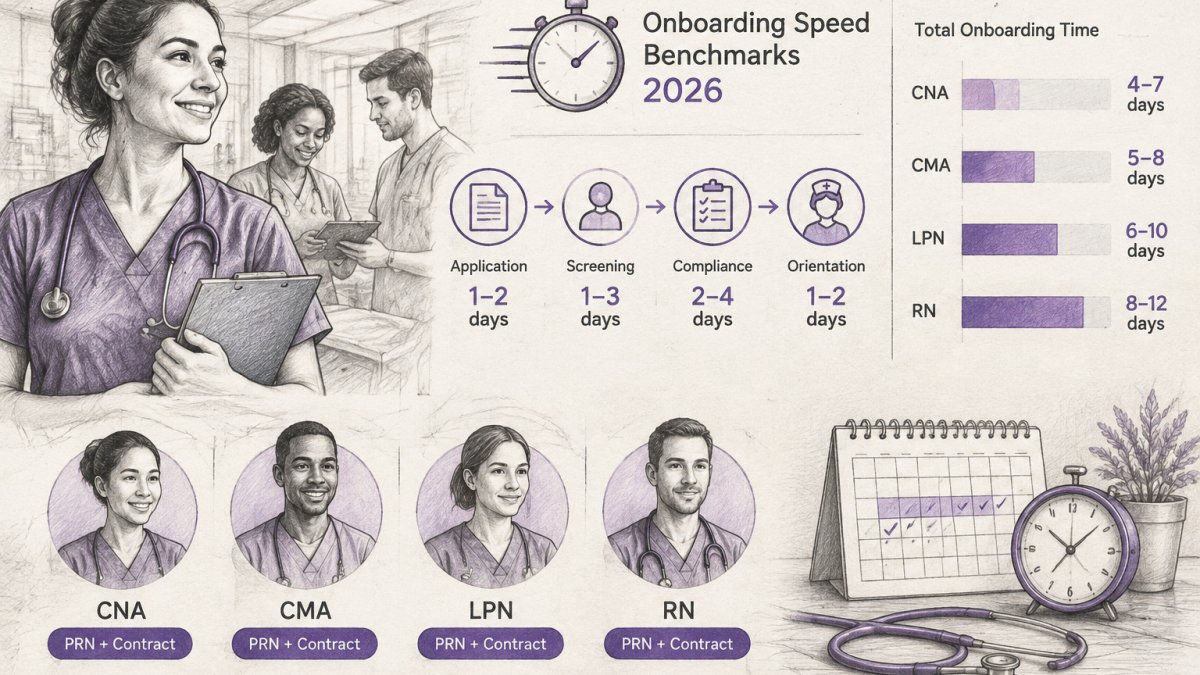
Set stage targets. Planning targets for each stage should be set from your own measured history, since published standards for onboarding stages are not available. For a stage-by-stage plan you can compare against, see this fast onboarding plan for temporary nursing staff.
Run these stages in parallel wherever the rules allow. Document collection and background check initiation can usually overlap. License verification can begin as soon as the license number is confirmed, without waiting for the rest of the file. The total is not the sum of the stages, it is the longest chain of steps that genuinely depend on each other.
!Timeline of onboarding stages from candidate intake through first shift, showing stage durations as planning ranges for each stage
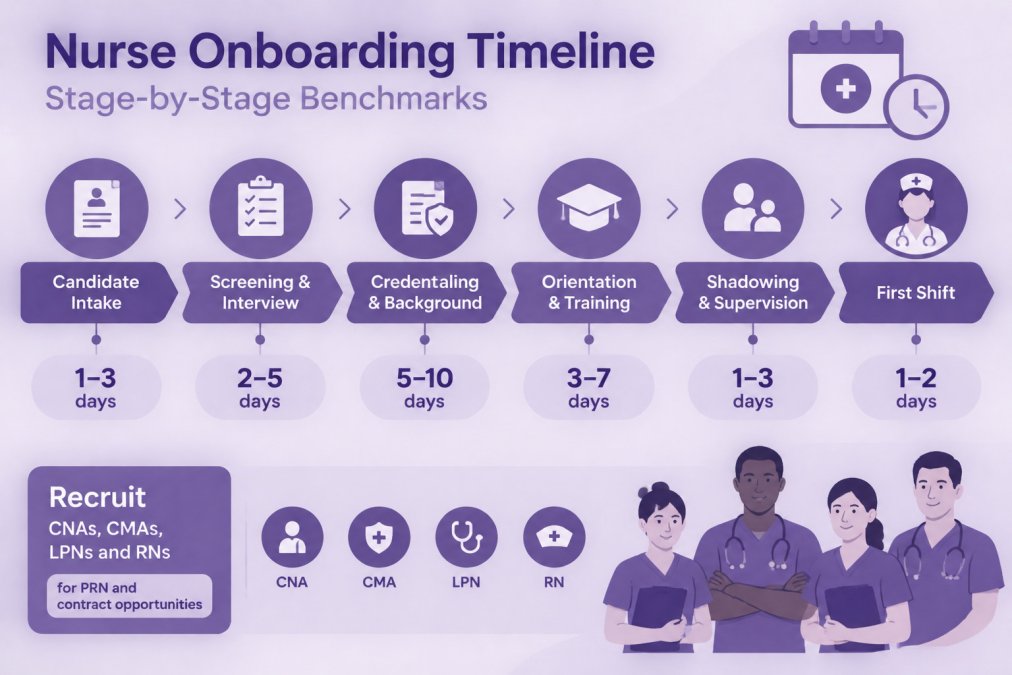
Benchmarks by Worker and Placement Type
A single onboarding average hides more than it reveals. Segment your targets by role and by placement type, because the credentialing burden is not the same across them.
Track CNAs, CMAs, LPNs, and RNs separately, and track PRN shifts apart from contract assignments. If you report one blended number, the fast PRN files will mask a credentialing bottleneck in contract and travel placements.
Watch out: comparing your median to another agency's published figure is only meaningful if both use the same start and end points. Ask how the other number was defined before you treat it as a target.
What Slows Nurse Credentialing and Causes Rework
Most onboarding delays trace back to a small set of causes. Incomplete applications are the most common. A missing license copy or an expired certification sends the file back to the candidate, and each round trip can cost days.
Other frequent causes include:
- Licenses verified in one state when the placement requires another
- Expired immunization or TB records discovered late in the process
- References that go unanswered because contact details were wrong
- Background check results that need manual review
Rework often starts with a checklist that was never fully completed at intake. Catching these gaps early is the cheapest way to speed up onboarding.
Nurse Credentialing Checklist for Faster Clearance
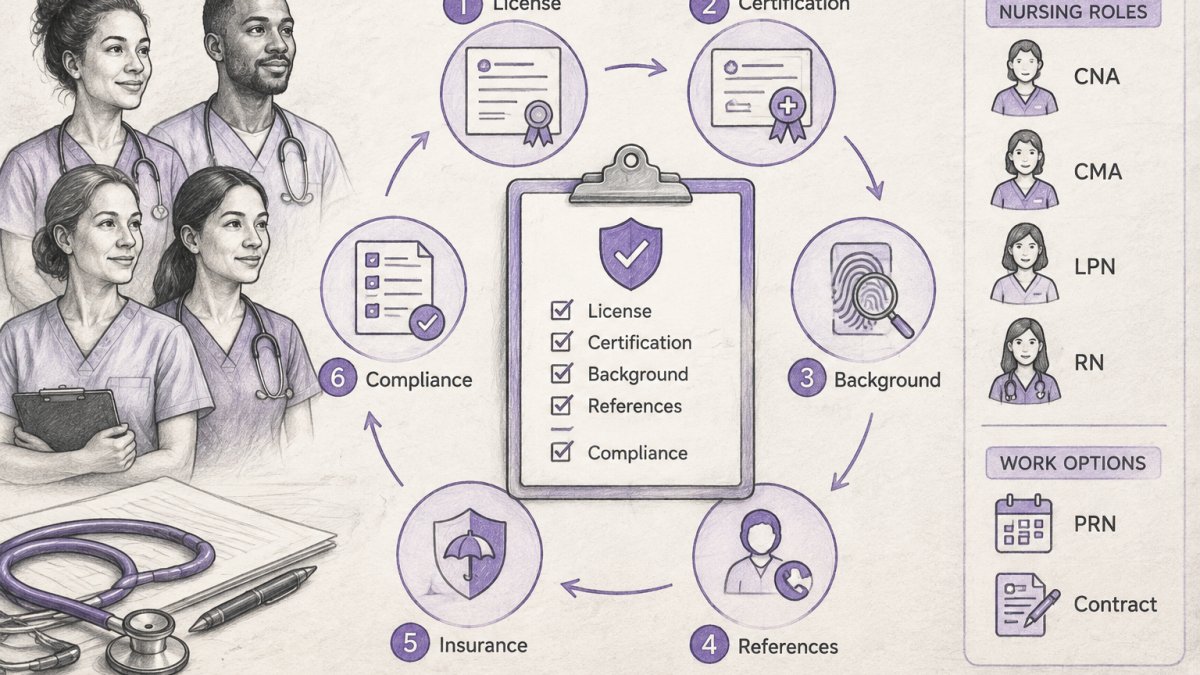
Use this checklist at intake, before a file moves to verification:
- Current license number and issuing state confirmed
- License expiration date recorded and checked
- Certifications (such as BLS or other required credentials) uploaded with dates
- Immunization and TB screening records requested
- Two professional references with working phone numbers
- Background check consent signed
- Work history with no unexplained gaps
- Facility-specific requirements noted
A complete checklist at the start prevents most of the back-and-forth that slows clearance. Requirements differ by facility and by state, so confirm the specifics for each placement.
Nurse Onboarding Best Practices That Shorten Time to First Shift
The fastest way to shorten onboarding is not to skip steps. It is to separate the steps that can safely run at the same time from the steps that must be completed in order, and then remove the waiting between them.
Parallelizable administrative steps. These can usually run alongside other work without compromising safety:
- Collecting the application, availability, and role preferences
- Requesting immunization and TB records while other documents are still coming in
- Contacting references as soon as contact details are confirmed
- Initiating the background check once consent is signed, without waiting for the full document file
- Confirming the license number and issuing state so primary-source verification can begin
Steps that must be completed and verified before a nurse works. These are not optional and should never be compressed:
- Primary-source license verification and confirmation that the license is active and unencumbered
- Background check clearance, including any manual review
- Required health screening and immunization confirmation
- Facility-specific orientation and any unit-specific training the facility requires
- Confirmation that the candidate is cleared for the specific role and setting
A compliance-safe accelerator is to build the file in parallel but gate the first shift on the mandatory steps. The nurse can be scheduled provisionally while verification finishes, as long as the schedule is confirmed only after clearance.
Assign one coordinator per file. A shared inbox is where files go to wait. One named coordinator who owns the file from acceptance to first shift removes the handoffs that cause most delays.
Send the full document list on the first call. Candidates who know exactly what to provide in one message are far less likely to send it in pieces over several days.
Communicate on a fixed cadence. A daily check-in, even a short one, keeps candidates engaged and surfaces problems early. Candidates who hear nothing are the ones most likely to accept another offer.
Get facility orientation requirements up front. A fully cleared nurse with no orientation slot is still not on the floor. Ask the facility for its orientation schedule and unit requirements at the time of the request, not after clearance.
Watch out: treating onboarding as finished when credentials clear is a common mistake. The clock stops at first shift worked, not at clearance, and a missing orientation slot can add days after the file is complete.
A Practical Measurement Framework
To compare onboarding speed consistently, define the rules before you collect data:
- Start point: offer acceptance or confirmed interest in a specific placement.
- End point: first shift clock-in.
- Metric: median days, with the 90th percentile reported alongside it.
- Cohort rules: group by role (CNA, CMA, LPN, RN) and by placement type (PRN, local contract, travel, direct hire). Do not mix cohorts in one average.
- Exclusions: document any file that was paused at the candidate's request, and report it separately rather than dropping it silently.
Review the stage data monthly. If the median is stable but the 90th percentile is climbing, the problem is usually a small set of files stuck in verification or waiting on a facility orientation slot. That is where a process change will have the largest effect.
The article sets out a measurement framework so that onboarding speed can be compared consistently across cohorts.
| Element | Setting | Note |
|---|---|---|
| Start point | Offer acceptance or confirmed interest | Placement-specific |
| End point | First shift clock-in | Not clearance |
| Metric | Median days | Report 90th percentile alongside |
| Cohort split | Role and placement type | Do not mix in one average |
| Exclusions | Paused files | Report separately, not dropped |
How Quickly Can You Fill Nursing Shifts? Measuring Time to Fill
Time to fill measures how long a posted shift stays open before it is staffed. It is the most useful single metric for a facility, because it reflects the whole pipeline at once. Track it from the moment a shift is posted to the moment a confirmed nurse is scheduled.
Pair time to fill with onboarding stage data. If time to fill is long, the stage timeline will show where the delay sits. Review both figures monthly and compare placement types separately, so you can see whether the bottleneck is in recruitment, credentialing or scheduling.
Set your own targets from your own history rather than copying a published number. The most reliable benchmark is the one you can measure consistently over time.
Putting These Benchmarks to Work at Your Facility
Start by measuring your current timeline for one placement type, such as CNA per-diem shifts. Record each stage's start and end date for at least 20 candidates, then identify the longest stage. That stage is where a small change will have the largest effect.
Facility leaders can also shorten their own part of the process. Share orientation requirements in advance, name a contact who can approve candidates quickly, and tell your agency about recurring shift needs. Clear expectations on both sides reduce waiting.
If you want help with staffing for your facility, visit https://majorstaffingsolutions.com/ or message the Major Staffing page to learn about current opportunities.
Frequently Asked Questions
How long does it take to onboard a nurse through a staffing agency?
Onboarding time depends on how quickly the nurse returns documents, how fast license and background verifications clear, and whether the facility's own orientation requirements are scheduled. Agencies should track each stage separately, from intake to credential clearance to orientation to first shift, so that delays can be traced to a specific step rather than a general sense that onboarding is slow. Benchmarks should be segmented by worker type and placement type, since a per-diem CNA and a contract RN rarely follow the same path. Use your own recent placements as the baseline and compare against the stage timelines in this article.
What documents are needed to onboard a nurse?
Most nurse onboarding packets include a current state nursing license or certification, proof of education, immunization and TB screening records, a background check, and references or work history. Requirements vary by facility and state, so confirm the exact list with each client before intake. Collecting complete documents on the first contact is one of the most reliable ways to avoid rework later. A nurse credentialing checklist helps staff confirm every item before a candidate is submitted for a shift.
What causes delays in nurse onboarding?
The most common delays are incomplete paperwork, expired or unverifiable licenses, slow references, and facility orientation slots that are booked weeks out. Rework happens when a credential is re-verified because the first check was missing a document or used an outdated source. Tracking the reason for each delay over a few months usually shows which two or three causes account for most of the lost time. Fixing those causes will do more for speed than any single change to the workflow.
How can agencies speed up nurse credentialing without compromising safety?
Start verifications as soon as a candidate submits documents rather than waiting for a full packet, and keep a standard checklist so no step is repeated or skipped. Run license and sanction checks in parallel with background checks where your process allows it. Never shortcut a required verification to meet a shift deadline, because a single missed check creates far more delay than it saves. Speed comes from clean intake and parallel work, not from skipping steps.