 blog
Best Nurse Staffing Agency for Skilled Nursing Facilities
Table of Contents
- What Makes a Nurse Staffing Agency Right for Skilled Nursing Facilities
- Per Diem Nursing for Skilled Nursing Facilities: Flexibility and Continuity
- Last-Minute Nurse Shift Coverage: Speed and Reliability When You Need It
- Nurse Staffing Agency Credentialing Requirements: What to Verify
- Understanding Nurse Staffing Agency Rates for Facilities
- Key Evaluation Criteria: Beyond Price and Availability
- Building a Partnership That Works for Your Facility
- Frequently Asked Questions
Last Updated: October 12, 2026
What Makes a Nurse Staffing Agency Right for Skilled Nursing Facilities
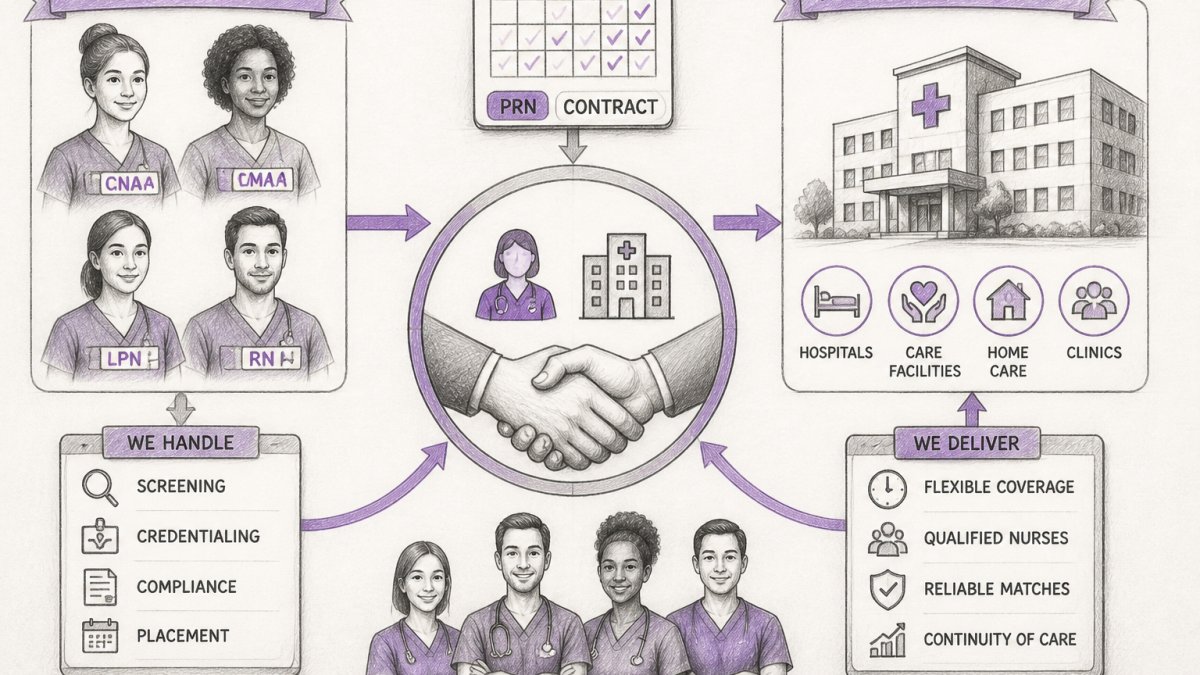
Choosing the best nurse staffing agency for skilled nursing facilities takes more than filling open shifts. The best nurse staffing agency for skilled nursing facilities understands your environment: complex patient needs, regulatory compliance, continuity of care, and quality standards maintained with limited resources.
At Major Staffing, partnership comes down to understanding your patient population, maintaining consistent nurse availability, screening thoroughly, and communicating proactively.
Most facilities know the frustration of agencies that treat them as just another account: algorithmic staffing decisions, unprepared nurses, and communication that breaks down when you need help most.
The right agency learns your culture, acuity levels, and staffing patterns upfront, prioritizes quality over volume, and follows up to confirm fit.
Per Diem Nursing for Skilled Nursing Facilities: Flexibility and Continuity
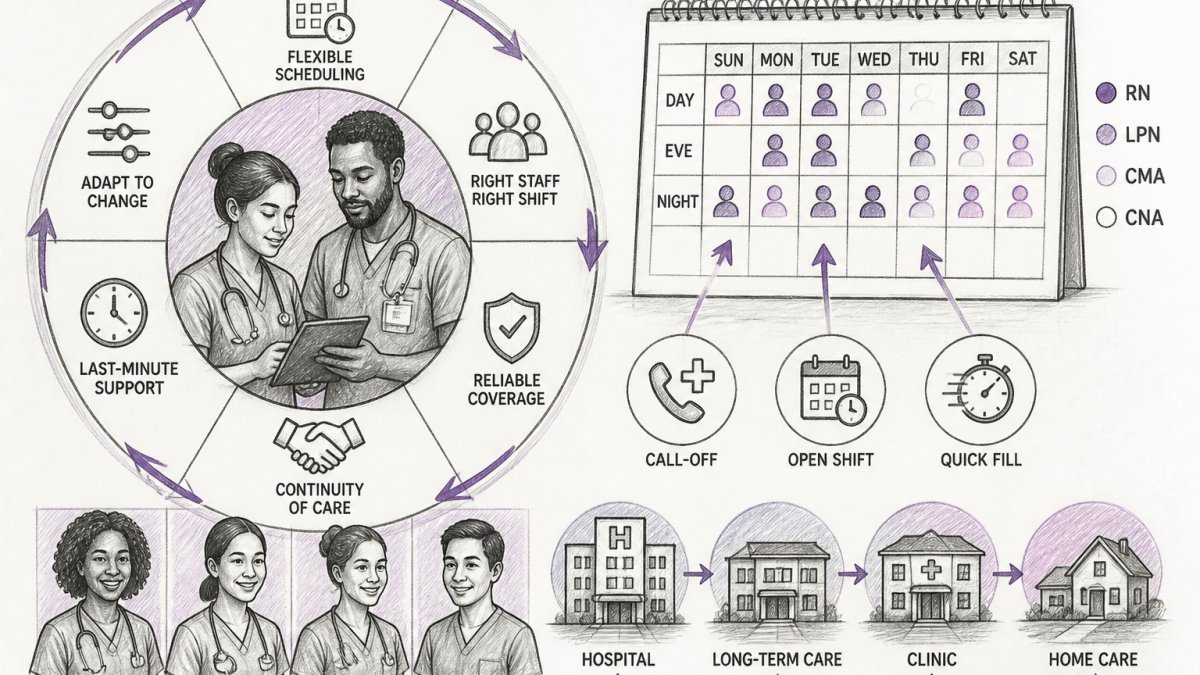
Per diem nursing for skilled nursing facilities offers flexibility permanent staffing cannot. A per diem nurse works as needed, filling gaps from illness, vacation, or seasonal census increases, and unlike contract positions, lets you build relationships with familiar nurses who know your operations.
The value lies in consistency. When the same per diem nurses return, they learn your workflow, residents' preferences, and documentation standards, easing admissions, improving handoffs, and raising resident satisfaction.
Per diem still requires careful management. You need an agency that actively recruits and retains a strong per diem pool; if it treats per diem as a dumping ground for unplaceable nurses, your facility suffers. The best agencies cultivate per diem relationships with competitive pay and scheduling flexibility.
Don't assume per diem is cheaper. True per diem rates reflect the flexibility nurses provide; suspiciously low rates often mean cut corners on screening or less experienced professionals. Quality per diem costs appropriately because it delivers continuity and reliability.
Last-Minute Nurse Shift Coverage: Speed and Reliability When You Need It
Last-minute nurse shift coverage separates reliable agencies from struggling ones. When a nurse calls in sick at 5 AM and you need coverage by 7 AM, speed matters, but speed without reliability brings no-shows or nurses unprepared for your acuity level.
The best nurse staffing agencies keep a reserve pool trained for urgent situations, contact available nurses quickly, verify credentials and facility-specific orientation before confirming, and follow up afterward.
That requires investment: paying nurses enough to be available on short notice, maintaining relationships with professionals who work variable schedules, and staffing nights and weekends. Agencies that cut this infrastructure will fail you when you need them most.
Ask agencies directly: How fast can you fill a shift? What's your same-day placement success rate? Can you guarantee overnight and weekend emergency coverage? The answers reveal whether they've built systems for reliability.
Nurse Staffing Agency Credentialing Requirements: What to Verify
Credentialing is where a staffing agency either protects your facility or exposes it. In skilled nursing, one unverified license or missed exclusion check can surface in a state survey or CMS validation review and become a deficiency, a plan of correction, and a hit to your star rating. The question is whether your agency's process would survive a surveyor's file review.
A defensible credentialing file for a skilled nursing placement typically contains:
- Active license verification. Primary-source verification through the state board of nursing (or the appropriate compact database for multistate licenses), not a photocopy of a wallet card. Licenses expire; the file should show the verification date and the expiration date.
- Exclusion and sanction screening. Every clinician should be checked against the HHS Office of Inspector General List of Excluded Individuals and Entities (LEIE) and the System for Award Management (SAM.gov) exclusion records before placement, and rechecked monthly, because the lists update. Facilities that bill Medicare or Medicaid are expected to screen employees and contractors, and an excluded clinician who provides care can create billing exposure.
- Criminal background checks. Fingerprint-based state checks where required, plus a national criminal history check. Many states also require a separate nurse aide registry check for CNAs and, in some cases, a check of the state's abuse or neglect registry.
- Health and immunization documentation. Tuberculosis screening (often a two-step or IGRA test), current influenza vaccination or a documented exemption, and any facility-specific requirements such as COVID-19 vaccination status.
- Competency validation. License and background checks confirm eligibility, not skill. For skilled nursing, that means validating IV therapy, wound care, tube feeding, ventilator or trach care, and dementia or behavioral health competencies against the units the clinician will actually work.
- Facility-specific orientation. A clinician who has never worked your building still needs your documentation system, your fall protocol, your infection control procedures, and your emergency codes before the first shift. The agency should track completion.
When you evaluate an agency, ask for the actual documentation, not a verbal assurance. A short, specific list of questions separates serious agencies from the rest:
- Do you verify licenses through primary source, and how often do you re-verify?
- Do you screen against the LEIE and SAM.gov, and how frequently?
- Can you show me a sample credentialing file with dates?
- How do you handle a clinician whose license lapses mid-assignment?
- What is your process for facility-specific orientation, and how do you document it?
- If a surveyor asks for proof of credentials for a clinician who worked here six months ago, how fast can you produce it?
Agencies with strong credentialing answer these in one conversation; weaker ones pivot to fill speed. The two aren't in conflict, the best credential fast because they have the infrastructure, but if an agency can't describe its process in specifics, assume it's thin.
One overlooked detail: ongoing monitoring. Credentialing is a live system, not a filing cabinet. The agency should watch expiration dates, track disciplinary actions, and flag any change affecting a clinician's eligibility. If it can't tell you when a nurse's license is up for renewal, it isn't managing your risk, it's transferring it to you.
Understanding Nurse Staffing Agency Rates for Facilities
Nurse staffing agency rates depend on location, specialty, shift type, urgency, and contract terms. There's no single industry standard because facilities have different needs and budgets.
Temporary staffing costs more per hour than permanent employees because it includes overhead, benefits, and margin. Per diem rates often fall between temporary and permanent costs, and longer-term contracts may cost less than emergency same-day coverage.
When comparing agencies, look beyond hourly rates. Ask about:
- Markup structure: What percentage does the agency take versus what goes to the nurse?
- Minimum shift requirements: Do you pay for four hours or eight hours minimum?
- Cancellation policies: If you cancel within 24 hours, do you still pay?
- Overtime and premium rates: What happens during nights, weekends, and holidays?
- Contract terms: Are there volume discounts for consistent placement needs?
Transparent agencies explain their fee structure and justify rates through value: faster placements, better-screened professionals, responsive service, and lower turnover. An agency that won't explain pricing is a warning sign.
The cheapest agency is rarely the best. Extremely low rates often mean lower-quality screening, less experienced nurses, and higher cancellations. You save nothing if you spend extra time managing placements or covering care gaps.
Key Evaluation Criteria: Beyond Price and Availability
Most facility leaders compare agencies on bill rate and fill speed.
Here is a practical framework, with questions that separate a skilled-nursing-capable partner from a general healthcare staffing vendor.
1. Skilled nursing experience, not just healthcare experience. Ask what percentage of placements are in skilled nursing, long-term care, or post-acute settings.
2. Fill rate and time-to-fill, measured honestly. Ask for fill rate on last-minute call-offs (same-day, under four hours' notice) and average time-to-fill for routine requests.
3. Call-off replacement and no-show rate. This metric determines whether your 7 AM shift is covered.
4. Clinician retention and consistency. High agency turnover means constantly orienting new faces.
5. Credentialing and compliance depth. For scoring: does the agency verify licenses through primary source, screen against the LEIE and SAM.gov, and re-verify on a schedule?
6. Specialty and acuity coverage. Skilled nursing facilities aren't monolithic. A building with a vent unit, memory care neighborhood, and short-term rehab wing has three staffing profiles.
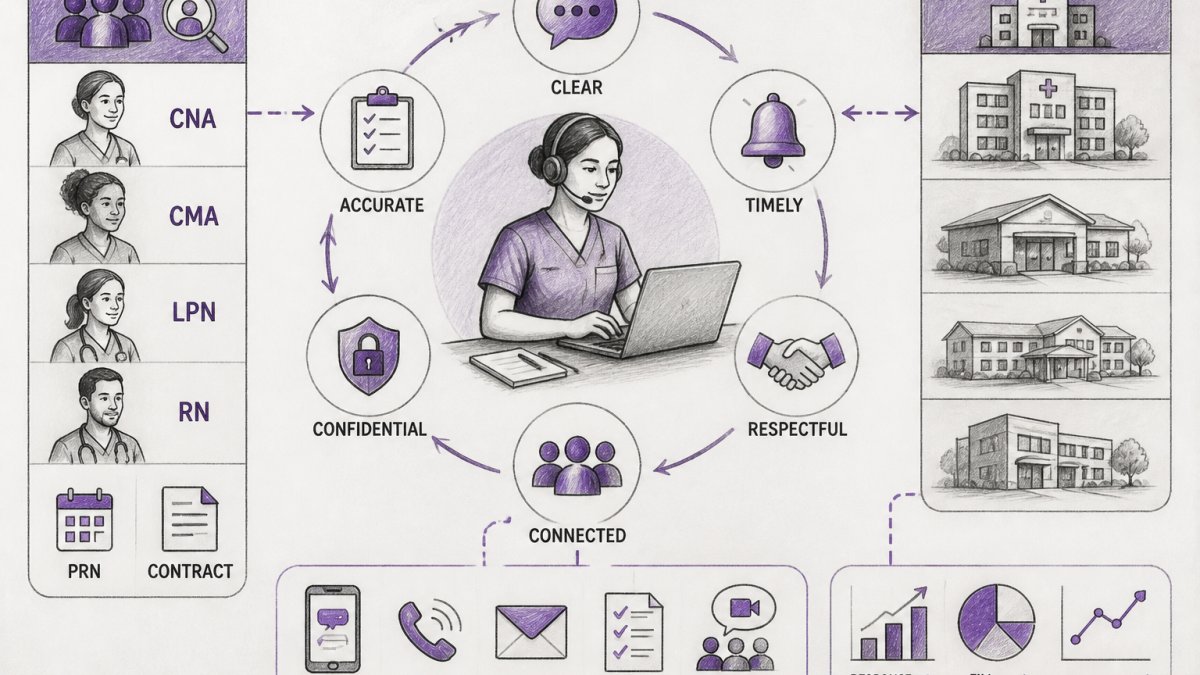
7. Communication and account management. Who answers the phone at 5 AM, a dedicated account manager who knows your building, or a rotating call center?
**8.
9. References and facility-side outcomes. Ask for two or three skilled nursing references you can call directly, ideally similar census, acuity, and payer mix.
The lowest-rate agency often scores poorly on credentialing, no-shows, and retention, and the true cost shows up in orientation time, survey risk, and management hours chasing coverage. The highest rate isn't automatically best either; find the agency whose strengths match your building's weaknesses. A facility with stable core staff and occasional call-offs needs a different partner than one with a chronic vent unit vacancy.
CMS State Operations Manual guidance on nurse staffing and competency requirements
Use this framework as a scorecard, not a checklist.
Building a Partnership That Works for Your Facility
The facility-agency relationship should feel like a partnership, not a vendor transaction. That means the agency is invested in your success, not just filling shifts, identifying patterns in your staffing needs, suggesting solutions, and communicating honestly about challenges.

A true partnership starts with clear expectations. Define staffing needs, preferred shift times, specialty requirements, and quality standards upfront, and discuss communication protocols, escalation procedures, and success metrics.
Regular check-ins strengthen the relationship. Schedule monthly or quarterly reviews, share feedback about individual nurses so placements improve, and address problems directly rather than letting frustration build.
Major Staffing builds partnerships by prioritizing your facility's needs: listening to understand your challenges, maintaining consistent communication, following through on commitments, and treating you as a valued partner, not an account number.
Look for an agency that asks about your long-term staffing strategy, not just immediate needs: permanent hiring plans, seasonal fluctuations, service expansion. Agencies that understand your trajectory provide more strategic support.
The strongest partnerships include flexibility on both sides. If you occasionally need coverage outside normal parameters, a true partner helps; if the agency must adjust scheduling for circumstances beyond its control, you accommodate. That reciprocal trust reduces friction and improves outcomes.
Finding the right nurse staffing agency for skilled nursing facilities requires evaluating more than just price and availability. You need a partner who understands skilled nursing environments, maintains rigorous credentialing standards, and communicates proactively when challenges arise.
Frequently Asked Questions
What credentials should a nurse staffing agency verify before sending nurses to my facility?
A reputable nurse staffing agency credentialing requirements should include current state licensure (RN, LPN, CNA), background checks, reference verification, proof of required certifications (CPR, BLS), and compliance with facility-specific training mandates. Ask your agency for their complete credentialing checklist and timeline. Facilities should request documentation that verifies each credential independently, not just the agency's attestation. This protects both your patients and your facility's compliance standing.
How quickly can a nurse staffing agency provide last-minute nurse shift coverage?
Response time varies by agency and staffing availability. Established agencies with deep local networks can often fill shifts within 2-4 hours for immediate needs. Last-minute nurse shift coverage depends on having qualified nurses actively available and willing to accept short-notice assignments. Ask prospective agencies about their average response time, how they maintain an on-call pool, and what their fill rate is for urgent requests. Verify these claims with facility references before committing.
What is the difference between per diem and contract nursing for skilled nursing facilities?
Per diem nursing for skilled nursing facilities provides flexible, shift-by-shift staffing with no minimum commitment, ideal for covering unexpected absences or seasonal surges. Contract nursing typically involves a set term (weeks to months) with guaranteed hours and more predictable staffing. Many facilities use both: per diem for unpredictable gaps and contract placements for longer-term coverage needs. Discuss your facility's mix of needs when evaluating agencies to ensure they can support both models.
How do nurse staffing agency rates for facilities compare, and what factors affect pricing?
Pricing depends on multiple factors: shift length, specialty requirements (wound care, dementia care), time of day (evening/night premiums), staffing urgency, and local market rates. Rates typically reflect the agency's overhead, nurse pay, compliance costs, and service level. Rather than comparing raw hourly rates, evaluate the total value: nurse retention, fill rates, credentialing rigor, and communication responsiveness. Request a detailed quote based on your facility's typical staffing patterns to make an informed comparison.