 how-to
Hire Skilled Nursing Professionals for Shifts
Table of Contents
- Why Hiring Skilled Nursing Professionals Requires a Different Approach
- Define Your Staffing Needs and Create a Nursing Shift Request Template
- Establish a Nurse Credentialing Checklist for Compliance
- Solve Last-Minute Nursing Shift Coverage Gaps
- Choose Between Per Diem Nursing Staffing and Long-Term Placements
- Match Staff Skills to Patient Acuity and Care Setting
- Measure Shift-Fill Performance and Reduce No-Shows
- Frequently Asked Questions
Last Updated: October 11, 2026
Why Hiring Skilled Nursing Professionals Requires a Different Approach
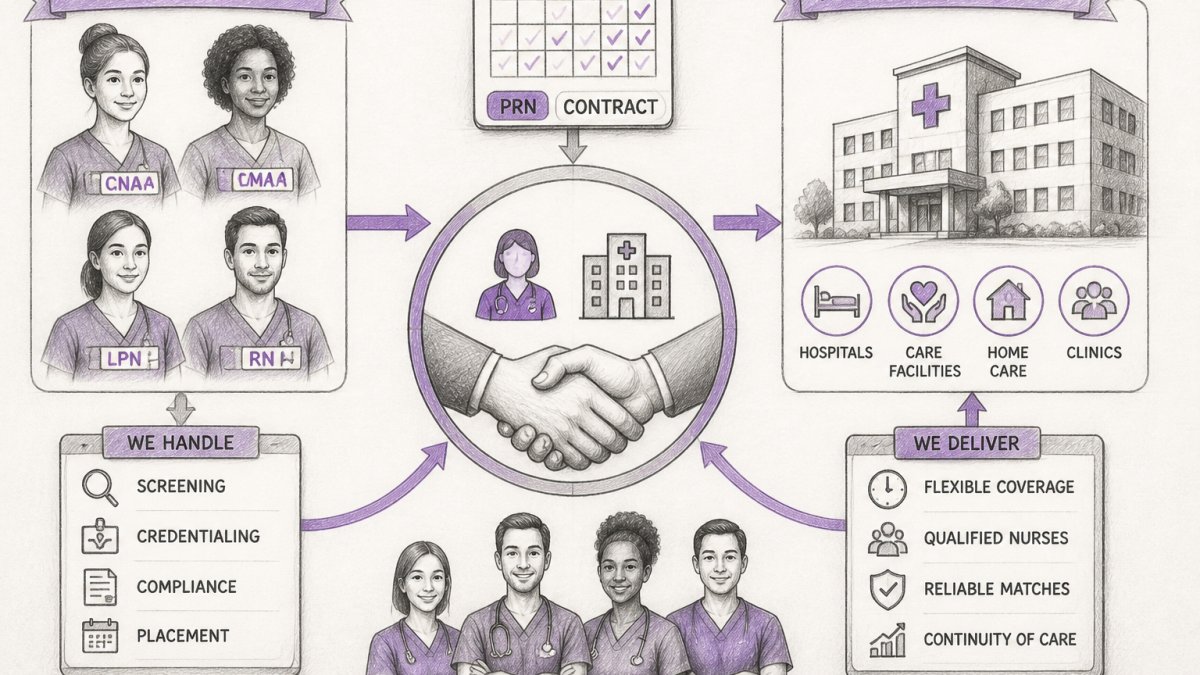
Hiring skilled nursing professionals for shifts differs fundamentally from traditional recruitment: you're solving immediate clinical needs while maintaining continuity and quality of care. Healthcare facilities face unique staffing challenges that demand speed, flexibility, and reliability.
The core problem: the gap between when coverage is needed and when it's available. A nurse calls in sick at 6 AM. You have two hours to find qualified coverage, verify credentials, and ensure they can step into your workflows. Traditional hiring timelines don't work.
Successful facilities define needs upfront, establish credentialing standards, and partner strategically, resulting in faster placements and better outcomes.
Define Your Staffing Needs and Create a Nursing Shift Request Template
Document exactly what you need before contacting a staffing partner. Vague requests get slower responses and mismatches; detailed requests get the right person fast.
Identify shift length, acuity level, and specialty requirements
Specify three core elements: duration, patient acuity, and clinical specialty. A 12-hour ICU night shift demands different skills than a 4-hour med-surg evening shift. Document acuity explicitly (post-operative, wound care, continuous monitoring) and specialty requirements (oncology, dialysis, pediatric). Precision accelerates matching.
Document facility-specific onboarding and workflow details
When you hire skilled nursing professionals for shifts, they must integrate into your specific environment quickly. Create a one-page orientation guide covering: EHR login, supply/equipment locations, communication protocol, escalation procedures, and facility policies (fall prevention, infection control, patient communication). This reduces disruptions and onboarding friction.
Establish a Nurse Credentialing Checklist for Compliance
Verify every nurse's licensure and qualifications before placement. Credentialing protects your facility, ensures standards compliance, and creates audit trails for regulators.
License verification and scope of practice alignment
Verify current, active licensure through your state's nursing board (most offer online lookup tools). Confirm scope of practice aligns with the role: document which tasks the nurse is qualified to perform (medication administration, catheter insertion, wound care, IV therapy, specialty skills). For multi-state or compact licenses, verify primary license and good standing in all states. Investigate any history of suspension, revocation, or disciplinary action.
Background checks, immunizations, and facility-specific requirements
Most facilities require background checks, immunizations, and drug screening. Your checklist should include: criminal background clearance (no felonies, no violence/theft/abuse convictions), immunization proof (flu, COVID-19, MMR, hepatitis B, TB), drug screening, current CPR certification (BLS for CNAs, ACLS for RNs), and facility-specific training (bloodborne pathogen, HIPAA, patient safety). Document your policy and apply it consistently.
Credentialing workflow and documentation
Establish a repeatable process: (1) Request credentialing documents immediately with a 24-48 hour deadline. (2) Verify each credential independently through state boards and vendors. (3) Create a credentialing file with copies and verification dates. (4) Flag expiring credentials and set renewal reminders. (5) Document who verified each item, when, and any discrepancies for audit readiness.
Clarify credentialing responsibility with your staffing partner. Agencies typically handle primary verification; you should conduct secondary verification for critical credentials. Marketplaces require independent verification since nurses self-report.
Handling incomplete or expired credentials
Establish policies for incomplete credentials: expired CPR (do not place in acute roles), incomplete immunizations (define grace period or require completion), out-of-state licenses (verify reciprocity or separate licensure before placement).
Compliance and audit readiness
Maintain organized records for audit readiness: signed credentialing checklists, verified licenses and certifications, background checks, immunization records, exceptions/waivers, and verification dates/names. Keep records for 3-5 years per state requirements.
Solve Last-Minute Nursing Shift Coverage Gaps
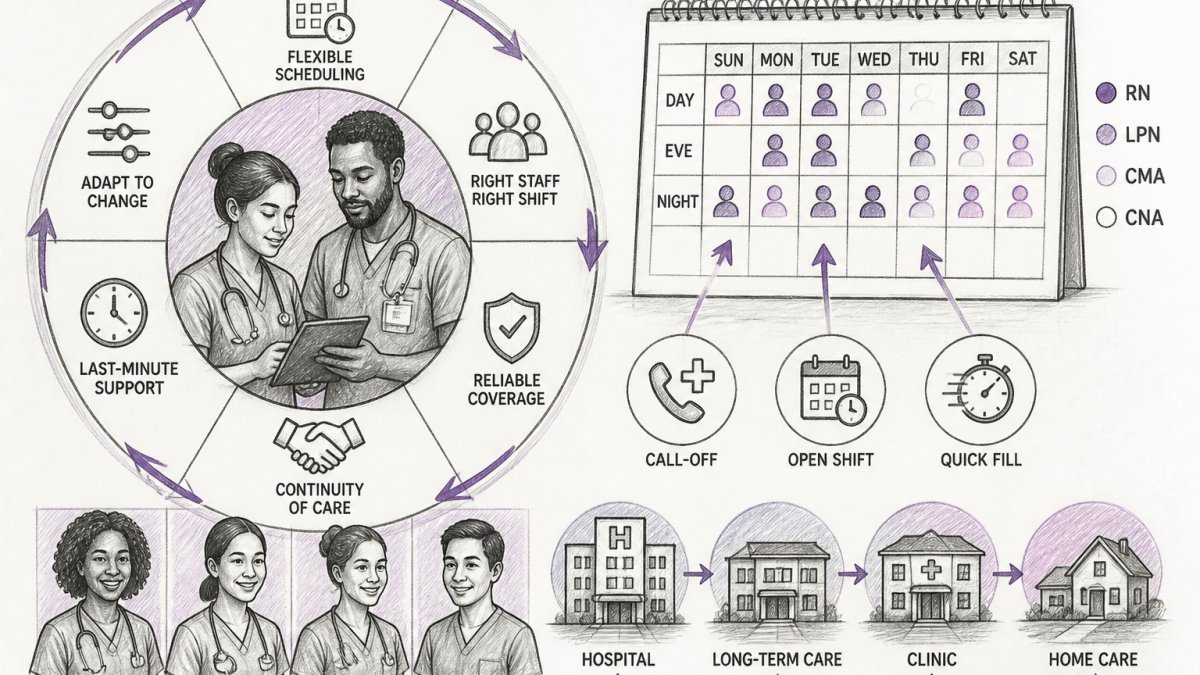
The real test of a staffing partnership is response time. You need coverage by 7 AM. Can your staffing partner deliver?
Speed of placement and response time expectations
Set clear expectations with your staffing partner about response times. Most facilities need coverage within 2-4 hours. Some need it within 1 hour. Be explicit about this timeline when you establish your partnership. A good staffing partner has systems in place to contact qualified nurses immediately, confirm availability, and get them on the schedule within your window.
Speed matters because delayed placements force your existing staff to absorb extra patients, which increases errors and burnout. When you can fill shifts fast, your team's workload stabilizes and patient care improves.
Backup plans and contingency staffing strategies
Develop a tiered backup plan: primary partner, secondary option, and internal contingency (pulling staff, overtime, reducing census). Document activation triggers and timelines to prevent panic and ensure sound decisions under pressure.
Choose Between Per Diem Nursing Staffing and Long-Term Placements
Most facilities layer multiple staffing channels to balance cost, speed, and continuity. Understanding trade-offs between agencies, marketplaces, float pools, and direct hire helps allocate budget strategically.
Staffing channel comparison: cost, speed, and control
Agencies fill shifts fastest (1-2 hours) but cost 25-50% more with potential cancellation fees; you have less control over assignments. Marketplaces cost less but are unpredictable; best for flexible timelines. Float pools offer best continuity and control but require higher base salary and HR overhead. Direct hire offers maximum continuity but requires 4-8 weeks and highest recruitment cost; best for core staffing, not gap coverage. Most facilities layer these channels.
Total cost of ownership: fees, overtime, and cancellation liability
When comparing staffing channels, look beyond the hourly rate. Calculate total cost of ownership:
- Agency fees: Base nurse wage + agency markup (typically 25-50%) + potential cancellation fees ($50-$200 per cancelled shift).
- Marketplace fees: Base nurse wage + platform fee (typically 5-15% of the shift cost) + risk of unfilled shifts (which may force overtime for existing staff).
- Float pool: Base salary + benefits + payroll taxes + scheduling overhead + training and onboarding. Float pools have higher fixed costs but lower variable costs per shift.
- Direct hire: Salary + benefits + payroll taxes + recruitment cost (often $2,000-$5,000 per hire) + training. Direct hire has the highest fixed cost but lowest per-shift variable cost once hired.
When a shift goes unfilled, your facility absorbs the cost through mandatory overtime for existing staff (typically 1.5× base wage) or reduced census (lost revenue). A single unfilled 12-hour shift in a high-acuity unit can cost $1,500-$3,000 in overtime alone. This hidden cost often makes faster, more reliable channels (like agencies) cost-effective despite higher per-shift rates.
Hybrid staffing model: layering channels for resilience
Most successful facilities use a hybrid approach:
- Core staffing: Direct hire or float pool for predictable, recurring needs.
- Primary gap coverage: Marketplace or preferred agency for most ad-hoc shifts.
- Emergency backup: Secondary agency or internal contingency (pulling staff, reducing census) for shifts that don't fill within your timeline.
This layering reduces your dependence on any single channel and gives you flexibility to respond to different scenarios. For example, a shift posted to your marketplace at 6 AM might fill by 7 AM. If it doesn't, you escalate to your primary agency by 6:30 AM. If that fails, you activate your contingency plan by 7 AM. This staged approach balances cost and reliability.
Document your channel preferences and escalation timeline in writing. Share this with your staffing partners so they understand your expectations and can plan accordingly.
Match Staff Skills to Patient Acuity and Care Setting
Not every nurse is right for every shift. Matching skills to acuity prevents errors and improves outcomes. A nurse with ICU experience may struggle in a behavioral health unit. A CNA with geriatric training is ideal for your skilled nursing facility but may be underutilized in acute care.
When you hire skilled nursing professionals for shifts, specify the skills required and match them to available nurses. A staffing partner maintains detailed profiles of each nurse's experience, certifications, and specialty areas. This allows for precise matching instead of generic placement.

Document which certifications matter for your unit. Wound care certification, IV therapy training, or experience with specific patient populations all affect placement quality. When you communicate these requirements clearly, your staffing partner can match the right nurse to the right shift.
Measure Shift-Fill Performance and Reduce No-Shows
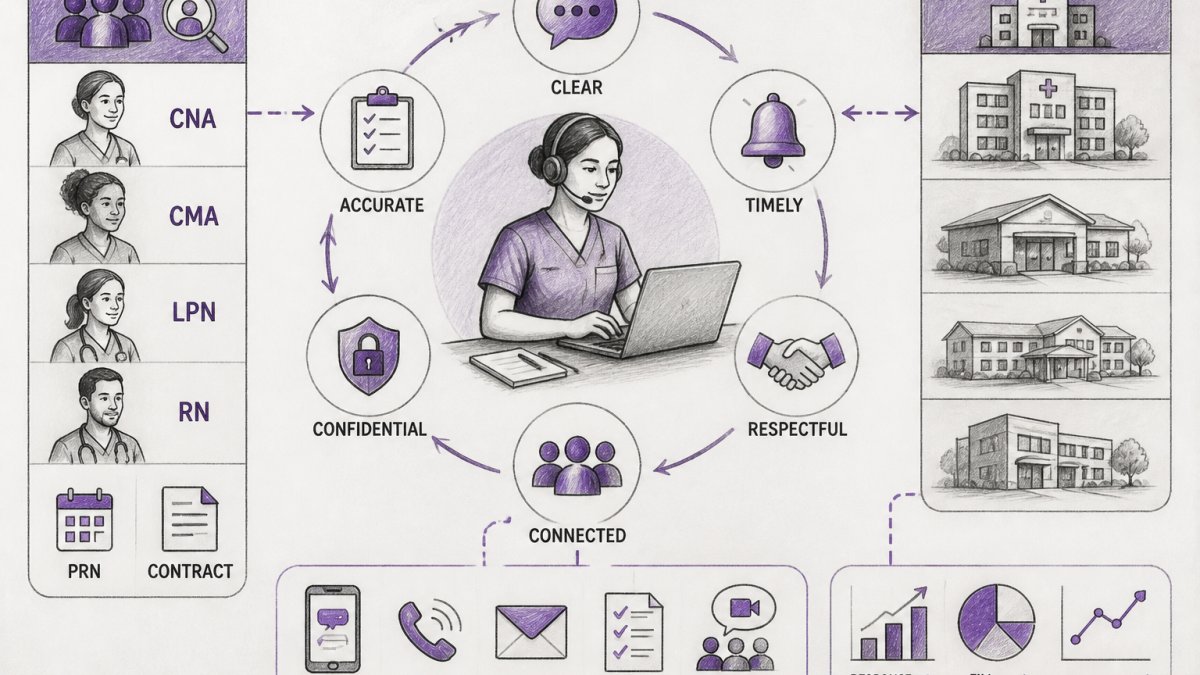
You can't improve what you don't measure. Track key metrics to evaluate your staffing performance: fill rate (percentage of shifts filled), time-to-fill (how quickly shifts are covered), and no-show rate (how often assigned nurses don't arrive).
A healthy fill rate is 90% or higher. Below 85% suggests either unrealistic shift requests or a staffing partner that can't deliver. Time-to-fill should align with your facility's needs, if you need coverage in 2 hours, your partner should consistently deliver within that window. No-show rates above 5% indicate reliability problems.
When no-shows happen, ask why. Did the nurse have a legitimate emergency? Did they accept the shift without fully committing? Is there a pattern with certain nurses? Understanding root causes helps you and your staffing partner address systemic issues.
Work with your staffing partner to implement accountability measures. Some facilities require confirmation calls 24 hours before shifts. Others use text reminders. These simple steps reduce no-shows significantly.
Hiring skilled nursing professionals for shifts requires a structured approach grounded in clear needs definition, rigorous credentialing, and reliable partnerships. Major Staffing specializes in exactly this, connecting healthcare facilities with vetted, compassionate nursing professionals who integrate seamlessly into your care teams.
Frequently Asked Questions
What is the difference between per diem and PRN nursing shifts?
Per diem and PRN (as needed) nursing shifts are often used interchangeably, but the distinction matters for scheduling. Per diem shifts are scheduled in advance for specific dates and times, allowing nurses to plan their availability. PRN shifts are filled on an as-needed basis when the facility has unexpected openings. Both offer flexibility, but per diem provides more predictability for the facility and the nurse. When you hire skilled nursing professionals, clarify whether you need committed per diem staffing or true on-demand PRN coverage.
How quickly can a facility fill a last-minute nursing shift?
Response time depends on your staffing partner's network and infrastructure. Facilities that partner with nurse-led agencies with strong local relationships often see shifts filled within 1-2 hours of request. The key is having a pre-vetted pool of professionals with active availability and clear communication channels. Your nursing shift request template should include urgency level and call-in procedures to speed the process. Agencies that prioritize partnership can maintain faster response times than transactional vendors.
What credentials should facilities verify before placing a nurse?
Your nurse credentialing checklist must include current state licensure (RN, LPN, or CNA), verification through your state's nursing board, malpractice history, and background screening. Depending on your facility type, also verify CPR/BLS certification, immunization records (including flu and COVID-19), and any specialty certifications (ICU, pediatrics, etc.). Many facilities require proof of liability insurance and reference checks. A nurse-led staffing partner will handle much of this verification, but your facility should maintain its own records and confirm credentials align with patient acuity levels.
How can facilities reduce cancellations and no-shows for nursing shifts?
Build relationships with your staffing partner to understand why cancellations happen and address root causes. Common reasons include unclear expectations, poor communication, or mismatch between promised conditions and reality. Use your nursing shift request template to set clear expectations upfront. Offer consistent scheduling when possible, competitive pay, and supportive communication. Track no-show patterns and work with your staffing provider to identify and retain reliable professionals. Facilities that treat per diem and PRN staff as valued partners can see lower cancellation rates than those treating shifts as transactional.