 how-to
Need Long-Term Nursing Placement Services? Here's How
Last Updated: October 25, 2026
Quick Summary
To request long term nursing placement services, send one clear message naming your roles, shift times, unit type, and start date. We verify credentials, orient the caregiver to your policies, and stay in contact for the life of the nursing placement.
- Long-term placement prioritizes fit and reliability so the same caregiver returns shift after shift.
- Vague requests are the number one reason placements stall, so be specific up front.
- Facilities can request CNAs, CMAs, LPNs, and RNs based on license level and unit needs.
- Send your request as soon as you see a scheduling gap forming, not the morning of a callout.
- Name one point of contact so the agency does not get three different answers.
Table of Contents
- What Long-Term Nursing Placement Services Actually Cover
- How to Request Nursing Staff for a Facility
- What Long-Term Nursing Staff Placement Looks Like in Practice
- Your Nursing Staff Onboarding Checklist
- Roles You Can Request and How Facilities Get Matched
- Common Mistakes That Slow Down a Nursing Placement
- Start Your Long-Term Nursing Placement Request
- Frequently Asked Questions
What Long-Term Nursing Placement Services Actually Cover
Long-term nursing placement services connect healthcare facilities with licensed nurses and aides who fill ongoing, recurring, or extended-duration roles rather than one-off shifts. At Major Staffing, we build those matches for long-term care communities, assisted living residences, and rural hospitals that need dependable clinical coverage.
The distinction matters more than most facilities expect. A placement partner who only handles emergencies will leave you re-explaining your unit culture every Monday morning.
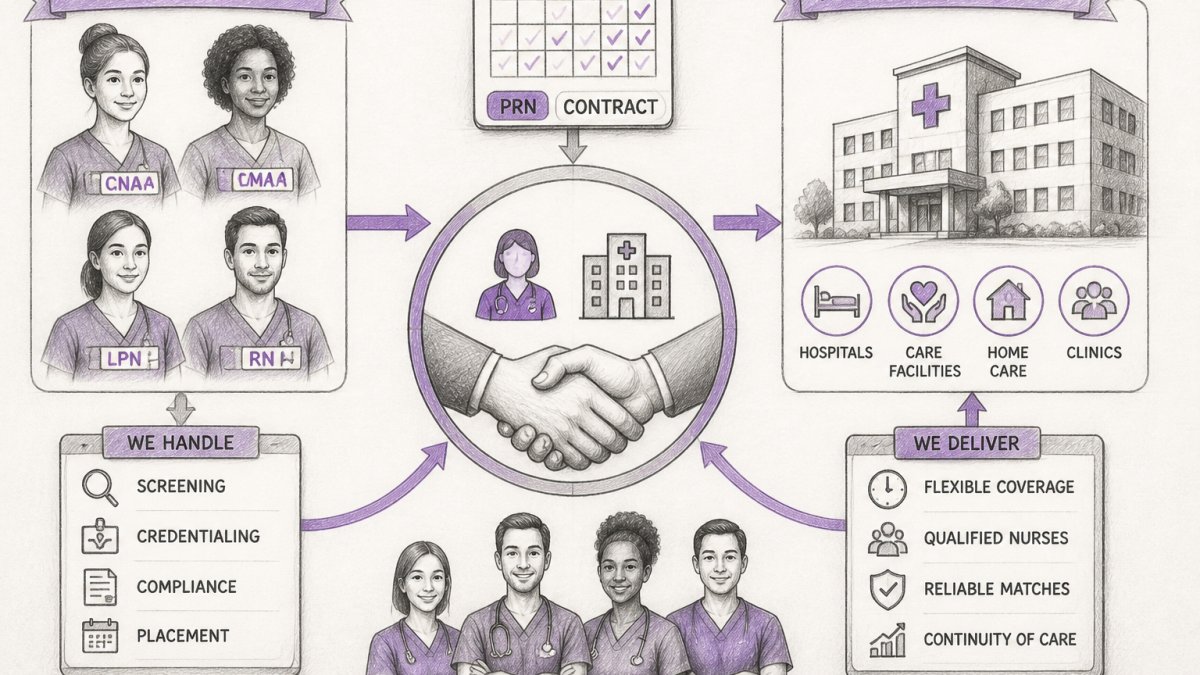
Long-term nursing staff placement is the process of matching a facility with a consistent caregiver or care team for an extended period, often spanning several weeks or running indefinitely. It covers credential verification, facility orientation, and ongoing check-ins, not just a name on a schedule.
Here's what a full placement relationship typically includes:
- Role scoping based on your census, acuity, and shift patterns
- License and certification verification before anyone reaches your floor
- Orientation to your policies, documentation system, and unit routines
- Ongoing communication between your leadership and the agency
- Replacement support when a caregiver cannot continue
PRN Coverage vs. Long-Term Placements
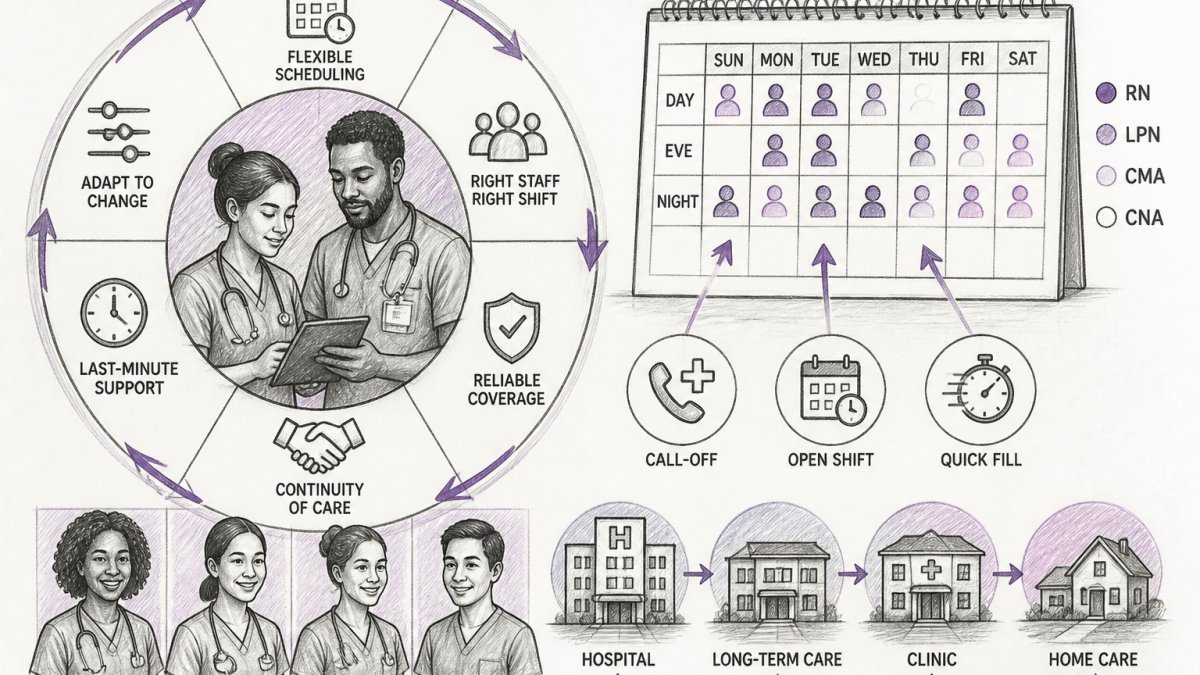
PRN coverage fills a gap. Long-term placement builds continuity. Facilities usually need both, and the request process differs for each.
PRN, or "as needed," staffing covers callouts, vacations, and census spikes. The priority is speed. Long-term placement prioritizes fit and reliability, because the same caregiver returns to your residents shift after shift. A nurse who knows which resident needs a slower walk to the dining room is worth more than a fast fill.
Most facilities start with PRN coverage and move toward long-term placement once they find caregivers who match their culture. We plan for that path from the first request.
How to Request Nursing Staff for a Facility
To request nursing staff for a facility, start with one clear message that names your roles, shift times, unit type, and start date. The more specific your first request, the faster a recruiter can match qualified candidates to your needs.
Vague requests are the number one reason placements stall. "We need a nurse" tells a recruiter almost nothing. "We need an LPN for a 6 a.m. to 2 p.m. medication pass shift on a 40-bed long-term care unit starting Monday" tells them everything.
Send your request with these details:
- Role and license level needed (CNA, CMA, LPN, or RN)
- Shift times and days per week
- Unit type and resident acuity
- Start date and expected duration
- Any required certifications or documentation systems
Expect a follow-up call to confirm details and discuss candidates. Availability depends on current facility needs, so we confirm what is realistic before promising anything. You should never hear a yes that our roster cannot back up.
What Long-Term Nursing Staff Placement Looks Like in Practice
In practice, long-term nursing staff placement runs on a simple rhythm: your facility states the need, we verify and match candidates, orientation happens, and then we stay in contact for the life of the placement. The work does not end at the first shift.
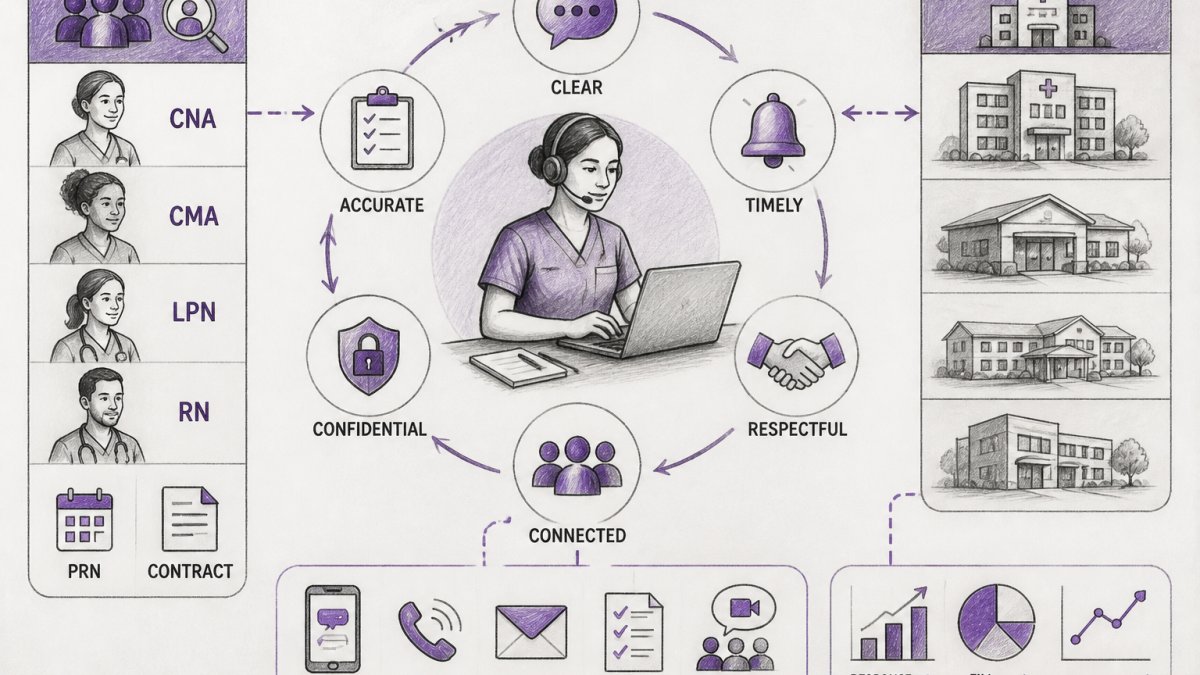
Communication keeps a placement healthy. A caregiver who feels supported shows up differently than one who was dropped onto a unit with no introduction. We check in with both sides, and we want your nurse manager to call us early when something feels off, not after a resignation.
Good communication practices for agency relationships make the difference between a placement that lasts a quarter and one that lasts a year. Facilities that share feedback quickly tend to keep the same caregivers longer.
Your Nursing Staff Onboarding Checklist
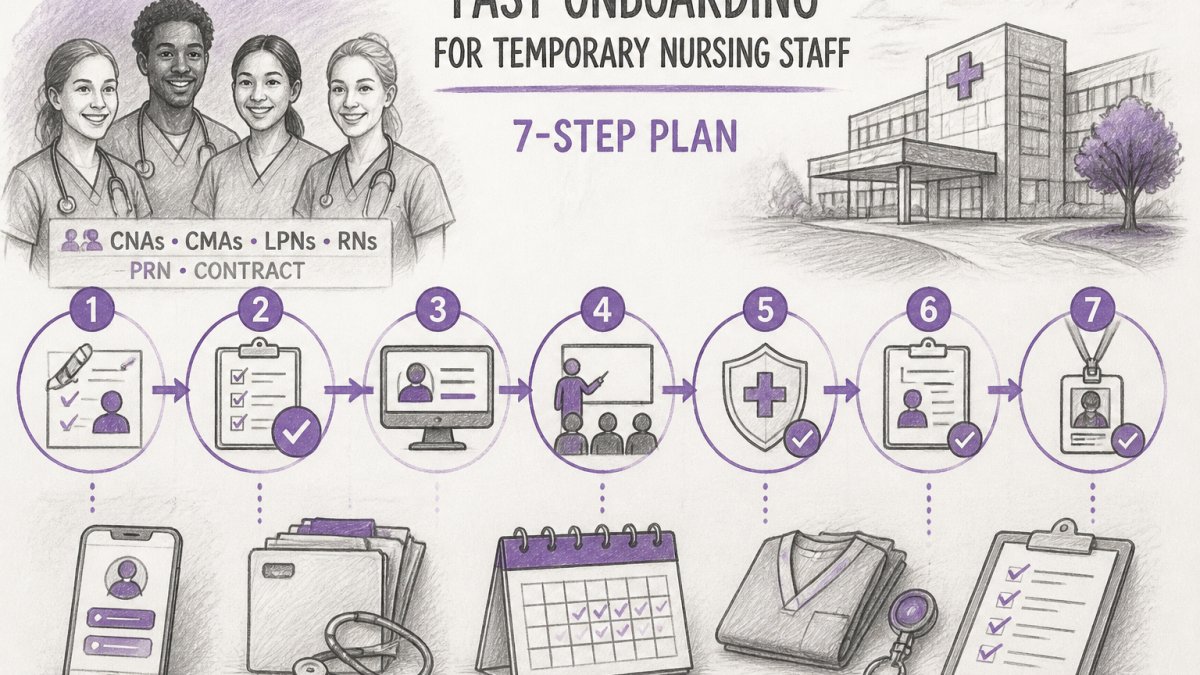
A nursing staff onboarding checklist is a shared list of steps your facility and the agency complete before a caregiver works independently. It protects residents, protects your license, and gets a new hire productive faster.
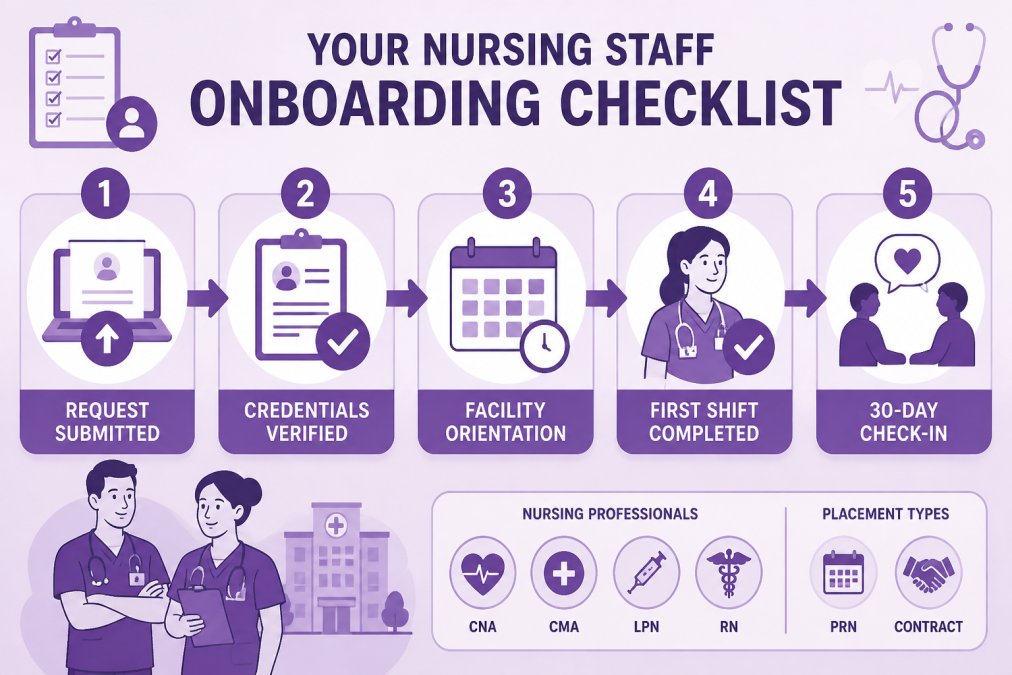
Before the First Shift
- Confirm license and certification are current and verified
- Share your policies, documentation system, and unit routines
- Assign a preceptor or point of contact for the first shift
- Confirm shift times, parking, badge pickup, and dress code
- Review resident acuity and any behavioral care notes
The First Two Weeks
- Pair the caregiver with an experienced staff member
- Check in after the first shift and the first week
- Collect feedback from the charge nurse
- Confirm the schedule for the following weeks
- Escalate any fit concerns to the agency immediately
If you want a deeper walkthrough, our step-by-step plan for getting temporary nursing staff shift-ready covers each stage in more detail.
Roles You Can Request and How Facilities Get Matched
Facilities can request CNAs, CMAs, LPNs, and RNs, and matching depends on license level, unit needs, and shift availability. We match by skill and setting, not just by who is free that week.
| Role | Typical Setting | What They Cover |
|---|---|---|
| CNA | Long-term care, assisted living | Daily living support, mobility, resident comfort |
| CMA | Skilled nursing, clinics | Medication administration under supervision |
| LPN | Long-term care, rural hospitals | Direct care, medication passes, charting |
| RN | Hospitals, skilled nursing | Assessment, care planning, supervision |
Matching starts with your unit. A rural hospital with a small night crew needs a different kind of nurse than a 120-bed skilled nursing community with a full therapy department. We ask about your team before we send a name.
If you are still deciding which roles to request, our guide on hiring skilled nursing professionals for specific shifts breaks down how each license level fits different coverage needs.
Common Mistakes That Slow Down a Nursing Placement
The biggest mistake facilities make is treating a placement request like a purchase order. Before you commit, it helps to review nursing agency pricing models for facilities so you understand the structures involved. Nursing placement is a relationship, and the facilities that communicate early and clearly get caregivers on the floor faster.
Other slowdowns we see often:
- Waiting until the schedule is already broken. A request sent the morning of a callout limits options. Send it as soon as you see the gap forming.
- Skipping orientation to save a day. A caregiver who does not know your documentation system loses that day anyway, and residents feel it.
- Not naming a point of contact. When three people give an agency three different answers, the placement stalls.
- Ignoring small fit issues. A quick conversation in week one prevents a resignation in week six.
Start Your Long-Term Nursing Placement Request
Ready to request long term nursing placement services? Send us your roles, shifts, and start date, and we will tell you honestly what we can cover. Major Staffing is a nurse-led agency, so the person reviewing your request has worked a floor and knows what a short-staffed unit actually feels like.
We work with long-term care communities, assisted living residences, and rural hospitals. Availability depends on current facility needs, and we confirm details before we commit.
If you want to see how we approach skilled nursing partnerships, read about our work as a nurse staffing partner for skilled nursing facilities. Then send your request through majorstaffingsolutions.com or message the Major Staffing page to learn about current opportunities. Tell us what your unit needs this week, and we will start there.
Frequently Asked Questions
How do I request long-term nursing placement services?
Start by contacting a nurse-led staffing agency and describing your facility, the roles you need, and your expected start date. Be ready to share your current census, shift patterns, and any credential requirements. The agency then matches nurses to your setting and confirms availability. At Major Staffing, you can submit a request through https://majorstaffingsolutions.com/ or message the page to talk through current opportunities and timelines.
What information should a facility provide when requesting nursing staff?
Provide the role types (CNA, CMA, LPN, or RN), the number of staff needed, shift times, and the expected length of the placement. Include your facility type, such as long-term care, assisted living, or a rural hospital, plus any unit-specific requirements. Share your onboarding process and point of contact so the agency can prepare nurses before the first shift. Clear details reduce back-and-forth and speed up matching.
How far in advance should a facility request long-term nursing coverage?
For long-term placements, earlier is better. Reach out as soon as you know about an upcoming vacancy, leave, or census increase so the agency has time to match the right nurse to your setting. Last-minute shift coverage is also available depending on current facility needs, but long-term placements benefit from advance planning. A short conversation about your timeline helps the agency set realistic expectations.
What should facilities confirm before a nurse starts a placement?
Confirm the nurse's license and credentials, the start date and shift schedule, and who will orient them on the unit. Walk through your onboarding checklist, including facility tour, documentation, and emergency procedures. Make sure the nurse has a named contact for questions. A brief pre-start call with the nurse and agency helps everyone arrive on the same page and supports a smooth first shift.
Your residents deserve caregivers who show up and know their names. Send your request today, and let Major Staffing match your facility with nurses and aides who treat every shift like it matters.