 How-to
How to Streamline Nursing Onboarding Step by Step?
Last Updated: November 7, 2026
Quick Summary
Streamlining nursing onboarding starts with a standardized plan that every unit follows, with preboarding tasks such as credentialing, logins, and preceptor assignment finished before day one. Use a shared orientation checklist, a phased program with named owners, and a competency assessment with clear criteria.
- Complete license checks, background checks, logins, and badge requests before the nurse's first shift.
- Assign each onboarding milestone a named owner and a concrete deliverable, such as a signed checklist.
- Schedule day-30 and day-90 reviews on the calendar at the start of orientation.
- Assess core skills in real settings, marking each as meets, needs practice, or not yet observed.
- Review progress monthly and fix small issues before they lead to rehiring.
Table of Contents
- Why Nursing Onboarding Breaks Down and What It Costs
- Step 1: Build a Standardized Onboarding Plan
- Step 2: Create a Nursing Orientation Checklist
- Step 3: Map a Sample Orientation Program for Newly Hired Nurses
- Step 4: Assess Competency with an Orientation Nursing Assessment
- Step 5: Assign Preceptors and Shared Accountability
- Nursing Onboarding Best Practices and Common Failure Points
- Start Your Next Onboarding Cycle With a Staffing Partner
- Frequently Asked Questions
Why Nursing Onboarding Breaks Down and What It Costs
Most nursing onboarding problems start before the first shift. A new nurse arrives with no badge, no login, and no clear idea of who to ask for help. Delays like this slow everything down.
The cost shows up fast. Slow orientation keeps new nurses off the schedule longer, leaves experienced staff covering gaps, and raises the chance of errors during the early weeks. A clear process can cut that friction. Read how turnover from poor onboarding affects patient care and costs for a closer look at the impact.
Common breakdowns include:
- Paperwork and credentialing that stall for days
- No single person owns the onboarding plan
- Orientation that varies by unit or by shift
- New hires who do not know who their preceptor is
- Competency checks that happen too late, or not at all
The fix is not complicated. It starts with a plan that every unit follows, and it ends with a clear check that the nurse is ready to work alone.
Step 1: Build a Standardized Onboarding Plan
A standard plan gives every new nurse the same starting point. It should list each task, who owns it, and when it must be done. This turns onboarding from a guessing game into a repeatable routine.
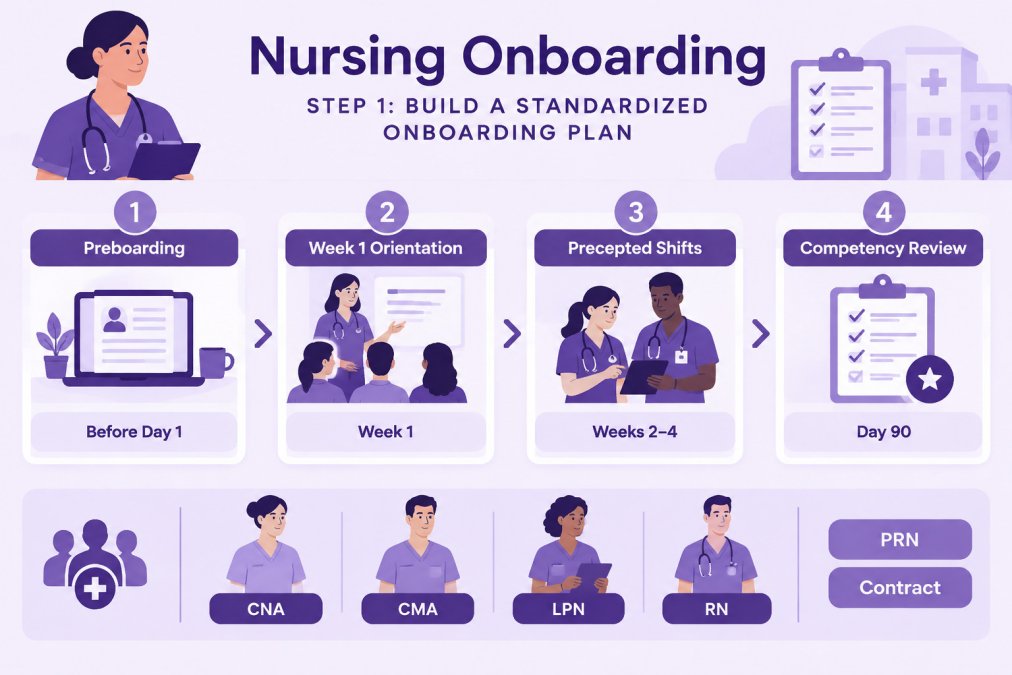
Start with a one-page timeline. Cover the days before arrival, the first week, and the first 90 days. Keep it short enough that a nurse manager can review it in a few minutes.
Your timeline should answer these questions:
- What must be finished before day one?
- Who meets the nurse on arrival?
- When does the first precepted shift happen?
- When is the first competency review?
Share the plan with HR, unit leads, and the new nurse. When everyone sees the same dates, fewer tasks slip through the cracks.
Preboarding Tasks Completed Before the First Shift
Preboarding is where many delays can be prevented, since much of the paperwork can be handled before the nurse ever walks onto the unit.
Complete these tasks before day one:
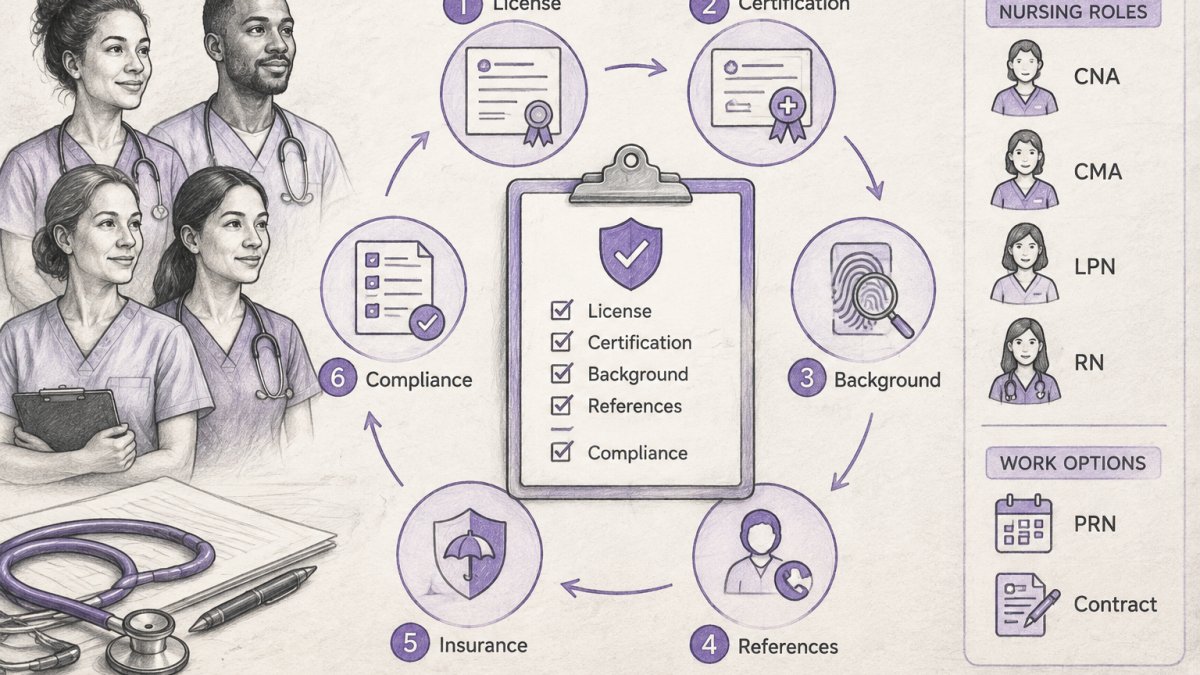
- Verify license and certifications
- Run background and reference checks
- Send login and badge requests to IT and security
- Share the unit schedule and parking or entry details
- Assign a named preceptor
When preboarding is finished early, the first shift can focus on learning the unit instead of chasing forms.
Step 2: Create a Nursing Orientation Checklist
A nursing orientation checklist turns the plan into daily action. It is a simple list of items that a nurse and a preceptor can check off together. A good checklist keeps orientation consistent from one nurse to the next.
Organize the checklist by area so it is easy to scan:
- Facility basics: tour, emergency exits, supply rooms
- Systems: EHR logins, medication tools, alarms
- Clinical routines: shift handoff, charting, rounding
- Safety: infection control, fall prevention, patient ID steps
- Team contacts: charge nurse, unit manager, on-call lead
Keep the checklist in a shared place both the nurse and preceptor can open. Each item should have a space for the date it was completed and the initials of the person who signed off.
A checklist is most useful when it is short. If it runs past a few pages, many nurses will skim it and miss key items.
Step 3: Map a Sample Orientation Program for Newly Hired Nurses
A sample orientation program shows how the checklist fits into real time. It gives the nurse a clear picture of what each week looks like, and it gives managers a way to plan staffing around orientation instead of reacting to it. The most useful version is a phased timeline with a named owner and a concrete deliverable at every milestone.
A typical program for a newly hired nurse might look like this:
| Phase | Timing | Focus | Owner | Deliverable / Sign-Off |
|---|---|---|---|---|
| Preboarding | Before day 1 | Credentialing, badge, logins, preceptor assignment | HR and recruiter | Completed preboarding checklist; named preceptor confirmed |
| Week 1 | Days 1-5 | Facility tour, systems training, shadowing | Nurse educator and preceptor | Systems access verified; orientation checklist started |
| Weeks 2-4 | Days 6-28 | Precepted shifts with growing responsibility | Preceptor | Weekly feedback note; competency items marked as observed |
| Day 30 | Week 5 | Progress review against the checklist | Nurse manager | Written 30-day review; remediation plan if any item is unmet |
| Days 31-60 | Month 2 | Independent shifts with backup available | Charge nurse and preceptor | Competency log complete for core skills |
| Day 90 | Month 3 | Final competency review and goal setting | Nurse manager and educator | Signed competency record; retention check-in |
Adjust the program for the setting. A long-term care unit, an assisted living site, and a rural hospital each have different daily routines and staffing patterns. Keep the structure the same and change the details to match the unit.
Watch out: many programs plan the first week well but leave the middle weeks vague. A nurse who does not know what to expect by week three often feels lost, so put a clear goal and a named owner on every phase, not just the first and last.
Two mechanics make the timeline stick. First, tie each milestone to a document the manager can actually see: a signed checklist, a competency log, or a short review note. Second, schedule the 30- and 90-day reviews on the calendar at the start, not when someone remembers.
Finally, build in a short feedback loop at each milestone. Ask the new nurse two questions: what is still unclear, and who has helped most. The answers tell you where the plan is thin and which preceptors are carrying the load.
Step 4: Assess Competency with an Orientation Nursing Assessment
An orientation nursing assessment confirms that the nurse can perform core tasks safely. It should be done in real settings, not just on paper. The goal is to find gaps early, while there is still time to close them.
Use a short, scored assessment with clear criteria. Each skill should be marked as meets, needs practice, or not yet observed. Record the date and the observer for each mark.
Core areas to assess usually include:
- Medication administration and documentation
- Patient assessment and vital signs
- Communication during handoff
- Response to emergencies and alarms
- Infection control steps
When a nurse does not meet a skill, set a specific next step and a new check date. Clear feedback helps nurses improve and gives managers a fair record.
Step 5: Assign Preceptors and Shared Accountability
A preceptor is an experienced nurse who guides the new hire through the first weeks. Choosing the right preceptor matters as much as the plan itself. A good preceptor is patient, consistent, and available during the shifts they are paired.
Set clear expectations for preceptors:
- Schedule overlapping shifts when possible
- Give daily feedback, even when it is brief
- Report concerns to the nurse manager the same day
- Sign off checklist items only after observing them
Accountability should be shared. The nurse manager owns the overall plan, the educator owns training content, the preceptor owns daily guidance, and the new nurse owns asking questions and tracking their own checklist. When each role is clear, fewer tasks fall through the cracks.
Nursing Onboarding Best Practices and Common Failure Points
Several habits separate smooth onboarding from rough onboarding. Facilities that do these well tend to see new nurses settle in faster, and they catch problems while there is still time to fix them. The difference is rarely a bigger budget, it is a plan that gets checked and a response that is consistent when something slips.
Best practices include:
- Reviewing the plan with each new hire on day one, in person
- Keeping one shared checklist for every unit, with a single owner
- Checking progress at day 30 and day 90 against written criteria
- Collecting short feedback from new nurses each month
- Updating the plan when a unit changes its routines
Common failure points include:
- Preceptors who are pulled off the unit without notice
- Checklists that nobody updates
- Competency checks skipped during busy weeks
- New nurses who are afraid to ask questions
- Plans written once and never reviewed
Naming the failures is the easy part. Our guide to reducing nursing burnout in facilities covers strategies for the burnout that drives new-hire attrition. The harder part is spotting them early and responding the same way every time. A few practical signals help:
- A competency item still marked "not yet observed" past its scheduled week usually means the preceptor pairing is not working, not that the nurse cannot learn the skill.
- A new nurse who stops asking questions after week two is often disengaging rather than settling in. A short check-in from the manager surfaces this faster than a formal review.
- A preceptor who cancels overlapping shifts more than once in a two-week stretch is a scheduling problem that will delay the whole timeline.
When a milestone is missed, use a short, consistent response: identify the specific skill or task, set a new check date, assign one person to observe it, and record the outcome. This keeps remediation fair to the nurse and gives the manager a clear record. Avoid the common habit of extending orientation indefinitely without a new target, it hides the problem instead of solving it.
Measuring the process matters as much as running it. Track a few simple numbers: how long it takes a new nurse to work independently, how many competency items are signed off on schedule, how many new hires stay past 90 days, and how new nurses rate their first month. Establish a baseline before you change anything, then compare against it each quarter.
Watch out: a plan that is reviewed only when something goes wrong tends to drift. Put a short monthly review on the calendar, look at the signals above, and fix small issues before they turn into a rehire.
Start Your Next Onboarding Cycle With a Staffing Partner
Simplifying nursing onboarding takes steady work, and it is easier when staffing needs are steady too. Learn about long-term nursing placement services if you need staffing beyond short-term shifts. Major Staffing works with facilities that need dependable nurses. A good start on the floor depends on preparation, respect, and support. If you are planning your next onboarding cycle, reach out to Major Staffing to talk through your needs.
Frequently Asked Questions
What should a nursing orientation checklist include?
A useful nursing orientation checklist covers administrative items such as license verification, credentialing and badge access, followed by clinical items: unit policies, medication administration procedures, documentation systems, infection control, emergency response and equipment training. Each item should have an owner, a due date and a sign-off field. Review the checklist with the new nurse on day one so both sides know what is complete and what is still pending.
How long should nurse orientation last?
Orientation length depends on the unit, the nurse's experience and the complexity of the patient population. Many facilities use a phased structure that begins with several shifts of guided practice and extends with a preceptor for several weeks, then a formal review. Set the length by defined competencies rather than a fixed calendar, and document when each nurse meets them.
How can I improve the nursing onboarding process?
Start by measuring where delays occur, such as paperwork completion, time to first precepted shift or time to independent practice. Standardize the plan so every new nurse follows the same core steps, then adapt only the clinical content for specialty. Gather feedback from new hires at the end of weeks one, four and twelve, and use that feedback to revise the checklist and preceptor assignments.
What is the difference between nurse orientation and onboarding?
Onboarding is the broader process that starts when a nurse accepts an offer and includes preboarding, credentialing, system access and introductions. Orientation is the structured clinical portion that begins on the first shift and focuses on role-specific skills, policies and competency validation. A streamlined program connects the two so that administrative tasks finish before the nurse is expected to work independently.