 How-to
7 Flexible Nursing Shifts That Improve Work-Life Balance
Last Updated: November 12, 2026
Quick Summary
Flexible nursing shifts are schedules that let you choose when, where, and how often you work, such as 8s, 10s, 12s, Baylor, seven-on/seven-off, and PRN. Choosing a pattern that fits your sleep, caregiving, commute, and recovery protects your balance and helps prevent burnout.
- Three 12-hour shifts grouped together are easier to manage when followed by a real block of rest.
- Block scheduling suits nurses who share caregiving duties or want to stack work into fewer, denser stretches.
- PRN nursing jobs are shifts you accept as facility needs allow, with no fixed weekly commitment.
- Cap your consecutive shifts and protect one full day off each week to sustain recovery.
- Tell your manager or agency your availability and shift limits before the schedule is built.
Table of Contents
- Why Flexible Nursing Shifts Change How the Week Feels
- The Shift Patterns Worth Knowing Before You Commit
- How Flexible Nursing Shifts Support Nurse Work-Life Balance
- PRN Nursing Jobs: Flexibility Without the Full-Time Grid
- Nurse Burnout Prevention Starts With the Schedule You Choose
- Nurse Scheduling Best Practices for Talking to a Manager or Agency
- Matching a Shift Pattern to Your Life Stage
- Telling Major Staffing Which Shifts Fit Your Life
- Frequently Asked Questions
Why Flexible Nursing Shifts Change How the Week Feels
Flexible nursing shifts are work schedules that let you choose when, where, and how often you work instead of locking into one fixed slot. At Major Staffing, we hear the same thing from nurses and aides across Kansas: the schedule decides how the week feels. A good one leaves room to breathe. A bad one drains you before your days off arrive.
The hours are long, the work is physical, and the need for coverage never stops. That is why the CDC guidance on shift work and long hours matters here. It notes that long and irregular shifts can affect sleep, alertness, and safety on the job. Schedule choice is not a small perk. It is a health decision.
Below, we break down the real shift patterns, the trade-offs, and how to pick what fits your life. If you want to see how flexible staffing works in practice, read our guide to flexible nursing shift staffing solutions that work.
The Shift Patterns Worth Knowing Before You Commit
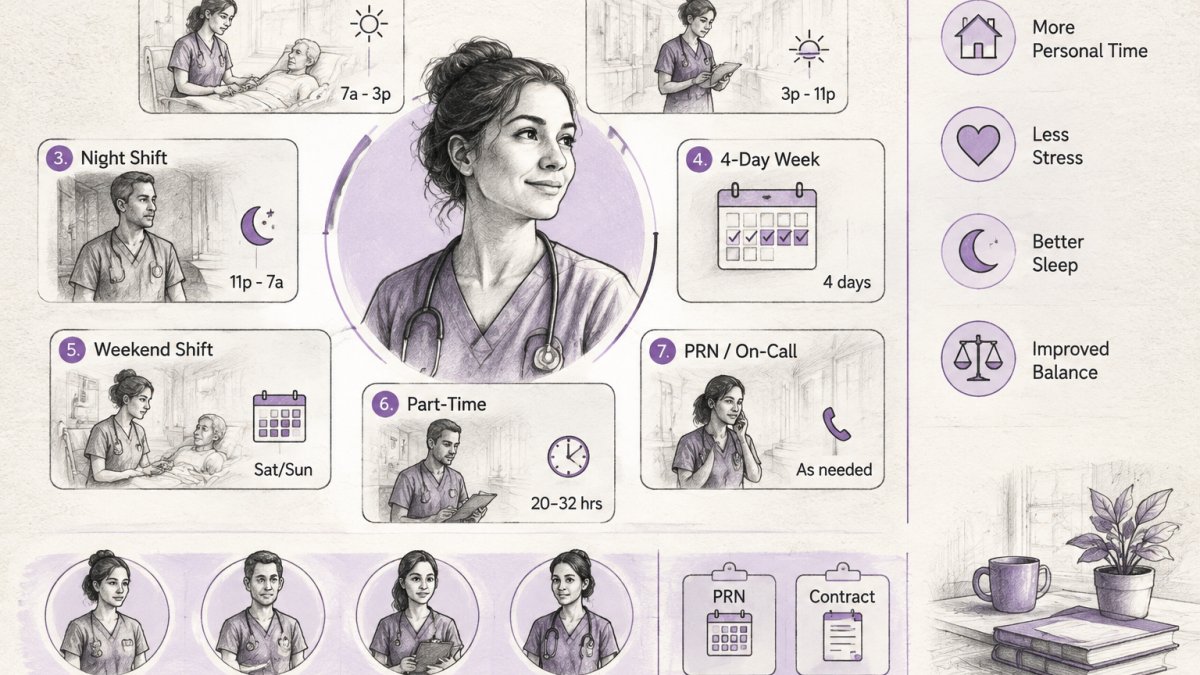
Most nurses know the big three: 8s, 10s, and 12s. Each pattern fits sleep, caregiving, and recovery time differently.
- 8-hour shifts: five days a week, steady and predictable.
- 10-hour shifts: four days a week, one extra recovery day.
- 12-hour shifts: three days a week, long but fewer commutes.
- Baylor schedule: weekend doubles traded for weekday time off.
- Seven-on/seven-off: a full week on, then a full week off.
- PRN: you pick up shifts as facility needs allow.
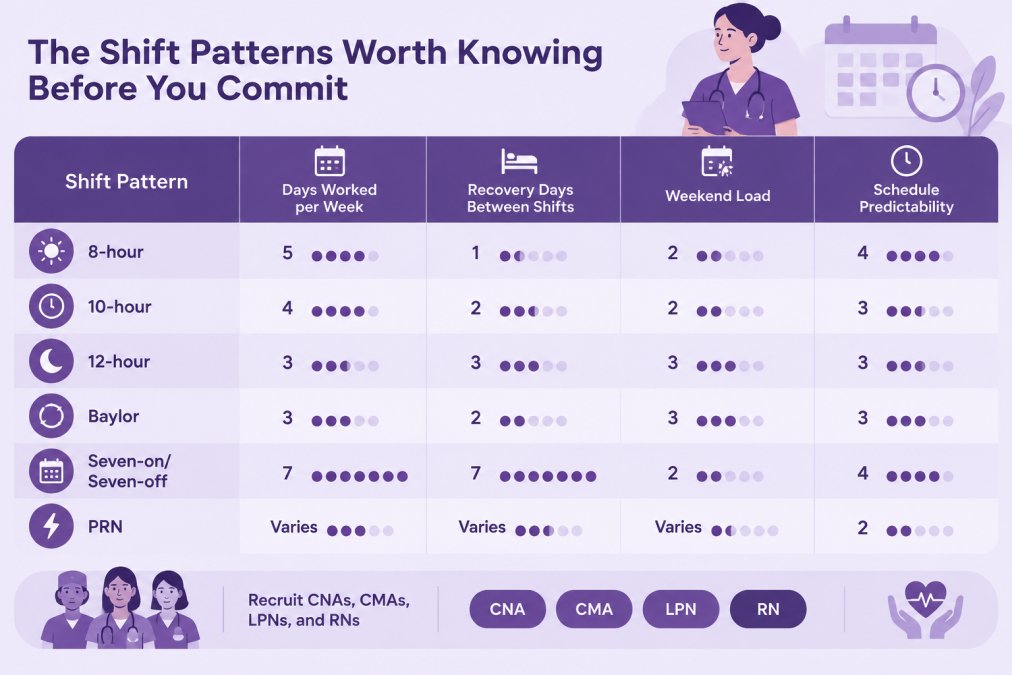
Each pattern changes your days worked, recovery time, and weekend load. The trick is comparing them on the dimensions that actually shape your week.
8-Hour, 10-Hour, and 12-Hour Shifts Side by Side
The 12-hour shift gives you more days off, but the long hours take a toll. The 8-hour shift gives you a normal rhythm but takes five days. The 10-hour sits in the middle for people who want one extra day without a full marathon shift.
A useful way to compare them is to sketch a sample week for each:
- 3x12: Work Monday, Tuesday, Wednesday; off Thursday through Sunday. Four consecutive days off, but three long shifts back-to-back with limited recovery between them.
- 4x10: Work Monday, Tuesday, Thursday, Friday; off Wednesday plus the weekend. One mid-week recovery day breaks up the stretch.
- 5x8: Work Monday through Friday; off Saturday and Sunday. Predictable, but five days of commute and five days of work clothes.
Three 12-hour shifts are generally easier to manage when grouped and followed by a real block of rest rather than scattered across the week.
Block Scheduling, Baylor, and Seven-On/Seven-Off
Block scheduling means you work several shifts in a row, then get a stretch off. It suits nurses who share caregiving duties or who want to stack work into fewer, denser stretches. The Baylor schedule packs weekends into longer blocks, often two doubles, in exchange for weekday time off. Seven-on/seven-off is the most extreme trade: a hard week, then a full week free.
A Decision Framework for Choosing Your Pattern
Before you commit to a pattern, run it against five questions:
- Sleep: Can you get consistent sleep between shifts, or does the pattern force you to flip day and night repeatedly?
- Caregiving: Does the pattern give you reliable blocks for school pickup, elder care, or appointments?
- Commute: How many days a week are you willing to make the trip? Fewer, longer shifts cut commute days; more, shorter shifts spread them out.
- Income goals: Do you need steady full-time hours, or can you absorb the variability of PRN?
- Recovery: How many consecutive shifts can you work before your alertness and mood drop?
Write your answers down. The pattern that scores well on sleep and recovery but poorly on income may still be right for a season, and the reverse is true too. The point is to choose on purpose rather than default into whatever is offered first.
A pattern that looks great on paper can fall apart if you have not counted the recovery hours between shifts, not just the days off.
How Flexible Nursing Shifts Support Nurse Work-Life Balance
Nurse work-life balance improves when you control your schedule instead of reacting to it. The NIOSH resources on work and well-being point to schedule control as a real factor in stress and fatigue. When you choose your shifts, you can protect sleep, family time, and recovery.
That control looks different for everyone. A parent may want school-hour shifts. A new grad may want steady full-time hours to build skills. Someone nearing retirement may want lighter PRN work. Flexible nursing shifts make room for all three.
The key is honesty about what you need. Pick the pattern that fits your real week, not the one that sounds best on paper.
PRN Nursing Jobs: Flexibility Without the Full-Time Grid
PRN nursing jobs are shifts you accept as facility needs allow, with no fixed weekly commitment. Some weeks are busy. Some are quiet. That is the trade.
PRN suits people who want variety or who are balancing school, family, or another role. It also asks something of you: reliable communication and honoring the shifts you accept. Facilities count on that.
If you are weighing PRN work, our article on how per diem nursing agencies support facility staffing needs explains how the model works on both sides.
Nurse Burnout Prevention Starts With the Schedule You Choose
Nurse burnout prevention often starts with something simple: a schedule you can sustain. The American Nurses Association on nurse well-being has long flagged burnout as a core issue for the profession. Schedule fit is one lever you actually control.
Watch out: saying yes to every open shift feels productive until recovery time disappears. Build in rest on purpose.
A few habits help:
- Cap your consecutive shifts before you hit a wall.
- Protect one full day off each week.
- Tell your agency when you need a lighter stretch.
Small choices add up. For a deeper plan, see how to reduce nursing burnout in facilities.
Nurse Scheduling Best Practices for Talking to a Manager or Agency
Clear, early communication helps with scheduling. Tell your manager or agency your availability, your limits, and your preferred shift length before the schedule is built, not after. But knowing you should speak up and knowing what to say are two different things. Here is how to prepare and what to actually say.
Prepare Before the Conversation
- Write down your availability for the next four to six weeks, including recurring commitments.
- Name the shift lengths you will accept and the ones you will not.
- Identify one or two realistic requests, a trial schedule, a swap, or a lighter stretch, rather than a long list.
- Bring a specific ask, not a general complaint.
Scripts You Can Adapt
For a trial arrangement:
"I would like to try a 10-hour schedule for the next four weeks to see how it fits my recovery and family time. Can we review it together at the end of the trial?"
For a shift swap:
"I have a commitment on Thursday. I have already asked a colleague who is willing to cover, and I can pick up their Friday shift in return. Would that work for the schedule?"
For a lighter stretch:
"I have a heavy personal stretch coming up in two weeks. I can still work my regular shifts, but I would like to hold off on extra pickups until it passes."
For setting limits:
"I can work up to three consecutive shifts. Beyond that, my alertness drops, and I would rather give you a full effort on three than a stretched effort on five."
What to Expect From a Good Agency
At Major Staffing, we are nurse-led, so the person on the other end of the phone understands floor work. We match nurses to current facility needs with availability depending on those needs.
Watch out: agreeing to a schedule you cannot sustain to avoid an awkward conversation usually backfires, missed shifts and last-minute swaps damage the trust you are trying to build.
Matching a Shift Pattern to Your Life Stage
The right pattern changes as your life does. Here is how it often breaks down:
| Life stage | Common fit | Why it works |
|---|---|---|
| New grad | Full-time 12s or 8s | Builds skills and steady income |
| Parent or caregiver | PRN or block scheduling | Protects family time |
| Mid-career | 10s or Baylor | Balances hours and recovery |
| Nearing retirement | PRN or part-time | Lighter load, kept skills sharp |
None of these is a rule. They are starting points. Your health, commute, and goals decide the rest.
Telling Major Staffing Which Shifts Fit Your Life
The last step is the easiest. Tell us what you want. Major Staffing is a nurse-led agency built on partnership rather than simple placement. We staff long-term care, assisted living, and rural hospital settings, with availability depending on current facility needs.
When you reach out, share:
- Your license or certification
- The shift lengths you prefer
- Your weekly availability
- How far you are willing to travel
We match reliable CNAs, CMAs, LPNs, and RNs to shifts that fit. You can also see how to get matched with shifts that fit your life.
Your skills matter most where they are needed and where you can keep showing up well. Major Staffing connects you to PRN and contract opportunities with supportive communication and a team that understands the floor. Get started with Major Staffing and find shifts that respect your time and your care.
Frequently Asked Questions
What kind of nurse has the most flexible schedule?
Per diem and PRN nurses usually have the most control over when they work, because they pick up shifts based on current facility needs rather than a fixed rotation. Nurses on block schedules or self-scheduling units also get meaningful flexibility inside a full-time role. The trade-off is income stability: PRN hours rise and fall with staffing demand, so many nurses combine a part-time or PRN position with occasional shift pickup to keep both flexibility and a steady baseline.
Can PRN nursing jobs improve work-life balance?
For many nurses, yes. PRN nursing jobs let you decline shifts that collide with family responsibilities, appointments, or recovery time, and you can stack shifts into a short stretch instead of spreading them across the week. The catch is that you need to plan ahead: track your hours, keep your availability updated with the agency, and confirm shift commitments early. Nurses who communicate clearly and honor the shifts they accept tend to get first pick of future openings.
How do nurses avoid burnout when working flexible shifts?
Flexibility only helps if you protect the recovery time it creates. Keep a consistent sleep window even when shift start times move, avoid stacking night shifts back-to-back without a full day off between them, and say no to pickups when you are already depleted. Nurse burnout prevention also means watching the signals early: irritability, dreading shifts, and poor sleep are reasons to adjust your pattern, not push through. A schedule you can sustain beats one that looks impressive on paper.
How can nurses find flexible shifts in their area?
Start by deciding which pattern you actually want, then ask directly. With an employer, request self-scheduling, block scheduling, or a set weekend rotation during hiring or your review. With an agency, tell them your availability, the shift lengths you prefer, and how far ahead you need notice. Major Staffing works with nurses and aides across long-term care, assisted living, and rural hospital settings, and current openings depend on facility needs, so the fastest path is to apply at majorstaffingsolutions.com or message the page to ask what is available now.