 Comparison
How to Choose Between Per Diem and Long-Term Nursing Work
Last Updated: November 19, 2026
Quick Summary
Choosing between per diem long-term work comes down to whether you want control over your calendar or predictability in your paycheck. Per diem offers shift-by-shift flexibility, while a long-term role gives you a set schedule and steadier hours. Neither path wins for everyone, so weigh your income floor and non-negotiables first.
- Per diem nursing is shift-by-shift work you accept based on current facility needs.
- A long-term role is a set schedule with a defined assignment duration.
- Nursing contract duration is the biggest factor in how predictable a per diem long-term schedule feels.
- A per diem rate that looks generous can shrink once you account for unpaid gaps between shifts.
- You can keep a stable long-term role and pick up occasional per diem shifts to test a new facility.
Table of Contents
- The Real Trade-Offs in Per Diem vs. Long-Term Nursing Work
- What Per Diem and Long-Term Roles Actually Look Like Day to Day
- How Nursing Contract Duration Shapes Your Income and Stability
- The Benefits of Per Diem Nursing for Flexibility and Control
- Comparing Total Compensation, Benefits, and Paid Time Off
- A Decision Framework for Your Schedule, Finances, and Career Goals
- Where Major Staffing Fits Your Next Move
- Frequently Asked Questions
The Real Trade-Offs in Per Diem vs. Long-Term Nursing Work
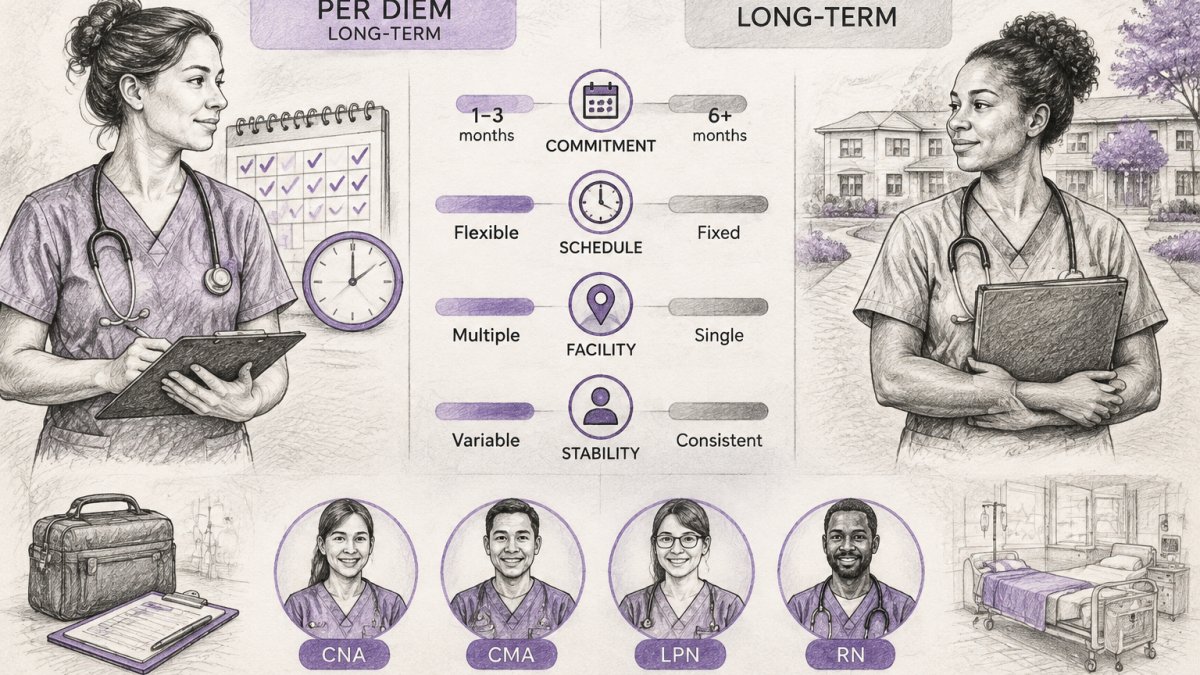
Choosing between per diem long-term work models comes down to one question: do you want control over your calendar or predictability in your paycheck? At Major Staffing, we talk with nurses and aides every week who are weighing exactly that trade-off, and the honest answer is that neither path wins for everyone.
Per diem nursing is shift-by-shift work you accept based on current facility needs. A long-term role is a set schedule with a defined assignment duration. The gap between them isn't just hours. It's how you budget, how you plan childcare, and how much say you have over your week.
Below, we break down both models honestly, including the parts most job posts skip.
What Per Diem and Long-Term Roles Actually Look Like Day to Day
The daily rhythm of each model looks completely different, and that difference matters more than any hourly rate.
A Typical Per Diem Week
You pick up shifts as they post. Some weeks you work three twelves; others you work one. You confirm availability, show up ready, and learn a new unit's routines each time. Flexibility is real, but so is the admin work of watching for openings.
A Typical Long-Term Assignment
You report to the same facility, same unit, same residents, on a repeating schedule. You learn the charting system once. You build rapport with the care team. The trade-off is less room to take a random Tuesday off.
How Nursing Contract Duration Shapes Your Income and Stability
Nursing contract duration is the single biggest factor in how predictable a per diem long-term schedule feels. A longer assignment gives you a stable number of scheduled shifts across weeks, which makes budgeting far easier. Short per diem shifts pay you for exactly what you work, so a light week means a lighter paycheck.
That volatility isn't a flaw, it's a feature you plan around. Nurses who do per diem well usually keep a cushion for slow stretches and confirm upcoming availability early. If steady income matters most right now, a longer assignment removes the guesswork.
The Benefits of Per Diem Nursing for Flexibility and Control
The benefits of per diem nursing center on schedule control. You decide which days you're available, and you build a work week around school pickups, appointments, or a second commitment.
- Choose shifts around your life instead of the reverse
The catch: you carry more of the planning. Per diem rewards people who communicate early and honor the shifts they accept. Facilities count on that reliability, and so do your teammates.
Comparing Total Compensation, Benefits, and Paid Time Off
Total compensation is more than the hourly rate on a posting. It includes weekly pay consistency, health insurance eligibility, retirement plan access, paid time off, and how many hours you can actually count on. Two roles can post the same hourly rate and still leave you in very different places by the end of a year.
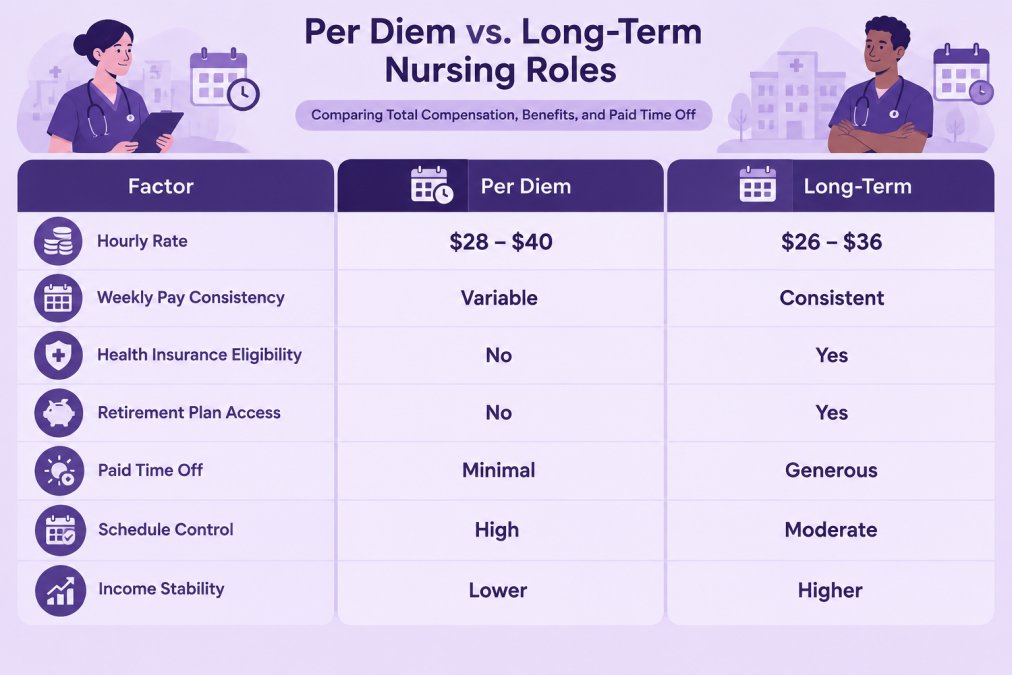
| Factor | Per Diem | Long-Term Role |
|---|---|---|
| Hourly rate | Often higher per shift | Often steadier overall |
| Weekly pay | Varies with shifts worked | Predictable schedule |
| Health insurance | Eligibility varies by hours | More likely to qualify |
| Retirement plan | Depends on agency | Depends by agency |
| Paid time off | Rarely included | Sometimes included |
| Schedule control | High | Lower |
| Income volatility | Higher | Lower |
Why the Hourly Rate Is the Least Useful Number
A per diem rate that looks generous can shrink once you account for unpaid gaps between shifts, weeks where facility needs dry up, and the time you spend watching for openings. A long-term assignment may post a lower hourly rate but deliver more scheduled hours across the assignment, which changes the math entirely. The honest comparison is annualized earnings after unpaid time, not the rate on the posting.
A common pattern is that nurses who do per diem well track their actual take-home across a full quarter, not a single good week. That habit turns a guess into a budget.
Benefits Eligibility Thresholds to Ask About
Benefits eligibility often hinges on average hours worked, and the threshold is set by the employer. Before you compare offers, ask each agency or facility directly:
- What average hours per week or per month make me eligible for health coverage?
- Is there a waiting period before coverage starts?
- Does the retirement plan include an employer contribution, and when does it vest?
- How is paid time off accrued, and does it apply to per diem staff at all?
- What happens to my eligibility during a slow stretch with fewer shifts?
Policies vary by employer, so the same title at two agencies can mean two different benefit packages. Get the answers in writing before you accept.
Income Volatility and Schedule Availability
Per diem income moves with facility needs, seasonal demand, and how early you confirm availability. Shift cancellations and competition for popular shifts can turn a strong month into a lean one. Long-term assignments reduce that swing because your schedule is set across the assignment duration.
For a closer look at how agency pay structures work, see our guide on how to estimate what a nurse staffing agency costs.
A Decision Framework for Your Schedule, Finances, and Career Goals
Most comparisons stop at "flexible versus steady." A better framework weighs your income needs, caregiving responsibilities, career stage, risk tolerance, and the schedule you actually want. Work through the questions below in order, the first ones carry the most weight.
Step 1: Pin Down Your Income Floor
Start with the number you must clear every month for rent, bills, and obligations. If a slow per diem week would put that number at risk, a long-term assignment removes the guesswork. If you have savings or a second income that can absorb a light week, per diem becomes far more workable.
Step 2: Map Your Non-Negotiables
- Do you need specific days off that a fixed schedule can't give you? If yes, lean per diem.
- Are you the primary caregiver for a child or an aging parent? Per diem lets you build the week around that, but you carry more of the planning.
- Do you need health insurance through your employer? Check eligibility thresholds before you compare anything else.
- Is continuity with residents important to you? Long-term work delivers that.
Step 3: Match the Model to Your Career Stage
If you're newer to a setting, per diem lets you sample different units and care settings before settling in. If you're established and want to deepen relationships with a care team, a longer assignment builds that continuity. Either way, ask what the role adds to your resume and your clinical range.
Step 4: Decide How Much Risk You Can Carry
Per diem rewards people who communicate early, honor the shifts they accept, and keep a cushion for slow stretches. Long-term work trades some schedule control for a steadier number of scheduled shifts. Neither is wrong, the question is which risk you'd rather manage.
Step 5: Consider a Hybrid or Transition Path
You don't have to pick one forever. A common pattern is to keep a stable long-term role and pick up occasional per diem shifts to test a new facility, or to start per diem and move into a longer assignment once you find a unit you like. Before you transition, ask:
- How much notice does the agency need to end or extend an assignment?
- What is the cancellation policy on per diem shifts I've accepted?
- Will my benefits eligibility reset if I change models?
- Who do I call if a shift falls through?
If you're leaning toward a steady placement, our article on long-term nursing placement services walks through how to request one. Weighing per diem instead? Read how per diem agencies support facility staffing needs, or explore flexible nursing shifts that improve work-life balance.
Where Major Staffing Fits Your Next Move
We're a nurse-led agency, which means the people placing you have worked the floor. We staff per diem and longer-term assignments across long-term care, assisted living, and rural hospitals, with availability depending on current facility needs.
Before you sign with any agency, it's worth knowing how to verify nursing agency credentials.
Whether you want the freedom of picking your own shifts or the steadiness of a set schedule, the right fit depends on your finances and your life right now. Major Staffing supports both paths with a nurse-led team, honest communication about current openings, and placements in long-term care, assisted living, and rural hospitals. Get started with Major Staffing and find work that fits the way you actually live.
Frequently Asked Questions
Is it better to be per diem or full-time?
Neither is universally better; it depends on what you need right now. Per diem work offers schedule flexibility and lets you sample different facilities, but hours vary with facility needs and benefits may not be available. A long-term or full-time role provides steadier hours, care continuity with the same residents, and often access to benefits like health insurance and paid time off. Many nurses use per diem shifts to supplement a full-time job or to bridge between permanent positions.
What are the downsides of working per diem?
The main downsides are income variability and fewer benefits. Shifts depend on current facility needs, so some weeks may be lighter than you planned. Per diem nurses usually do not receive paid time off or health insurance through the agency, and they may need to set aside money for taxes if classified as independent contractors. You also need strong communication and reliability, since facilities rely on you to honor each shift commitment.
How does nursing contract duration affect my income and schedule?
Longer contracts generally mean more predictable weekly pay and a steadier routine, while shorter assignments give you more chances to try new facilities and adjust your schedule. Before accepting any assignment, ask about the expected duration, the likelihood of extension, and how shift availability is communicated. Ask any agency you're considering to walk you through contract lengths and how they match duration to your financial and personal goals.
What are the benefits of per diem nursing for someone seeking consistent facility relationships?
Per diem nursing can let you work regularly at the same facilities without a permanent commitment, so you can build relationships over time. The key is clear communication with your agency about which facilities you prefer and which shifts you can reliably cover.